Stanford

Visiting Stanford University

Stanford's campus is open to visitors and sits right next to downtown Palo Alto. This guide covers how to get there, where to park, how tours work and what to see first.

On this page
  1. Why it is called the Farm
  2. Stanford vs Palo Alto: where the line falls
  3. Getting there
  4. Visitor parking
  5. The Visitor Center and tours
  6. Top things to see
  7. Game days
  8. A half-day plan
  9. FAQ

Stanford University is the biggest reason many people visit Palo Alto. The campus begins just across El Camino Real from downtown and its sandstone arcades, gold mosaics and long palm-lined drive feel nothing like a typical office park town. You do not need a tour, a ticket or a Stanford connection to see the highlights. You only need a plan for getting there and parking, since that is where most visitors run into trouble.

This hub covers the practical side of a campus visit: transit, parking, the Visitor Center and admission tours, the sights worth seeing first and what changes on football game days. It also clears up a common question about where Stanford ends and Palo Alto begins.

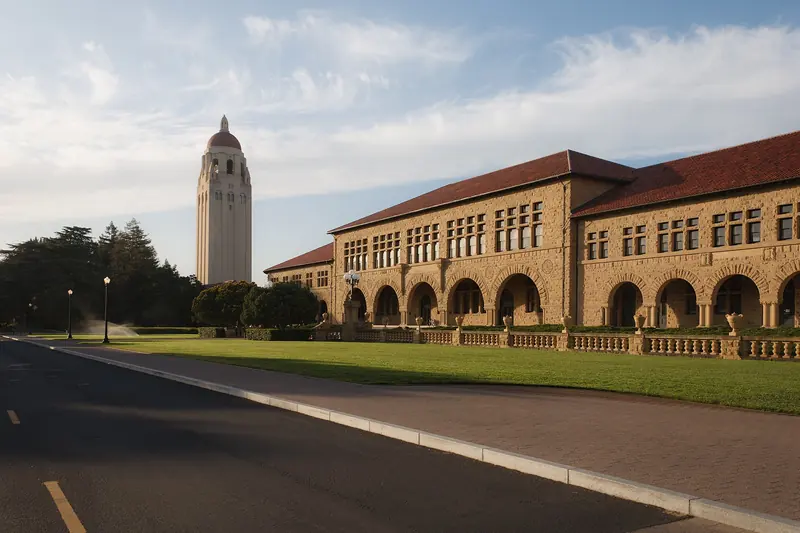
Sandstone arcades of the Stanford Main Quad with Hoover Tower behind
The Main Quad is the place to start any visit to campus. Photo: King of Hearts, Wikimedia Commons, CC BY-SA 3.0

Why it is called the Farm

Leland Stanford, the railroad tycoon and former governor, began buying land along San Francisquito Creek in 1876 for a horse farm. He named it the Palo Alto Stock Farm after the old redwood on the creek. In 1878 the photographer Eadweard Muybridge used the farm's track to prove that a galloping horse lifts all four hooves off the ground.

After the Stanfords' only son died in 1884, they turned the farm into a university in his memory. It opened to students on October 1, 1891. The horses are long gone, but students and alumni still call the campus the Farm. You will see the nickname on sweatshirts, in alumni magazines and in the names of campus programs. For the full story, read our history of Palo Alto.

Stanford vs Palo Alto: where the line falls

Stanford is not part of the city of Palo Alto, even though most people treat them as one place. According to Stanford Facts, the university's land covers 8,353 acres spread across six local jurisdictions.

JurisdictionStanford acres
Unincorporated Santa Clara County3,994
Unincorporated San Mateo County2,603
City of Palo Alto1,292
Woodside226
Menlo Park142
Portola Valley95
Los Altos Hills1

The academic core, including the Main Quad, sits on unincorporated county land with its own mailing address: Stanford, CA 94305. Stanford's own Department of Public Safety patrols it. The Stanford land inside Palo Alto includes two places visitors often assume are on campus. One is Stanford Shopping Center, about 70 acres with more than 140 stores. The other is Stanford Research Park, about 700 acres that hold around 150 companies. In practice the line is invisible. You can walk from University Avenue to the Main Quad without noticing when you leave the city.

Advertisement

Getting there

By Caltrain and the Marguerite shuttle

The easiest way in is by train. Take Caltrain to the Palo Alto station at the foot of University Avenue. Next to it, the Palo Alto Transit Center is a stop for the Marguerite, Stanford's free shuttle. According to Stanford Transportation, Marguerite buses are open to the public with no ID required. They run Monday through Friday year-round, except university holidays. All buses are wheelchair accessible and carry bike racks. Routes and timetables are on the shuttle lines page.

On weekends, when the shuttle does not run, walking is the simple answer. From the station it is about a mile up Palm Drive to the Oval and the Main Quad. The walk under the palms is part of the experience. Our getting to Palo Alto page covers Caltrain from San Francisco and San Jose.

By car

Palm Drive meets El Camino Real at the edge of downtown and leads straight to the Oval. Campus roads are shared with thousands of cyclists. Stanford counts about 10,400 bikes on campus on a typical weekday, so take roundabouts and crosswalks slowly.

By bike

Cycling is how most people get around campus. Bring your own or look for rentals in town. Lock your bike at a rack, not to a railing or tree.

Visitor parking

Parking is the part of a Stanford visit that trips people up. Visitor and hourly spaces are in designated areas and all payment is contactless through ParkMobile. Every space has a zone number on a green sign. You can pay in three ways:

  1. Use ParkMobile's zone parking page in a browser. No app or account is needed.
  2. Call ParkMobile's automated pay-by-phone line, posted on the signs.
  3. Download the ParkMobile app and set it up before you arrive.

Rates are set by the hour with a daily maximum and each payment adds a small transaction fee. Payments are not refundable, so buy only the time you need. The Visitor Parking layer on Stanford's searchable campus map shows zone numbers, paid hours and time limits for each lot. Full details are on the visitor parking page. International visitors can pay online by choosing Other for country and entering 00000 as the billing ZIP code. The free Stanford Visitor Wi-Fi works for this.

The Visitor Center and tours

The Stanford Visitor Center is at 295 Galvez Street, near the stadium. Visitor Information Services lists it as generally open Monday through Friday from 9 a.m. to 5 p.m., except most federal holidays and some breaks between academic quarters. Check visit.stanford.edu for closures.

Guided campus tours are run by the Office of Undergraduate Admission and are aimed at prospective students and their families. They run several times on most weekdays and on selected Saturdays during the spring and fall quarters. You register online. Registered self-guided visitors get priority for any spare spots. Admission also runs information sessions and live virtual tours for people who cannot come in person.

Good to know about tours

  • Tours pause between quarters. In 2026 none ran from August 29 to September 17, though the public could still walk the campus.
  • Group requests through commercial tour operators are not granted. Guided groups are limited to qualifying high schools, community colleges and college access nonprofits.
  • Middle school and elementary groups use self-guided materials.
  • For self-guided visits, Stanford points visitors to its mobile app and its virtual tours.

If you are not a prospective student, a self-guided walk is often the better choice anyway. Private operators also run Stanford and Silicon Valley tours that start in San Francisco.

Advertisement

Top things to see

The core of campus is compact. These sights are all within about a 15 minute walk of the Oval.

  • The Main Quad: Sandstone arcades from the founding years, class plaques in the walkway and Rodin's Burghers of Calais in Memorial Court.
  • Memorial Church: Jane Stanford's 1903 church with its gold facade mosaic and five organs.
  • Hoover Tower: A 285-foot landmark with an observation deck, closed from August 14, 2026 to January 25, 2027 according to the Hoover Institution.
  • Cantor Arts Center: A free museum with world art and close to 200 works by Rodin, plus the outdoor Rodin Sculpture Garden.
  • Anderson Collection: A free museum of postwar American art next to the Cantor.
  • The Dish: A 3.5 mile paved trail in the foothills above campus, open during daylight hours.

Our attractions guide covers sights in town too, such as the HP Garage and El Palo Alto.

Game days

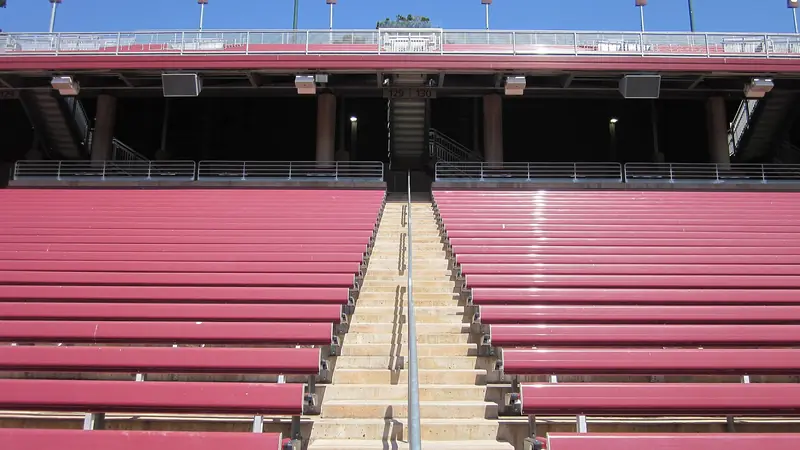
Stanford Stadium seats 50,424. The original stadium opened in 1921 and was rebuilt in 2005 and 2006. It hosted Super Bowl XIX in January 1985 and matches during the 1994 FIFA World Cup. Home football games bring tens of thousands of fans, heavy traffic on the roads around campus and special event parking near the stadium.

If you are not going to the game, avoid driving to campus on those days. Hoover Tower closes on home football game days. If you are going, check the schedule and parking information on gostanford.com and arrive by Caltrain if you can.

Rows of seats inside Stanford Stadium
Stanford Stadium seats just over 50,000 fans on game days. Photo: BrokenSphere, Wikimedia Commons, CC BY 3.0

A half-day plan

  1. Arrive by Caltrain and ride the Marguerite or walk up Palm Drive to the Oval.
  2. Walk through Memorial Court into the Main Quad and visit Memorial Church if it is open.
  3. Head east to Hoover Tower for the free ground-floor exhibits, or the deck when it reopens.
  4. Walk north to the Cantor Arts Center, the Anderson Collection and the Rodin garden.
  5. Have lunch at the Cantor's cafe or return to University Avenue for more choice.

With an extra day you can hike the Dish at sunrise and explore downtown Palo Alto at a slower pace. Visiting families and conference guests often stay close to campus, so compare hotels near Stanford early during graduation and big game weekends.

In this section

Arboretum and MausoleumWalk the Stanford Arboretum to the Stanford Family Mausoleum, the Angel of Grief and the Arizona Garden: history, what to look for and easy walking routes.ArchitectureA guide to Stanford architecture: Olmsted's plan, Shepley, Rutan and Coolidge's Romanesque Quad, red tile roofs and the buildings that came after.Arrillaga Alumni CenterThe Frances C. Arrillaga Alumni Center on Galvez Street: its history, the living room and gardens, alumni bikes and workspace, cafe hours and events.AthleticsA visitor's guide to Stanford Cardinal sports: Stanford Stadium, Maples Pavilion, Sunken Diamond, Avery Aquatic Center, ACC play, tickets and game day tips.Avery Aquatic CenterStanford's Avery Aquatic Center: its four outdoor pools and dive tower, the Cardinal swim, dive and water polo teams, free meets and what public access exists.Biking on campusRiding a bike at Stanford: speed limits, no-ride zones, roundabouts, lights, tickets, locking, bike registration, repair stands and Marguerite bike racks.Bing Concert HallA guide to Bing Concert Hall at Stanford: the 842-seat vineyard hall by Ennead and Yasuhisa Toyota, Bing Studio, Stanford Live tickets and free evening parking.Bing Nursery SchoolStanford's Bing Nursery School: the 1966 lab preschool, the marshmallow studies and other research done there and how enrollment works for Palo Alto families.Campus eventsHow visitors find events at Stanford: the Stanford Events calendar, the arts calendar, athletics, library exhibits and how parking works for evening events.Campus walkA self-guided Stanford walking tour from the Oval past the Main Quad, Memorial Church, Hoover Tower, the Cantor, Stone River and the Arizona Garden.Cantor collection highlightsA floor-by-floor guide to the Cantor Arts Center's galleries and collection areas, its long-term installations and the exhibitions listed for fall 2026.CCRMAStanford's Center for Computer Research in Music and Acoustics at the Knoll: John Chowning and FM synthesis, the building's history and free public concerts.Central Energy FacilityHow Stanford's heat recovery plant has heated and cooled campus since 2015, the two solar plants behind its renewable power and how to tour the facility.Cobb Track and Angell FieldStanford's Cobb Track and Angell Field: the 1935 field, the nine-lane track, the Payton Jordan Invitational, the 2019 Prefontaine Classic and public use rules.CommencementPlan Stanford commencement weekend 2027: the June 13 ceremony, baccalaureate at Frost, the Wacky Walk, hotel booking timing, traffic and parking tips.Community recreationCan Palo Alto residents join Stanford's gyms or pools? Who qualifies for Rec and Wellness memberships, guest pass rules, Masters swimming and public options.Continuing StudiesHow Stanford Continuing Studies works: open enrollment for adults, online and campus formats, the $35 fee, refunds, discounts and winter 2027 registration.David Rumsey Map CenterVisit the David Rumsey Map Center in Stanford's Green Library: drop-in hours, Friday tours, the 2026 exhibition and the free online map collection.Dining on campusWhere visitors can eat at Stanford: Tresidder Union, The Axe and Palm, Coupa Café's campus cafes, Arbuckle at the GSB and more. Dining halls are not public.Doerr School of SustainabilityThe Stanford Doerr School of Sustainability: its 2022 founding, the Doerr gift, seven departments and two institutes, its buildings and its public talks.Dogs on campusBringing a dog to Stanford: why dogs are banned on the Dish, leash rules Stanford publishes, no-pet buildings and venues and better dog walks near Palo Alto.Educational FarmVisit the O'Donohue Family Stanford Educational Farm: open hours, Wednesday and Saturday volunteer shifts, how to register, where to park and what grows there.Engineering QuadA visitor's guide to Stanford's Science and Engineering Quad: the Huang Center's tech exhibits, the Gates building, Pars pro Toto and cafes.FootballStanford football for fans and visitors: its history and titles, the ACC era, the 2026 schedule under Tavita Pritchard, tickets, parking and game day tips.Free things to doThe best free things to do at Stanford: two art museums, the Rodin garden, the Dish, library exhibits, lectures, noon concerts and free college sports.Golf courseStanford Golf Course: the 1930 Thomas and Bell layout, who can play, the public driving range on Campus Drive and the Siebel Varsity Golf Training Complex.Green LibraryVisiting Stanford's Cecil H. Green Library: public day passes, Bing Wing exhibits, the David Rumsey Map Center, the East Asia Library and other branches.GymnasticsStanford gymnastics: 11 men's NCAA titles including 2026, the women's ACC era at Maples Pavilion, the 2027 home meet schedule, tickets, parking and tips.Hoover Library and ArchivesVisit the Hoover Institution Library and Archives at Stanford: free exhibits in Hoover Tower, what the archives hold and how researchers book the reading room.Hopkins Marine StationStanford's Hopkins Marine Station in Pacific Grove: its history since 1892, how it helped start the Monterey Bay Aquarium and what visitors can actually see.Hospital visitorsA practical guide for visiting Stanford Hospital and Lucile Packard Children's Hospital: parking rates, shuttles, visiting hours, nearby hotels and food.Jasper RidgeVisit Stanford's Jasper Ridge Biological Preserve: free docent-led hiking tours by appointment, the rules (age 14 and up, no pets) and the research done there.Knight Management CenterVisit Stanford GSB's Knight Management Center: its 2011 LEED Platinum campus, Peter Wegner's flip-digit art, TA Café and Arbuckle dining, parking and events.Lake LagunitaLake Lagunita at Stanford is a seasonal lake that is often dry. Learn its history, the California tiger salamander habitat work and how to walk the rim trail.Law SchoolVisiting Stanford Law School: Crown Quadrangle and the Neukom Building, its history, how events work and why the Crown Law Library is closed to the public.Library accessCan non-Stanford people use Green Library? Day pass rules, the 7-day limit, paid access and borrowing cards, alumni rates and which libraries are off limits.Lou Henry Hoover HouseThe Lou Henry Hoover House at Stanford: the 1920 home Lou Henry Hoover designed, Herbert Hoover's election nights and why the landmark is not open to visitors.Main QuadA guide to Stanford's Main Quad: the Olmsted plan, sandstone arcades, Memorial Court and the Burghers of Calais, class plaques and a short self-guided walk.Maples PavilionA fan's guide to Maples Pavilion, Stanford's 7,233-seat arena: its 1969 history, the teams that play there, tickets, parking, bag rules and free volleyball.McMurtry BuildingStanford's McMurtry Building by Diller Scofidio + Renfro: its 2015 design, the Bowes Art and Architecture Library, galleries and fall 2026 student shows.Memorial AuditoriumStanford's Memorial Auditorium: built in 1937 to honor the World War I dead, its 1,700-seat hall, MLK's 1967 speech and the shows and student events there now.Men's basketballStanford men's basketball at Maples Pavilion: the 1942 NCAA title, the ACC era under Kyle Smith, the 2026 to 2027 home schedule, tickets, parking and food.Music concertsStanford's Department of Music runs free noon concerts, student recitals and ticketed ensemble nights at Campbell Recital Hall, Dinkelspiel and Bing.Nobel laureatesStanford's Nobel laureates by field as the university lists them: 22 living and 16 deceased as of October 2026, plus the two new 2026 winners and their work.Parking and transitHow to park at Stanford as a visitor, pay with ParkMobile, ride the free Marguerite shuttle from Caltrain, bike on campus and handle game day and event parking.PNG Sculpture GardenThe story of Stanford's Papua New Guinea Sculpture Garden: the 1994 Sepik River carvers, what the poles show, how to find it and the free monthly tour.Pre-collegiate programsA plain guide to Stanford Pre-Collegiate Studies and other Stanford summer programs for teens: who runs them, grades, formats, 2026 costs and aid deadlines.Prospective studentsPlan a Stanford college visit: official info sessions and student-led tours, how to register, where to park, where to stay and where to eat nearby.Public artFind Stanford's outdoor art: the Rodin garden, the Burghers of Calais, Goldsworthy's Stone River, the Papua New Guinea Sculpture Garden and free walking tools.Public lecturesFind free public lectures at Stanford: Humanities Center series such as the Presidential Lectures, book talks, science seminars and how to search the calendar.Red BarnThe Stanford Red Barn on Fremont Road: Leland Stanford's 1870s stock farm stable, the Muybridge connection, the equestrian center today and how to visit.Religious and spiritual lifeStanford's Office for Religious and Spiritual Life: Memorial Church services as published, the CIRCLE multi-faith center, Windhover and faith groups on campus.Research studiesHow to find and join Stanford research studies: clinical trials, healthy volunteer lists, paid psychology and GSB lab studies and your consent rights.Rodin Sculpture GardenVisit Stanford's free Rodin Sculpture Garden: The Gates of Hell, the Burghers of Calais, free Friday and Saturday Rodin tours, parking and the best times to go.School of MedicineA visitor's guide to the Stanford School of Medicine: the Li Ka Shing Center, Lane Library access rules, public courses and lectures and where to eat nearby.SLAC National Accelerator LaboratoryA visitor's guide to SLAC near Palo Alto: the two-mile linac, three Nobel Prizes, the X-ray laser and how to book the lab's free public tours on Fridays.SoccerStanford soccer at Cagan Stadium: three NCAA titles each for the women and men, the ACC era, the 2026 season, free parking, tickets and where to eat nearby.SoftballStanford softball for fans: four Women's College World Series trips, the 2026 move into the rebuilt Stanford Softball Stadium, ACC play, tickets and parking.Special CollectionsHow the public can use Stanford's Special Collections and University Archives: registering, booking the Field Reading Room and the rules for handling materials.SRI InternationalSRI International's story: founded by Stanford in 1946, the 1968 oN-Line System demo, an early ARPANET node, the 1970 split and SRI in Menlo Park today.Stanford AI historyHow Stanford and nearby SRI shaped artificial intelligence: John McCarthy and SAIL from 1963, Shakey the robot, the 2004 revival and the HAI institute.Stanford Art GalleryThe Stanford Art Gallery on Lasuen Mall: Thomas Welton Stanford's 1917 gift, its earthquake years, how student shows work and what is on in fall 2026.Stanford BandMeet the Leland Stanford Junior University Marching Band: its 1893 roots, the 1963 strike, scatter style, the Tree, All Right Now and the 1982 Big Game play.Stanford BookstoreThe Stanford Bookstore on White Plaza: what it sells, hours, parking and Stanford's other shops at Town & Country Village, Galvez Street and Tresidder.Stanford for residentsA Palo Alto resident's guide to Stanford: libraries, classes, gyms, free museums, tickets, volunteering, research studies, dogs, bikes and parking in one place.Stanford Historical SocietyWhat the Stanford Historical Society does: its oral history archive, Sandstone & Tile, public talks and tours, its 50th year and how anyone can join.Stanford historyThe story of Stanford University: Leland Jr., the 1885 founding grant, the 1891 opening, Jane Stanford's rescue, 1906, Terman and the research park.Stanford Humanities CenterThe Stanford Humanities Center since 1980: its fellows, its home on Santa Teresa Street and its free public lectures, including the Presidential Lectures.Stanford Jazz WorkshopThe Stanford Jazz Workshop since 1972: an independent nonprofit that runs a summer jazz festival and youth camps on the Stanford campus, plus how camps work.Stanford LiveStanford Live's 2026 to 2027 season at Bing Concert Hall, The Studio, Memorial Auditorium and Frost Amphitheater, with ticket office hours, policies and tips.Stanford Medicine historyHow Stanford Medicine grew from Cooper Medical College in San Francisco to the 1959 medical center beside Palo Alto and the new Stanford Hospital of 2019.Stanford Redwood CityStanford Redwood City explained: the 35-acre campus that opened in 2019 for about 2,700 staff, its Ampex-era site, what the public can use and how to get there.Stanford StadiumStanford Stadium from its 1921 earthen bowl to the 2006 rebuild: capacity, Super Bowl XIX and the World Cup, the Big Game and how to reach it by Caltrain.Stanford with kidsPlan a Stanford visit with kids: the free Cantor and Anderson museums, the Rodin garden, Arizona Cactus Garden, the Dish, Lake Lagunita, game days and tips.Student ObservatoryStanford Student Observatory stargazing nights are free, by registration and only a few times a year. How they work, parking and weekly stargazing nearby.Sunken DiamondWatch Stanford baseball at Klein Field at Sunken Diamond: how the sunken bowl was made, the 1987 and 1988 titles, berm seating, free parking and tickets.Taube Tennis CenterStanford's Taube Family Tennis Center: 17 lighted courts, free regular season college matches, its NCAA and WTA history and what to know about public play.The Cardinal and the TreeWhy Stanford teams are the Cardinal, a color and not a bird: the 1930 to 1972 Indian mascot and its removal, the Cardinals years, the 1981 change and the Tree.The d.schoolVisiting Stanford's d.school, the Hasso Plattner Institute of Design: its history, Building 550, self-guided weekday visits and workshops for non-students.The Oval and Palm DriveStanford's grand approach: the history of Palm Drive and its palms, the Oval lawn in front of the Main Quad and tips for walking, photos and picnics.Theater and danceSee theater and dance at Stanford: the TAPS 2026 to 2027 season at Roble Gym and Pigott, $5 tickets, Ram's Head Gaieties and other student companies.Ticket officesHow to buy Stanford Live and Stanford Athletics tickets: box office hours and locations, phone lines, fees, discounts, will call, exchanges and game day tips.Track and cross countryStanford track and field and cross country: 13 national team titles, ACC results, the November 2026 NCAA races, free meets at Cobb Track and the Big Meet.TraditionsA visitor's guide to Stanford traditions: Big Game week and the Axe, the Tree, Full Moon on the Quad today, the Wacky Walk and which ones the public can see.Tresidder and Old UnionWhat visitors can use at Stanford's student unions: Tresidder's food court, CoHo, the bike shop and shipping counter, plus Old Union's history and its cafe.Visitor CenterThe Stanford Visitor Center at 295 Galvez Street: weekday hours, admission tours and info sessions, group tour rules, winter closures and where to park nearby.VolleyballStanford volleyball for fans: nine women's NCAA titles, two men's titles, the 2026 ACC season at Maples, free men's matches at Burnham Pavilion and parking.Volunteering at StanfordHow Palo Alto residents can volunteer at Stanford: hospital programs and age rules, museum roles, Jasper Ridge docent training, the farm and conservation days.Water poloStanford water polo at Avery Aquatic Center: 11 men's and 10 women's NCAA titles, the fall 2026 men's home schedule, the Big Splash, tickets and parking.White PlazaWhite Plaza at Stanford: the 1964 Claw fountain, its Big Game bear tradition, student life on the plaza, the buildings around it and the Town Center plans.WindhoverWindhover at Stanford: Nathan Oliveira's kestrel paintings, the Aidlin Darling building, who can enter, the public labyrinth and hours as Stanford lists them.Women's basketballStanford women's basketball at Maples Pavilion: three NCAA titles, the ACC era under Kate Paye, the 2026 to 2027 schedule, ticket prices, parking and food.

Frequently asked questions

Can anyone walk around Stanford campus?

Yes. Stanford's outdoor spaces are open to the public and visitors can walk the Main Quad, Palm Drive and the Rodin garden on their own. Some buildings, labs and residences are restricted to the Stanford community.

Is Stanford in Palo Alto?

Not exactly. Most of the campus is unincorporated land in Santa Clara and San Mateo counties with the mailing address Stanford, CA 94305. About 1,292 acres of Stanford land, including Stanford Shopping Center and Stanford Research Park, lie inside Palo Alto city limits.

How do I get to Stanford from the Palo Alto Caltrain station?

Take the free Marguerite shuttle from the Palo Alto Transit Center beside the station. It runs on weekdays and is open to the public with no ID needed. You can also walk about a mile up Palm Drive to the Oval.

How much does parking cost at Stanford?

Visitor parking is paid by the hour through ParkMobile, with rates set by Stanford Transportation. Look for the zone number on the green sign in your space. Check transportation.stanford.edu for current rates and restrictions.

Why is Stanford called the Farm?

The university was built on Leland Stanford's Palo Alto Stock Farm, where he bred and trained horses. Students and alumni have called the campus the Farm ever since.
Advertisement
Advertisement