On this page
A few miles west of the main Stanford campus, past Interstate 280 on Sand Hill Road, the university keeps 1,193 acres of oak woodland, chaparral, grassland and wetland mostly as nature left it. Jasper Ridge Biological Preserve is a research station first. Scientists run long-term studies here, Stanford classes meet in the field and volunteer docents lead small groups along trails that are otherwise closed to the public.
That last part matters. You cannot just show up and hike. If you want to see Jasper Ridge, you book a free docent-led tour and follow some firm rules. This page explains the preserve's mission, how the tours work and what to bring. For trails you can walk any day, see our guide to the best hikes near Palo Alto.
What Jasper Ridge is for
The preserve's stated mission is to contribute to the understanding of the Earth's natural systems through research, education and protection of the preserve's resources. In practice that means three jobs:
- Research. Scientists from Stanford and around the world use the preserve as a natural laboratory. The 2025 to 2026 annual report counted 92 research projects and 27 publications.
- Education. The same report counted 29 Stanford courses and more than 5,600 educational visits. Classes meet at the field station and on the trails.
- Refuge. Native plants and animals get a protected home in a region where most open land has been developed.
Recent project titles give a flavor of the work: microbes in the nectar of sticky monkeyflower, changes in flying insect populations, willow recovery after changes to a dam and checks of satellite estimates of leaf nitrogen against measurements on the ground. Some of this research has run for decades, which is what makes a protected site valuable. Long records of rainfall, plant cover and wildlife let scientists see how a landscape changes over time.
The name: Jasper Ridge and 'Ootchamin 'Ooyakma
Jasper Ridge takes its name from the red siliceous rock, jasper, found on the ridge. The preserve says the name was coined by Stanford's geology department around 1901.
Since January 2024 the preserve has also used a Chochenyo name, 'Ootchamin 'Ooyakma, pronounced roughly oot-cha-mean oo-yahk-ma. It means red ridge or mountain. The Muwekma Ohlone Tribe suggested it, since the original Puichon Ohlone name of the area was never recorded. The translation appears on signs at the preserve. Our page on the Ohlone and the land before 1769 covers the region's first peoples.
A short history
The preserve's own chronology describes a long human story on this land:
- Thousands of years ago: Muwekma Ohlone occupation sites along the lower San Francisquito Creek watershed date back more than 5,000 years. Permanent villages stood within the preserve area between 600 and 2,000 years ago.
- Mid-1800s: Sawmills along the creeks supplied lumber for growing towns. Most redwoods in the area were logged by the 1870s. The small town of Searsville grew up around the mills.
- 1879: Searsville was condemned to make way for a dam.
- 1890s: A water company built Searsville Dam, creating Searsville Lake.
- 1892 to 1926: Stanford bought the dam, the lake and the surrounding land.
- Mid-1900s: Leaseholders ran Searsville Lake as a recreation area while science grew in the central preserve. Grazing ended in 1960.
- 1973: Stanford's trustees formally designated Jasper Ridge as a biological preserve.
- 1975: Recreation at Searsville Lake ended.
The preserve's research, classroom and office building, the Leslie Shao-ming Sun Field Station, was completed in June 2002. It covers 9,800 square feet with a research lab, two classrooms, a reference library, an herbarium and offices. It was designed to show principles of energy efficiency and won the first Sustainable San Mateo County Green Building Award in 2003. The Oakmead Herbarium inside holds more than 5,300 collections representing over 1,000 species of plants and lichens.
Docent-led hiking tours
Jasper Ridge's volunteer docents are trained through a long-running Stanford course, BIO/EARTHSYS 105, Ecology and Natural History of Jasper Ridge Biological Preserve. The preserve says its docents bring diverse areas of expertise. According to the public hiking tours page:
| Detail | What to expect |
|---|---|
| Availability | By appointment only |
| Length | About 2 hours |
| Distance | Typically 1.5 to 3 miles on singletrack trails and gravel roads |
| Climbing | 100 to 500 feet of elevation gain |
| Pace | Relaxed, with regular stops for discussion |
| Weather | Tours run in most conditions; heavy rain or severe weather warnings cancel them |
| Cost | Free; donations welcome |
You request a tour through the preserve's website. Tours introduce the natural history of the Santa Cruz Mountains and the research and stewardship projects underway. Teachers and professors use a separate class visit form and should apply at least six weeks ahead.
Rules for visitors
The preserve's visitor regulations are strict and they apply to everyone on a tour:
- Trails are open to the public only on docent-led hiking tours.
- Visitors must be 14 or older.
- No pets, including service animals.
- No food on the trails. Eat at your car or at the field station.
- No smoking anywhere in the preserve.
- Visitors who are not current Stanford students, faculty or staff must sign a waiver before going on the trails. The waiver is available in English and Spanish.
What to bring and safety
Dress for rough ground and changeable weather. The preserve recommends sturdy closed-toe shoes or hiking boots, 1 to 2 liters of water, long pants and a long-sleeved sun shirt, a hat, sunglasses, sunscreen and insect repellent. Bring a rain jacket and warm layers in winter and spring, an EpiPen if you have one prescribed and a basic first-aid kit.
Good to know
- Ticks are most active from December through June. The preserve says the Lyme disease bacterium has been found in about 3 percent of ticks in San Mateo County. Do a full tick check after your hike.
- Rattlesnakes live here and are most often seen in the morning and early evening. Back away at least 12 feet if you see one.
- Heat builds fast on open grassland. Drink water before you feel thirsty and tell your docent if you feel unwell.
- Stay on the trail. It protects you and the habitat researchers are studying.
Lectures and events
Jasper Ridge hosts community lectures at the Sun Field Station. The fall 2026 calendar listed a talk on November 4 from 3:30 p.m. to 5 p.m. on using camera traps to capture the hidden lives of wildlife on the San Francisco Peninsula. Check the preserve's events page for upcoming talks and whether registration is needed. The preserve also sends a monthly newsletter.
If you cannot get a tour
Tours depend on docent availability. The age limit rules out younger kids. The preserve itself points people to nearby public lands, including Edgewood Park, Huddart Park, Wunderlich Park and the preserves of the Midpeninsula Regional Open Space District. Closer to Palo Alto, good options include:
- The Dish, Stanford's paved foothill loop, open daily during posted hours.
- Foothills Nature Preserve, Palo Alto's big hillside park with oak woodland and a lake.
- Pearson-Arastradero Preserve, with open grassland trails and good birding.
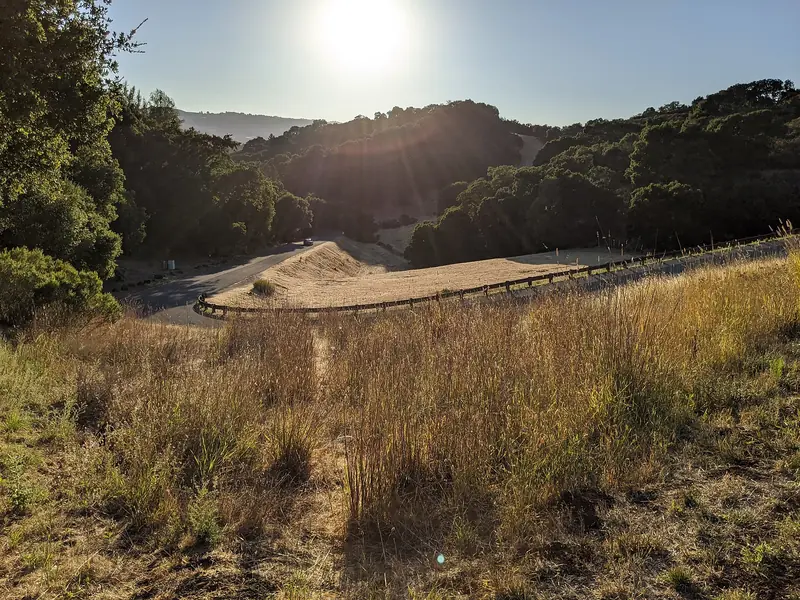

The drive to Jasper Ridge also passes through some of the Peninsula's prettiest country. Our guides to Woodside and Portola Valley suggest places to stop for lunch after a morning tour.
Frequently asked questions
Can you hike at Jasper Ridge without a tour?
No. Jasper Ridge says its trails are open to the public only through docent-led hiking tours. Researchers, Stanford classes and permit holders have separate access rules.
How much does a Jasper Ridge tour cost?
Public hiking tours are free. The preserve welcomes donations to support its education programs. Tours are by appointment and are requested through the Jasper Ridge website.
Can kids go on a Jasper Ridge tour?
Visitors must be 14 or older. Younger children are not allowed on the public hiking tours. Teachers can request class visits through a separate form at least six weeks ahead.
Can I bring my dog to Jasper Ridge?
No. Pets are not allowed at the preserve, including service animals. Food is also not allowed on the trails and smoking is prohibited everywhere in the preserve.
Where is Jasper Ridge Biological Preserve?
It is in the eastern foothills of the Santa Cruz Mountains, west of Interstate 280. The preserve lists its address as 4001 Sand Hill Road, Woodside. Tour confirmations give the meeting point.