On this page
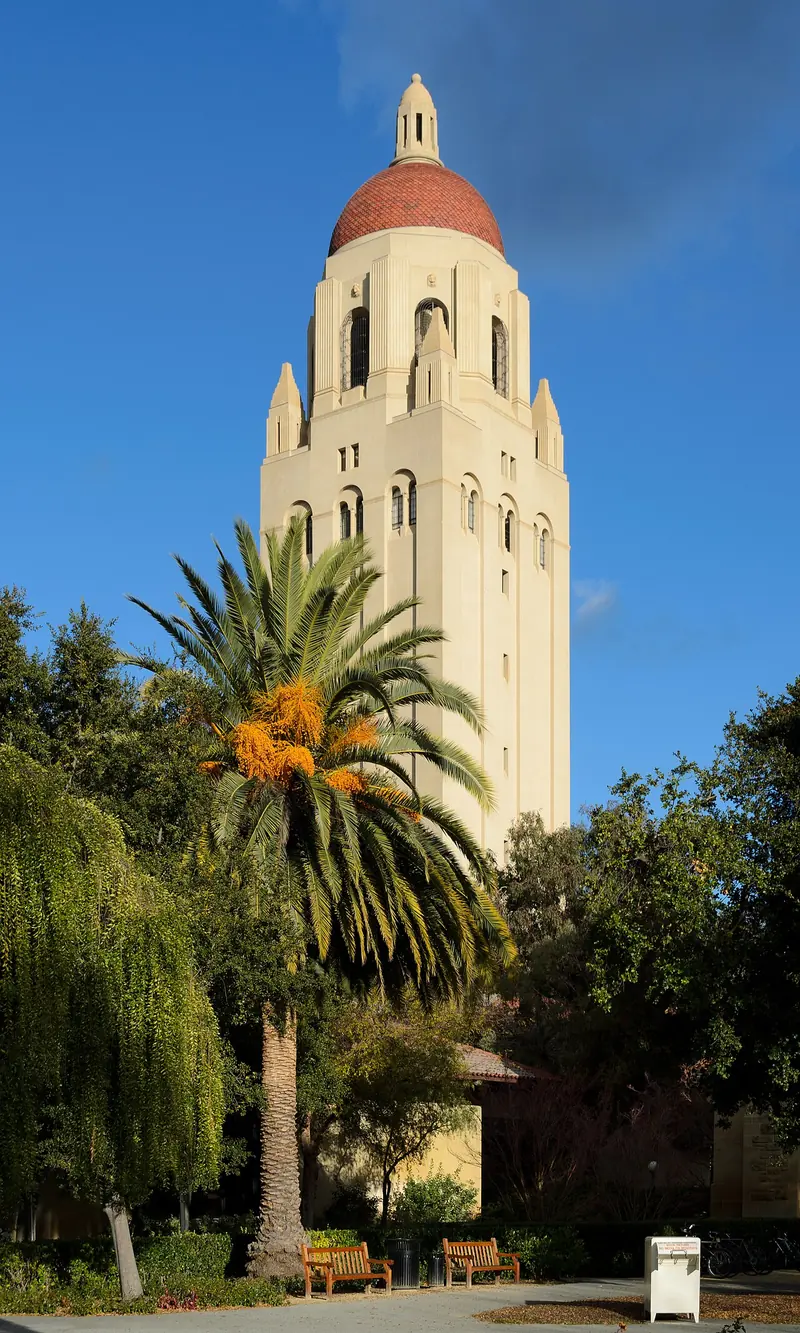
Walk from the Main Quad toward Hoover Tower and you pass a low sandstone building that many people mistake for part of the library. It is the Stanford Art Gallery, finished in 1917 and one of the oldest art spaces on campus. It is small, it keeps irregular hours and it is easy to miss. When a show is up, though, it is one of the best free stops in the core of campus.
This page covers who paid for the building, how it carried Stanford's art program through two disasters and how the Department of Art and Art History uses it today. For the big museum on campus, see our guide to the Cantor Arts Center.
The other Stanford brother
Thomas Welton Stanford was Leland Stanford's younger brother. According to the art department's history, he came to California in the wake of the forty-niners and made his first money as a storekeeper in El Dorado County. His reports of good fortune in the Sierra foothills helped draw several brothers west, Leland among them.
Thomas later moved to Australia, where he became wealthy. He never lost touch with the family university. His early gifts helped set up programs in the arts and sciences and also funded research into Victorian spiritualism, a subject that fascinated him.
His largest single contribution to the campus skyline was the gallery. He gave $80,000 to build a home for his collection of paintings. Stanford dates the finished building to 1917. A Stanford News story on the gallery's centennial described it as the keystone of a planned second quadrangle. The art department adds that it was the first building to anchor a planned library quadrangle, the area that later filled in with Green Library's original wing.
The building
The gallery is a plain rectangle of sandstone, the same stone that gives the Main Quad next door its color. Its most important feature is overhead. Stanford News noted that more than half of the roof is glass, so the galleries were lit by daylight long before museum lighting systems existed.
The exhibition space covers about 1,900 square feet, according to the department. That is small enough to see in 15 to 30 minutes, which makes the gallery an easy add-on to a walk past the Main Quad or a library visit.
The building has needed work over the years. Renovations in 2000 repaired earthquake damage and strengthened the structure. In 2016 the sandstone exterior was cleaned and minor repairs were made. The department's page also mentions a planned ADA-accessible ramp to improve access, so call ahead if steps are a concern.
Pedro de Lemos and the early years
The first director and curator was Pedro de Lemos, a painter, printmaker and arts educator who left the San Francisco Art Institute in 1917 to join Stanford. He ran the gallery for nearly three decades. Stanford News also credits him with directing the Stanford University Museum, today's Cantor, during the long years after the 1906 earthquake had wrecked much of it.
De Lemos is better known today for his own work and his writing on art education, but his role at the gallery shaped how the campus saw art for a generation. In fall 2017 the gallery marked its centennial with a show of his work called Lasting Impressions of Pedro de Lemos: The Centennial Exhibition.
His years at Stanford left marks off campus as well. In 1925 he built the Gotham Shop at 520 Ramona Street downtown around an old oak he wanted to save. He later designed more buildings on the same block. Our page on Palo Alto architecture covers the Ramona Street district and the Spanish Colonial Revival style it made famous in town. In Menlo Park he also worked on the Allied Arts Guild.
Filling in after Loma Prieta
The gallery played its most important role after October 17, 1989. The Loma Prieta earthquake badly damaged the Stanford Museum and forced it to close. For the next decade the art gallery served as the main exhibition venue on campus. Shows that would have gone to the museum came here instead.
That stretch ended when the museum reopened in 1999 as the Iris and B. Gerald Cantor Center for Visual Arts. The gallery then underwent its own repairs in 2000. Since then it has shifted toward teaching and student work, under the care of the Department of Art and Art History.

How exhibitions work today
The Department of Art and Art History administers and curates the gallery. It describes the space as a venue for exhibitions that engage the university and the wider community with historical and contemporary visual culture. In practice the schedule mixes faculty-curated shows, student exhibitions and work by visiting artists.
The key rule for visitors: the gallery opens to the public only when an exhibition is on display. Dates and hours vary by show. Between exhibitions the doors are locked, sometimes for weeks, so do not plan a trip around it without checking first.
On view in fall 2026
The department's exhibitions page lists one show at 419 Lasuen Mall this quarter:
- Touch Me Not: 12th Annual Undergraduate Juried Exhibition. October 12 to December 4, 2026, with viewing listed from 1 to 5 p.m. The show presents work by Stanford undergraduates selected by a juror.
The listing does not spell out which days of the week the gallery is staffed, so check the event page or call the department at (650) 723-3404 before a special trip. The same page lists three other fall shows in the McMurtry Building, covered in our McMurtry Building guide.
The department's other galleries
The Stanford Art Gallery is one of several spaces the department runs. The others sit inside the McMurtry Building on Roth Way in the arts district near Palm Drive:
| Space | Building | What it shows |
|---|---|---|
| Stanford Art Gallery | 419 Lasuen Mall | Department exhibitions, about 1,900 square feet |
| Penny and Jim Coulter Art Gallery | McMurtry Building | Teaching shows and curatorial experiments |
| Nancy and Larry Mohr Student Exhibition Gallery | McMurtry Building | Shows planned and installed by undergraduates |
| Gunn Foyer and Vitrine Gallery | McMurtry Building, ground floor | Rotating student and faculty work |
The two locations are about a 15 minute walk apart. Fit both into one afternoon by starting at the gallery near the Quad and finishing in the arts district, where the Cantor, the Anderson Collection and the outdoor public art are all close by.
Visiting tips
The gallery faces Lasuen Mall on the east side of the Main Quad, between History Corner and Hoover Tower. It sits right next to the Bing Wing of Green Library, so you can pair it with the library's exhibitions and the David Rumsey Map Center upstairs.
Good to know
- Open only during exhibitions, with hours set for each show.
- No admission fee is listed.
- The art department says visitor parking is paid through ParkMobile and is free after 4 p.m. in most areas, except near the Oval.
- The free Marguerite shuttle runs from the Palo Alto Transit Center on weekdays.
- Steps lead to the entrance. Ask the department about access before you go.
Arriving by Caltrain is easy. From the Palo Alto station, ride the Marguerite or walk about a mile up Palm Drive. Our parking and transit guide explains both options. Student shows often end with a closing reception or open studio event, which is a chance to talk with the artists. These appear on the department's calendar a week or two ahead.
Frequently asked questions
Is the Stanford Art Gallery free?
Stanford's art department does not list an admission fee for the gallery. It opens to the public only while an exhibition is on display, with hours set for each show.
Where is the Stanford Art Gallery?
It is at 419 Lasuen Mall on the east side of the Main Quad, between History Corner and Hoover Tower. Green Library's Bing Wing is next door.
Who built the Stanford Art Gallery?
Thomas Welton Stanford, Leland Stanford's younger brother, gave $80,000 to build it as a home for his paintings. The building was completed in 1917 and Pedro de Lemos became its first director and curator.
What is showing at the Stanford Art Gallery in fall 2026?
The department lists Touch Me Not, its 12th annual undergraduate juried exhibition, at 419 Lasuen Mall from October 12 to December 4, 2026, with viewing from 1 to 5 p.m. Confirm days on art.stanford.edu before you go.
Is the Stanford Art Gallery the same as the Cantor Arts Center?
No. The Cantor is Stanford's main art museum near Palm Drive. The Stanford Art Gallery is a much smaller exhibition space run by the Department of Art and Art History.