On this page
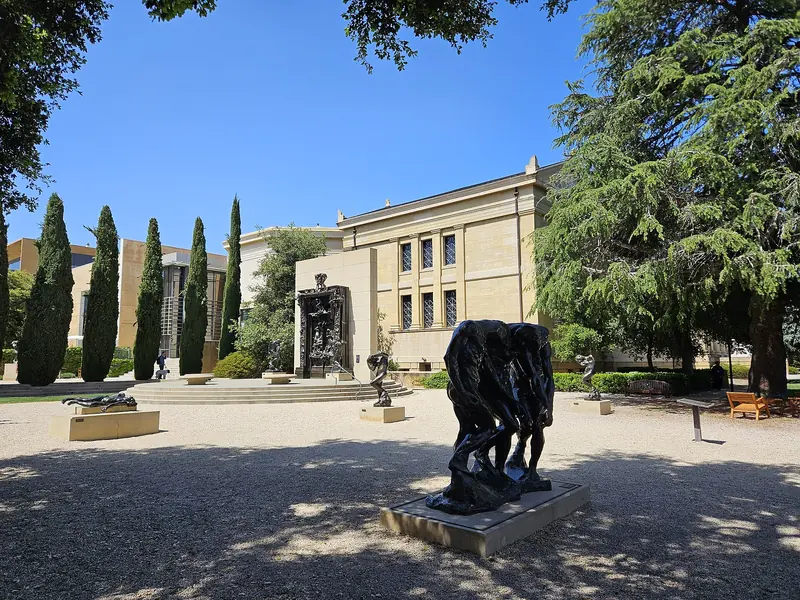
The Rodin Sculpture Garden is the easiest great art experience in Palo Alto. You walk in from Lomita Drive, past a lawn and a few trees and suddenly you are standing in front of The Gates of Hell, a bronze doorway more than 20 feet tall crowded with falling, twisting bodies. There is no ticket desk and no closing time. People eat lunch on the benches, students cut through on bikes and on summer evenings the bronzes glow in the low sun.
This guide goes deeper than our overview of public art at Stanford. It explains what the main works are, how the garden came to be, how the free tours work and how to fit a visit around museum hours and parking. For the museum indoors, read our Cantor Arts Center guide.

What the garden is
The full name is the B. Gerald Cantor Rodin Sculpture Garden. It opened in 1985 on the north side of the museum building and covers about one acre. It holds about 20 large bronzes by Auguste Rodin (1840 to 1917), the French sculptor who changed how artists showed the human body. The works were given to Stanford by the collector B. Gerald Cantor and his foundation, which is why his name is on the garden and on the museum.
Stanford's Rodin holdings are among the largest in the world. The Cantor's own tour listing describes its collection on view as spanning three indoor galleries plus the outdoor garden, with nearly 100 Rodin sculptures. The garden is the part you can see at any hour.
The layout is simple. Paths and low hedges divide the space into outdoor rooms, so you meet the sculptures one or two at a time. The Gates of Hell closes off the garden's eastern end like a wall at the end of a room. Benches face several of the big pieces, which makes it a good place to sit and look rather than rush.
The Gates of Hell
The Gates of Hell is the reason many people come. Rodin received the commission in 1880 for a set of bronze doors for a planned museum of decorative arts in Paris. The museum was never built and Rodin kept reworking the doors for the rest of his life. He drew on Dante's Inferno and filled the surface with about 180 figures that climb, fall and cling to each other.
Stanford's cast was made in 1981 by the Coubertin Foundry in France using the lost wax method Rodin favored. Look for these details:
- The Thinker: Above the doors, a seated man leans forward with his chin on his hand. He began as a figure of Dante looking down at his poem. Rodin later enlarged him as a separate statue and that version became world famous.
- The Three Shades: Three identical men stand on top of the frame, heads bowed, their arms pointing down to one spot.
- The Kiss and the lovers: Paolo and Francesca, the doomed lovers from Dante, appear in small form on the left door. Rodin later made The Kiss from the same idea.
- The side panels: The vertical strips at left and right are packed with smaller bodies. Walk close and look up. The relief is deep, so the light changes them through the day.
Expect to spend at least ten minutes here. Many figures that later became famous on their own started life on this door, so it works as a map of Rodin's ideas.
Other bronzes to find
Beyond the Gates, the garden's large single figures reward a slow walk. According to the Cantor, the garden includes:
- Adam and Eve: Two large figures made in the same years as the Gates. Adam twists and strains while Eve turns inward and shields herself.
- The Walking Man: A headless, armless man caught mid-stride. Rodin cared more about movement than finish and this work shows it.
- The Three Shades: A full-size version of the group from the top of the Gates, set at eye level so you can study their faces and hands.
- Heads from The Burghers of Calais: Two heads from the monument that stands in full at the Main Quad.
Next to the garden grows Sam Van Aken's Tree of 40 Fruit, planted in 2022, according to the Almanac. It is a single tree grafted with many kinds of stone fruit, so different branches flower and fruit at different times.
The Burghers of Calais at the Main Quad
Do not leave without seeing the full Burghers of Calais. The group stands in Memorial Court, the front courtyard of the Main Quad, facing Palm Drive. Calais commissioned the work in 1884 to honor six leading citizens who in 1347 offered their lives to the English king to save their besieged town. Rodin showed them as frightened, exhausted men rather than heroes on a pedestal.
At Stanford the six figures stand as separate pieces at ground level, so you can walk between them and look each man in the face. It is about a ten minute walk south from the garden. Pair it with Memorial Church at the far side of the Quad. The church was closed to visitors for maintenance from June 15 to October 31, 2026, so check its status before you go.
Free Rodin tours
You can visit on your own, but the free public tour is the best way to understand the work. The Cantor's event listing in late October 2026 described it this way:
- When: Fridays and Saturdays at 11:30 a.m.
- What: A tour of the indoor and outdoor Rodin sculptures, covering the three Rodin galleries and the sculpture garden.
- Cost and booking: Free with no reservation. Spots are first come, first served.
- Where: The Cantor Arts Center, 328 Lomita Drive. Arrive a few minutes early.
Schedules can change during holidays and university closures, so check the Stanford events calendar or the museum website the week you go. Groups of 10 or more should register with the museum in advance. The Cantor also runs a free monthly tour of the Papua New Guinea Sculpture Garden, a ten minute walk away.
Planning your visit
| Question | Answer |
|---|---|
| Hours | Garden open 24 hours, every day. The museum is closed Tuesdays and Wednesdays. |
| Cost | Free for the garden, the Cantor and the Anderson Collection |
| Time needed | 30 minutes for the garden, 2 hours with the museum |
| Parking | Paid weekdays through ParkMobile. Many central zones are free on weekends. |
| Transit | Caltrain to Palo Alto, then the free Marguerite shuttle on weekdays or a 20 minute walk |
| Accessibility | Level paths. The museum says its galleries and gardens are wheelchair accessible. |
Weekday parking near the museum is limited and paid by zone through ParkMobile. Our Stanford parking and transit guide explains the zone signs and which lots are free after hours.
Best times to go
- Late afternoon: Low western sun rakes across the bronzes and brings out the modeling of muscles and faces.
- Evening: After the museum closes the garden is quiet. It is a good stop after a show at Bing Concert Hall, a short walk east.
- Friday or Saturday late morning: Join the 11:30 a.m. tour, then eat at the museum cafe or downtown.
- Tuesday or Wednesday: The museum is shut but the garden is open, so it still makes a free stop.
Good to know
- Do not touch or climb on the bronzes. Skin oils damage the patina and conservators wash and wax the sculptures to protect them.
- Bring a light layer in the evening. The garden is open and catches the bay breeze.
- The museum cafe and restrooms are inside the Cantor and follow museum hours.
- Home football games bring heavy traffic to this end of campus. Check the Stanford sports schedule before you drive.
What else is nearby
The garden sits at the center of Stanford's arts district, so a single visit can cover a lot. The Cantor is a few steps away. The Anderson Collection, a free museum of postwar American art, is across the plaza. Andy Goldsworthy's Stone River curves through a sunken trough just northeast of the Cantor. Walk west across Palm Drive to reach the Arboretum, the Stanford Mausoleum and the Arizona Cactus Garden.
If you have a full day, start here, walk south to the Main Quad and Memorial Church, then finish at Hoover Tower. The observation deck is closed until January 25, 2027, but the ground floor exhibits are open on weekdays. Families with kids can see more ideas in our list of free things to do in Palo Alto.
Why it matters
Rodin was the bridge between classical sculpture and modern art. He left marks of his hands and tools in the clay, cut off arms and heads when he wanted and cared more about feeling than polish. Standing among his large bronzes in the open air, with no glass and no rope, you can see that directly. That is rare. Most museums keep work like this indoors, behind barriers or with an admission fee. At Stanford it is free, open all night and a short train ride from San Francisco or San Jose.
Frequently asked questions
Is the Rodin Sculpture Garden at Stanford free?
Yes. The garden is outdoors with no gate or ticket and the Cantor Arts Center beside it is also free. You only pay for parking if you drive on a weekday.
What are the Rodin Sculpture Garden hours?
The Cantor describes the garden as open 24 hours a day, every day of the year. The museum building has its own hours and is closed on Tuesdays and Wednesdays, so plan indoor time around that.
Is there a free Rodin tour at Stanford?
Yes. The Cantor lists a free public Rodin tour on Fridays and Saturdays at 11:30 a.m. that covers the indoor galleries and the outdoor garden. No reservation is needed and spots are first come, first served.
Is The Thinker at Stanford?
A small version of The Thinker sits above the doors on Stanford's cast of The Gates of Hell, where the figure first appeared. The famous large Thinker that stands alone is in Paris and in other collections.
Where are the Burghers of Calais at Stanford?
The full group stands in Memorial Court at the front of the Main Quad, about a ten minute walk south of the garden. Two heads from the same work are in the Rodin garden itself.