On this page
Most college marching bands march. The Stanford Band runs, jogs, wanders and occasionally lies down on the field. It wears red blazers and white fishing hats, plays 1970s rock and treats halftime as a comedy sketch. Its official name, the Leland Stanford Junior University Marching Band, is longer than most of its songs. Students call it LSJUMB or simply the Band.
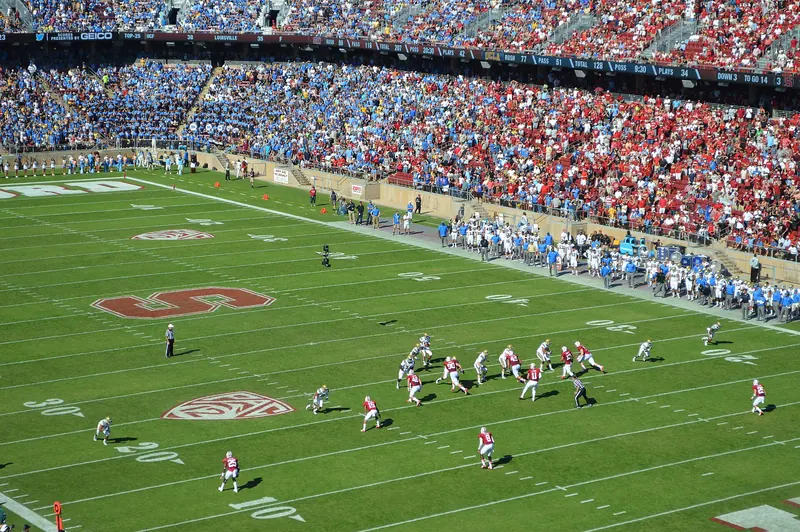
For visitors, the band is the soundtrack of a Stanford game day and the reason a dancing evergreen shows up on the sidelines. This page covers how it got this way, its traditions, the 1982 Big Game play that made it famous and where you can hear it. Sources are Stanford, the Stanford Daily and published histories.

From 1893 to the 1963 strike
The band was founded in 1893, two years after the university opened. For its first seven decades it ran under a faculty director, much like other college bands. It became co-ed in 1972.
The turning point came in 1963. A reorganization of the music department led to the dismissal of longtime band director Jules Schucat. Angry band members refused to perform and the band missed the first two football games of the fall 1963 season. Arthur P. Barnes, a former band and music theory instructor at Fresno State who was working on his doctorate at Stanford, took over as interim director. He got the job full time in 1965.
Barnes changed the band's character. He arranged popular rock songs for it and handed students control of its operations. The band has been almost entirely student-run ever since, which explains most of what follows. Russell Gavin has served as director in recent years.
What a scatter band is
Instead of marching set paths between formations, Stanford's players run haphazardly from one shape to the next. The Stanford Daily traced the habit to the post-1963 era, when members wanted to keep playing while they moved. The result looks chaotic, which is the point. Halftime shows lean on scripted jokes and props as much as on the music.
The look
The band's uniform is part of the act: a white fishing hat with red trim, a red blazer, black pants and, by tradition, the ugliest tie a member can find. Its bass drum has its own name, the Axis o' Rhythm. At spring and nonathletic events members wear a looser rally outfit.
All Right Now
Stanford's de facto fight song is not a fight song. It is All Right Now, the 1970 hit by the British rock band Free. Barnes arranged it after a student suggested it and it stuck. You will hear it after scores, at rallies and at the end of almost every band appearance.
The Stanford Tree
Stanford dropped its Native American mascot and names in 1972 and has never adopted an official replacement. In 1975 the band ran a series of halftime shows that mocked up possible new mascots. The Tree drew so much attention that the band kept it.
The Tree is a redwood, a nod to El Palo Alto, the tree on the seals of both Stanford and the city. Each new Tree builds a fresh costume, a custom that began after the original was stolen in 1987 and held for ransom. Candidates earn the role during Tree Week, a run of stunts and challenges, some of which the university has banned. The Stanford Historical Society marked the mascot's half century with a talk called The Stanford Tree at 50 in October 2026.
The Play: November 20, 1982
The band's most famous moment came at the end of the 1982 Big Game, at California Memorial Stadium in Berkeley. Stanford quarterback John Elway, in his final regular season college game, had driven Stanford into field goal range. Mark Harmon's kick with eight seconds left put Stanford ahead 20 to 19.
Stanford squib-kicked the ensuing kickoff with four seconds on the clock. Cal's return team then threw five laterals across the field. As the ball changed hands, members of the Stanford Band, believing the game was over, poured onto the field from the end zone. Kevin Moen took the last lateral near the Stanford 25 and ran through the band into the end zone, flattening trombonist Gary Tyrrell. Officials ruled it a touchdown. Final score: Cal 25, Stanford 20.
- The call: On KGO radio Joe Starkey shouted "Oh, the band is out on the field!" before declaring "The Bears have won!"
- The dispute: Stanford still argues that Cal's Dwight Garner was down before one lateral. Elway later called the ruling "an insult to college football."
- The trombone: Tyrrell's crushed instrument is on display at the College Football Hall of Fame.
- The plaque: When Stanford holds the Axe, the Big Game trophy, the plaque for 1982 is altered to show a 20 to 19 Stanford win.
- The handover: Each year the new band manager takes over with four seconds left in the Big Game, in memory of the play.
Big Game week
The week before the Cal game is the band's busiest. In 2025 the Stanford Daily described a schedule that began with Bearial on Monday, when the band declared an effigy of Oski, Cal's bear mascot, dead and impaled it on the Claw fountain in White Plaza. Midweek the band sailed against Cal's band at a regatta hosted by the St. Francis Yacht Club in San Francisco. Any Stanford student can play in the Big Game band if they come to a Friday volleyball game and the Saturday field rehearsal, so the band can swell from about 30 to about 80 players. Sections keep their group costumes secret until kickoff. Our Stanford traditions guide covers the rest of the week, including the Axe.
A history of getting in trouble
A student-run band built on irreverence crosses lines. A few episodes stand out:
- 2006: After the band's trailer, the Band Shak, was vandalized, the band was suspended and kept out of the Big Game halftime that year. Stanford reinstated it in July 2007 after charging it $8,000.
- 2015 and 2016: A conduct and Title IX investigation led to a one-year ban from away games. In December 2016 a review panel cited "a systemic cultural problem" and the band lost its registered student group status, then was placed on provisional status after an appeal.
- 2017: A halftime routine at the Alamo Bowl mocking Texas, including the Whataburger chain, was booed.
- 2022: The Tree was suspended over a "Stanford Hates Fun" sign at a game against Arizona State. Later that year Stanford Athletics apologized for a halftime show at the BYU game.
The band remains a fixture at Stanford games. Its supporters see the edge as part of the tradition. Its critics see a group that sometimes punches down. Both views have been aired in campus debates for decades.
Where to see the band
- Home football games at Stanford Stadium, with a halftime show and pregame music. The final home game of 2026 is against SMU on November 28.
- Basketball and volleyball at Maples Pavilion, where band members turn up to play for the crowd.
- The Big Game, on November 21, 2026, at Cal in Berkeley.
- Rallies and campus events through the year. The band's site lists performances.
Check schedules and tickets on our Stanford sports and game days page. For a home game weekend, hotels along El Camino Real fill fast, so compare hotels near Stanford Stadium early. If you prefer an indoor concert with no costumes, our guide to Department of Music concerts covers the university's other ensembles.
Frequently asked questions
What is the Stanford Band's official name?
It is the Leland Stanford Junior University Marching Band, or LSJUMB, named for the university's full legal name. The band was founded in 1893 and is almost entirely run by its student members.
Why does the Stanford Band not march?
It is a scatter band. Since a student-led shakeup in the 1960s its members run between formations instead of marching in step, which lets them keep playing as they move. The style matches the band's irreverent, student-run culture.
What song does the Stanford Band always play?
All Right Now, the 1970 rock hit by the British band Free. Director Arthur P. Barnes arranged it after a student suggestion and it became the band's de facto fight song, played at games and rallies.
What happened with the Stanford Band in the 1982 Big Game?
With four seconds left and Stanford leading 20 to 19, Cal returned the final kickoff with five laterals. Band members had run onto the field thinking the game was over and Cal's Kevin Moen scored through them, knocking over trombonist Gary Tyrrell. Cal won 25 to 20.
Is the Stanford Tree the official mascot?
No. Stanford has no official mascot. The Tree is the band's mascot, born in a 1975 halftime show. It also serves as the university's unofficial mascot at games.