On this page
Stanford's central campus rewards anyone who walks it. The sandstone Quad, the gold church facade, the free art museums and a garden of century-old cacti all sit within a short loop of each other. Most visitors see only the Quad and leave. This route adds the museums, the outdoor sculpture and the quieter corners of the Arboretum without any backtracking that matters.
The loop starts and ends at the Oval. It covers roughly 2 to 3 miles on flat, paved paths, so it suits strollers and wheelchairs. Plan on 2 to 4 hours depending on how long you spend inside. For transit and parking basics, start with our Stanford visitor guide.
Before you go
A little planning helps because several stops keep their own hours.
- Museums: The Cantor Arts Center and the Anderson Collection are free and both close on Tuesday and Wednesday. The Anderson lists its hours as 11 a.m. to 5 p.m.
- Memorial Church: The church was closed to visitors for maintenance from June 15 to October 31, 2026. Check the church's own site for visiting hours and services before you count on going inside.
- Hoover Tower: The observation deck is closed from August 14, 2026 to January 25, 2027 and the tower is closed on weekends until then.
- Parking: Visitor parking is paid through ParkMobile on weekdays. Our Stanford parking and transit guide explains zones and rates.
- Restrooms and water: The museums have restrooms. Bring a water bottle on warm days because shade is patchy between stops.
Stop 1 and 2: The Oval and the Main Quad
Begin on the Oval, the big lawn at the top of Palm Drive. On a sunny weekend it is full of picnics and frisbees. Face south and the whole composition lines up: the Quad's arcades, the gold mosaic of Memorial Church straight ahead and Hoover Tower rising to the left.
Cross into Memorial Court, the Quad's front courtyard. Rodin's Burghers of Calais stand here as separate bronze figures that you can walk among. Pass through the central arches into the Inner Quad. Look down for the class plaques in the arcade walkway, starting with 1896 in front of the church. Our Main Quad guide has a detailed 30 to 45 minute route if you want to linger.
Stop 3: Memorial Church
Memorial Church closes the far side of the Inner Quad. Jane Stanford built it in memory of her husband and it was dedicated in 1903. The facade mosaic is the photo everyone takes. If the doors are open, step inside for the mosaics, the stained glass and the organs. Keep your voice down because services, weddings and memorials happen here. See our Memorial Church guide for etiquette and visiting details.
Stop 4: Hoover Tower
Leave the Quad through the east side and walk a few minutes to Hoover Tower. The 285-foot tower was finished in 1941 for the university's 50th anniversary. Its 48-bell carillon still plays on occasion. While the observation deck is closed, the ground floor exhibits still make a short weekday stop worthwhile. On weekends, enjoy the tower from outside. Read more in our Hoover Tower guide.
From here, turn north. Walk back past the Quad and across the Oval toward the museum district. This leg is the longest of the loop, around 10 to 15 minutes.

Stop 5: Cantor Arts Center and the Rodin garden
The Cantor Arts Center began as the Leland Stanford Jr. Museum in 1894. Admission is free and the collection runs from ancient art to contemporary work, with a large group of Rodin bronzes. Even if the museum is closed, the outdoor B. Gerald Cantor Rodin Sculpture Garden next to it is open around the clock. Look for The Gates of Hell at its eastern end. Our Cantor Arts Center guide covers the galleries.
Next to the Rodin garden stands Sam Van Aken's Tree of 40 Fruit, a single tree grafted to grow many kinds of stone fruit. It blooms in several colors in spring.
Stop 6: The Anderson Collection
A short walk away on Lomita Drive, the Anderson Collection holds postwar American painting and sculpture: Rothko, Diebenkorn, Frankenthaler and many more. Ennead Architects designed the 2014 building around a grand staircase that leads to one floor of galleries. Pollock's Lucifer, the collection's best known painting, is on loan to the Metropolitan Museum of Art until January 31, 2027. See our Anderson Collection guide for what is on view.
Across Lomita Drive in the Arboretum, Beverly Pepper's The Stanford Columns, installed in 2022, rise from the grass. Bing Concert Hall and Frost Amphitheater are a few minutes east if you want to see the arts district.
Stop 7: Stone River
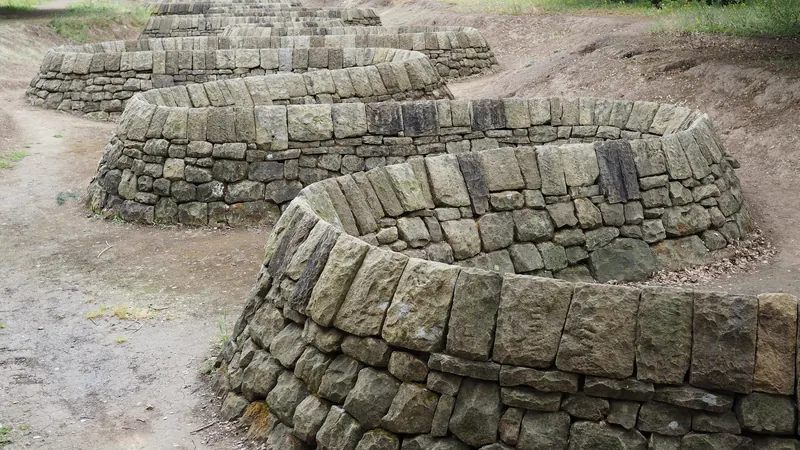
Just northeast of the Cantor, Andy Goldsworthy's Stone River winds along a broad trough in the ground. The British artist built it in August 2001 with a team of dry stone wallers. The wall runs about 445 feet and holds around 6,500 stones, all salvaged from university buildings damaged in the 1906 and 1989 earthquakes. It honors Gerhard Casper, Stanford's president from 1992 to 2000. Walk its length. The stones change color with the light and the triangular capstones along the top were cut to fit their exact spots. Our public art guide lists more outdoor works to find.
Stop 8: The Mausoleum and the Arizona Garden
From Stone River, head into the Arboretum toward the Stanford Family Mausoleum. Allow 10 to 15 minutes through the trees. The granite tomb, guarded by stone sphinxes, holds Leland, Jane and Leland Jr. Nearby stands the Angel of Grief, a marble memorial from the Stanford era.
Beside the mausoleum is the Arizona Cactus Garden, laid out between 1880 and 1883 for a family mansion that was never built. It holds roughly 500 cacti and succulents in 58 beds, with some original plantings still growing. Wear closed shoes because spines end up near the paths. Our Arizona Cactus Garden guide has a plant list.
To finish, walk south through the Arboretum back to Palm Drive and the Oval. The full loop ends roughly where it began.
Official tours and other options
The route above is unofficial. Stanford publishes several ways to see campus with more structure:
| Option | Who it is for | How it works |
|---|---|---|
| Admission information sessions and tours | Prospective undergraduates and their families | Student-led walks of central campus on most weekdays and select Saturdays in fall and spring. Registration required. |
| Stanford Mobile App walks | Anyone | Self-guided themed walks with a public art map, including a wheelchair-accessible route. |
| Cantor public tours | Anyone | Free, no reservation. The Rodin tour includes the outdoor garden. Outdoor sculpture walks have run on Sundays in past seasons. |
| Virtual tours | Anyone who cannot visit | Live and recorded virtual tours from Stanford's visitor site. |
The Visitor Center at 295 Galvez Street is generally open on weekdays from 9 a.m. to 5 p.m. It is run by the Office of Undergraduate Admission and closes for most federal holidays and the winter break. Check visit.stanford.edu before a special trip. According to Stanford, guided admission tours pause between quarters and commercial tour operators cannot book group tours. Families with college-bound students should read our page on visiting as a prospective student.
If you would rather hear commentary as you walk, a self-guided audio tour is a simple add-on to this route.
Good to know
- Bikes have the right of way on many campus paths. Look both ways before stepping off a curb, especially at class change times.
- Weekends are the easiest days to drive in, since many central lots do not charge then. The Marguerite shuttle does not run on weekends.
- Late afternoon light is best for the church facade and Stone River.
- Home football Saturdays fill campus roads. Avoid them unless you are going to the game.
- For coffee before you start, see our Palo Alto coffee guide.
Frequently asked questions
Can you tour Stanford without a guide?
Yes. The outdoor spaces are open to the public and Stanford itself offers self-guided walks in the Stanford Mobile App. Guided admission tours are meant for prospective students and need registration.
How long does it take to walk around Stanford?
The loop on this page covers roughly 2 to 3 miles. Without stops it takes about an hour. With time in the Main Quad, Memorial Church and the two museums, plan on 3 to 4 hours.
Where should I start a Stanford campus walk?
Start at the Oval, the lawn at the top of Palm Drive in front of the Main Quad. It is about a mile from the Palo Alto Caltrain station and the free Marguerite shuttle stops nearby on weekdays.
Are there free guided walks of the outdoor art?
The Cantor Arts Center runs free public tours, including a Rodin tour that covers the outdoor sculpture garden. Docent-led outdoor sculpture walks from the Oval have run on Sundays in past seasons, so check Stanford's events calendar for current dates.
What is the best day for a self-guided Stanford tour?
Thursday through Monday, when both the Cantor Arts Center and the Anderson Collection are open. Weekends also mean free parking in many central lots, but no Marguerite shuttle and no admission tours.