On this page
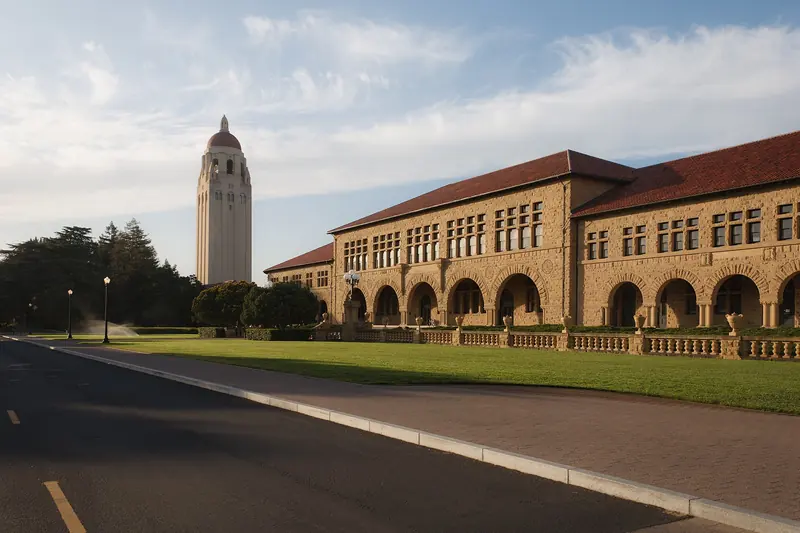
Stanford Law School does not look like a grand old law school. There is no columned courthouse facade. Instead it occupies Crown Quadrangle, a complex that opened in 1975, plus the newer William H. Neukom Building next door. It sits a few minutes' walk from White Plaza, close to the center of student life.
For visitors the law school is a place to walk past and understand rather than tour. The buildings are workplaces and classrooms, the law library is closed to the public and most events are aimed at students. Still, it is worth knowing what you are looking at. This guide covers the buildings, a short history, how events work and the library's access rules as Stanford publishes them. For transit and parking, start with our Stanford visitor guide.

A short history
Law was part of the plan from the start. Stanford Law notes that Leland Stanford was admitted to the New York bar in 1848 and that his 1885 founding grant gave law a central place in the new university. When classes began in 1891, legal study followed soon after.
The school's own history of its locations reads like a series of upgrades:
- 1894: The young Law Department set up its first office and library in a bedroom of Encina Hall, then a men's dormitory.
- The Inner Main Quad: Law moved into the academic heart of campus and stayed for 49 years. Our Main Quad guide describes the arcades it occupied.
- 1950: With enrollment growing after World War II, the school moved to remodeled space on the Outer Quad.
- 1975: Stanford Law moved into the newly built Crown Quadrangle. President Gerald Ford attended the inauguration.
- 2010 to 2011: The William H. Neukom Building was added to the south. The law school's campus page gives 2011 as its opening year.
The school's alumni include two Supreme Court justices from one class. William Rehnquist and Sandra Day O'Connor both graduated in 1952. As the story goes, Rehnquist ranked first and O'Connor third. Stanford Law says no official record shows who was second, so the mystery lives on. For the wider story of the university, see our history of Stanford.
The buildings
Crown Quadrangle
Crown Quadrangle is the main law school complex and the address on every letter: 559 Nathan Abbott Way. It holds classrooms, faculty offices and the Robert Crown Law Library. The law school's campus page notes that the library recently gained a renovated reading room. Crocker Garden, an outdoor space at the school, hosts informal gatherings. In October 2026 it was the starting point for a lunchtime trick-or-treat for law school families.
The William H. Neukom Building
The Neukom Building is a 65,000 square foot academic building south of the original complex. Stanford Law describes it as a new focal point on the route between the campus's residential and academic areas. It provides space for clinics, seminars, meetings and offices, which the older complex lacked.
The Munger Graduate Residence
Next door, the Munger Graduate Residence houses law students and other graduate students. It was made possible by a gift from Charles and Nancy Munger. It is a residence, so treat it as private.
Clinics and community work
Much of Stanford Law's public impact happens off campus. The school lists 11 immersive legal clinics and about 20 law and policy practicums. Its clinics have deep local roots. In 1984 students founded the school's first clinic, the East Palo Alto Community Law Project. It was reborn in 2003 as the Stanford Community Law Clinic. Stanford Law tells a favorite story from those early years: retired California Chief Justice Rose Bird volunteered there without revealing her background and was assigned to the copy machine until the dean pointed out who she was. Our page on East Palo Alto covers the community the clinic grew up serving.
The school also says its students have worked on 330 U.S. Supreme Court cases since spring 2004.
Public events
Stanford Law keeps an events calendar with lectures, panels, student group programs and academic events. Each listing gives the date, room and an RSVP link where one is required. In the late October 2026 listings, most events were aimed at the law school community: study sessions for first-year students, workshops run by the policy lab and student social events. Events open to outside guests do appear, but you need to check each listing rather than assume.
- Read the listing's audience line and RSVP instructions before you go.
- Arrive early. Classrooms in Crown Quadrangle are not large and popular talks fill up.
- For larger university lectures, the Stanford events calendar lets you filter for events open to everyone.
Prospective law students get a separate path. Stanford Law's visiting page says a variety of classes may be available to sit in on depending on when you visit. It asks you to arrange this through the Office of Admissions. Our page on visiting as a prospective student covers undergraduate admission visits.
The Robert Crown Law Library
The Robert Crown Law Library is the legal research center for the whole university. It is also one of the most restricted libraries on campus. Its published access policy says:
| Who | Access |
|---|---|
| Stanford University ID cardholders | Welcome during regular hours, with exceptions during limited-access periods |
| Stanford Hospital affiliates | Welcome during regular hours |
| Stanford Law alumni | Limited access and borrowing with an SLS alumni card from the Stanford ID Card Office |
| Holders of cards from other campus libraries | No access |
| Continuing Studies students without a Stanford ID | No access |
| Summer program attendees | No access |
| Members of the general public | No access |
During law school reading and exam periods, study space is reserved for current law students and other Stanford ID holders can only request books, get reference help and use e-resources. The library's calendar lists November 30 to December 11, 2026 as a limited-access period. Hours split between times open to the Stanford community and evening and weekend times for law students only. Always check the hours page because the library says hours and access can change at any time.
Good to know about the law library
- Photography and filming inside are not allowed without written approval from the library's associate dean.
- The library is fine-free but charges replacement fees for lost or damaged books.
- It does not accept book donations. It suggests giving to groups such as the Friends of the Palo Alto Library instead.
- Its access page links to a list of nearby academic and public law libraries for people who cannot get in.
If you simply want a library to sit and read in, Palo Alto's public libraries are open to everyone. See our guide to Palo Alto libraries. Stanford's main research library has its own visitor pass rules, covered in our Green Library guide.
Nearby on campus
The law school is close to several places that are open to visitors. The Stanford Bookstore and White Plaza are a short walk away and Tresidder Union and Old Union have food and coffee. Parking near the law school is limited on weekdays. Our Stanford parking and transit guide explains visitor zones and the free Marguerite shuttle.
Frequently asked questions
Can the public use the Stanford Law library?
No. The Robert Crown Law Library's access policy lists members of the general public among those who cannot enter. Access is for Stanford University ID cardholders and Stanford Hospital affiliates during regular hours, with tighter limits during law school reading and exam periods.
Where is Stanford Law School?
In Crown Quadrangle at 559 Nathan Abbott Way on the Stanford campus, a short walk from White Plaza and the Stanford Bookstore. The William H. Neukom Building stands just south of the original complex.
Can I sit in on a Stanford Law class?
Stanford Law's visiting page says a range of classes may be available to prospective students depending on when they visit. Arrange it through the Office of Admissions in advance rather than walking in.
Did Sandra Day O'Connor go to Stanford Law School?
Yes. Sandra Day O'Connor and William Rehnquist both graduated in the class of 1952. Stanford Law notes they are the only two Supreme Court justices in U.S. history to come from the same law school class.
Are Stanford Law School events open to the public?
Some are, but many are for the law school community. Each listing on the SLS events calendar shows its audience, location and any RSVP requirement. Check the listing before you go and bring ID for campus events that require it.