On this page
Most people come to Stanford for the sandstone and the palm trees and leave having walked past a Rodin, a Calder and a 445-foot wall made from earthquake rubble. The campus holds about 100 outdoor works of art. They are free, outdoors and on view every day of the year, from Victorian marble to sculpture installed in the last few years.
This guide picks out the works worth seeking and groups them by area so you can see several in one walk. For the indoor collections, see our guides to the Cantor Arts Center and the Anderson Collection.
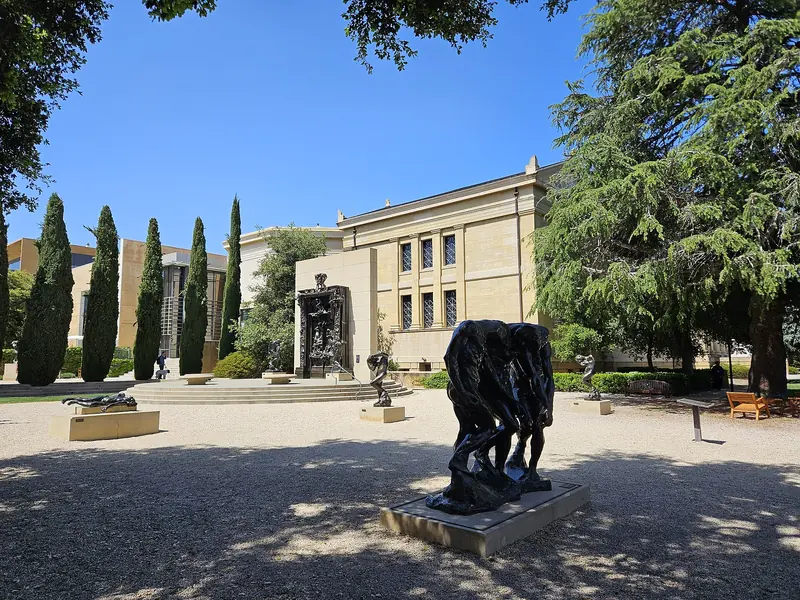

Rodin at Stanford
Stanford holds one of the largest collections of Auguste Rodin's work outside Paris, thanks largely to the collector B. Gerald Cantor. The outdoor B. Gerald Cantor Rodin Sculpture Garden opened in 1985 beside the museum. It covers about an acre and holds about 20 bronzes.
- The Gates of Hell: Rodin's huge portal, crowded with figures from Dante, anchors the garden's eastern end. Stanford's cast was made in 1981 at the Coubertin Foundry. The Thinker began as a figure at its top.
- The Three Shades: Three identical male figures leaning toward a single point.
- Adam and Eve: Large single figures from the same period.
- The Walking Man: A headless, armless figure in mid-stride.
- Heads of the Burghers: Two heads from The Burghers of Calais.
The garden never closes, so it is a good stop on an evening walk or a day when the museum is shut. Next to it grows Sam Van Aken's Tree of 40 Fruit, planted in 2022, according to the Almanac. The single tree is grafted to grow many kinds of stone fruit.
The Burghers of Calais
The full group of Rodin's Burghers of Calais stands in Memorial Court, the front courtyard of the Main Quad. Calais commissioned the work in 1884 to honor six citizens who offered their lives to the English king in 1347 to save their city. At Stanford the figures stand as separate casts at ground level, so you can walk among them and look each man in the face. Our Main Quad guide tells the full story.
Stone River
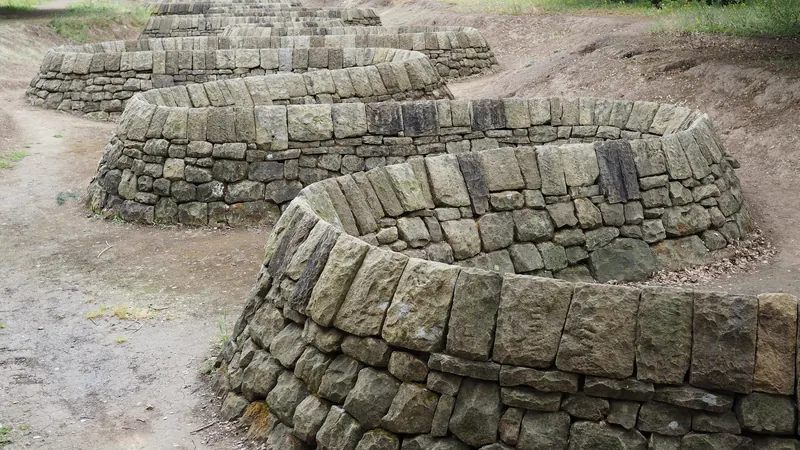
Just northeast of the Cantor, Andy Goldsworthy's Stone River snakes along a broad trough cut into the ground. The British artist designed it and a team of eight dry stone wallers from Britain built it over about three and a half weeks in August 2001. They worked six days a week, eleven hours a day.
The wall runs about 445 feet. It contains roughly 6,500 stones weighing about 128 tons, all sandstone salvaged from university buildings damaged in the 1906 and 1989 earthquakes. Along the top, about 700 triangular capstones were cut to fit their exact places. The work was a gift from the Robert and Ruth Halperin Foundation in honor of Gerhard Casper, Stanford's president from 1992 to 2000. Goldsworthy has said he tries to make connections between what we call nature and what we call man-made. Here the man-made stone returns to the ground like a dry riverbed. For more on the sandstone itself, see our Stanford architecture guide.

Papua New Guinea Sculpture Garden
At Santa Teresa Street and Lomita Drive, a grove of carved wooden poles, figures and stone pieces surprises most visitors. The Papua New Guinea Sculpture Garden was created on site by ten artists from the Sepik River region of Papua New Guinea during a residency in 1994 that sources describe as lasting three to five months. It has stood since the mid-1990s and holds around 40 carvings, including garamut slit drums.
The carvings are wood left to weather in the open, so their surfaces change over time. Walk the paths slowly. Many pieces stack human and animal figures from top to bottom. Treat the garden with the same care as a museum gallery and do not climb on the works.
Around the arts district
The area around the Cantor, the Anderson and Bing Concert Hall holds the densest cluster of outdoor art.
- The Stanford Columns: Beverly Pepper's tall forms, installed in 2022 in the Arboretum across Lomita Drive from the Anderson Collection.
- Bike racks by David Byrne: The musician designed playful bike racks along Lomita Drive in 2016. They still hold bikes.
- MOCNA: Ursula von Rydingsvard's monumental bronze from 2018 at Denning House.
- Angel of Grief: A marble memorial in the Arboretum, first carved in 1901 and replaced in 1908 after the 1906 earthquake wrecked the original. It stands near the Stanford Family Mausoleum and the Arizona Cactus Garden.
Elsewhere on campus
| Work | Artist and year | Where to find it |
|---|---|---|
| White Memorial Fountain, known as The Claw | Aristides Demetrios, design chosen in 1963 | White Plaza, between Old Union and the Stanford Bookstore |
| Pars pro Toto | Alicja Kwade, 2021 | Science and Engineering Quad |
| Mozart I | Kenneth Snelson, 1982 | Lawn outside the Packard Electrical Engineering Building |
| The Stanford Legacy, a carved totem pole | Don Yeomans, 2002 | Canfield Court |
| Vanguard | Bruce Beasley, 1980 | Canfield Court |
| Le Faucon | Alexander Calder, 1963 | Check the public art map for its current spot |
The Claw is the one students know best. It sits in the middle of White Plaza and its bronze tines fill with water. Students have been known to wade in on hot days and during celebrations.
Free tours and the app
You can see all of this on your own, but Stanford provides some help.
- Stanford Mobile App: The app includes an interactive public art map and six themed self-guided walks with 4 to 10 stops each. Themes have included the art around the museums, sculptural landscapes, art and science and murals. The BeWell art tour has 10 stops, takes 15 to 30 minutes and is wheelchair accessible.
- Cantor public tours: The Cantor's free public tours need no reservation. Its Rodin tour, listed on Fridays and Saturdays at 11:30 a.m., covers the galleries and the outdoor sculpture garden and meets in the museum lobby.
- Outdoor sculpture walks: Cantor docents have led free outdoor sculpture walks on Sunday afternoons in past seasons, including a 90 minute walk from the top of the Oval. These were not listed on the museum's tours page in late October 2026, so check the Stanford events calendar for current dates.
Our self-guided campus walk strings Stone River, the Rodin garden and the Burghers into a loop with the Main Quad and the Arizona Garden. If you like hearing context as you walk, an audio tour adds commentary.
Good to know
- Do not touch or climb on sculpture, even outdoors. Oils from hands damage bronze patinas and weathered wood.
- The outdoor works are on open campus land with no gates or tickets.
- Weekday parking is paid. Weekends are easier in many central lots.
- Low afternoon sun is best for photos of Stone River and the bronzes.
- Palo Alto has its own public art program across town. See our guide to public art in Palo Alto.
A collection built over time
Art has been part of the campus since the founding. The Stanfords filled their son's museum with objects from their travels and some outdoor marble pieces date to the Stanford era. The Rodin collection grew from the 1970s onward, culminating in the 1985 garden. Large commissions such as Stone River followed as the university built up its arts district. Our history of Stanford covers the founders and the museum's early years.
Frequently asked questions
Is the Rodin Sculpture Garden at Stanford free?
Yes. The B. Gerald Cantor Rodin Sculpture Garden next to the Cantor Arts Center is free and open around the clock. It holds about 20 bronzes, including The Gates of Hell.
Where is Stone River at Stanford?
Stone River sits just northeast of the Cantor Arts Center in a broad, shallow trough. Andy Goldsworthy built it in 2001 from about 6,500 pieces of sandstone salvaged from buildings damaged in the 1906 and 1989 earthquakes.
Where is the Papua New Guinea Sculpture Garden?
The garden is at the corner of Santa Teresa Street and Lomita Drive, a short walk west of the Cantor. Its carved posts, figures and drums were made on site by artists from the Sepik River region of Papua New Guinea.
Are there free tours of Stanford's outdoor art?
The Stanford Mobile App has self-guided themed art walks with a public art map. The Cantor Arts Center runs free public tours, including a Rodin tour that covers the outdoor garden. Docent-led outdoor sculpture walks have run on Sundays in past seasons, so check Stanford's events calendar.
Where are the Burghers of Calais at Stanford?
Rodin's Burghers of Calais stand in Memorial Court, the front courtyard of the Main Quad facing Palm Drive. Two heads from the same work are in the Rodin Sculpture Garden.