On this page
Artificial intelligence feels like a 2020s story, but Stanford has been at it for more than six decades. The term itself was coined by a scientist who later spent nearly half a century at Stanford. One of the first AI labs worked out of a building in the foothills above campus. A few miles away in Menlo Park, a wobbly robot named Shakey taught computers to plan a route. Today the same campus is home to one of the best known AI policy institutes in the world.
This page follows that thread, using Stanford's archives and the institutions' own sites. For the wider tech history of the area, see our Silicon Valley history.
John McCarthy comes west
John McCarthy coined the name "artificial intelligence" in 1955, in a proposal for a summer research project at Dartmouth College. His Stanford memorial page lists a run of other firsts. He invented the LISP programming language in 1958, wrote a 1960 paper that laid out its theory and described general-purpose computer time-sharing in a January 1959 memo. Time-sharing let many people use one computer at once.
McCarthy left MIT for Stanford in 1962, joining the Mathematics Department. He moved to the new Computer Science Department in 1965. Over his career he received the ACM Turing Award, the National Medal of Science and the Kyoto Prize. He died on October 24, 2011, at 84. He also had a life off campus. Our page on Perry Lane and Ken Kesey notes he was among the members of that bohemian Stanford enclave.
SAIL: the Stanford Artificial Intelligence Laboratory
McCarthy founded the lab with Lester Earnest, its longtime executive officer. Stanford's archives date it to 1963. The lab's own site gives the same year. It became known as the Stanford AI Lab or simply SAIL.
The foothills years, 1965 to 1980
According to the finding aid for SAIL's records at Stanford, the lab was housed from 1965 to 1980 in the D.C. Power building, in the foothills of the Santa Cruz Mountains overlooking campus. The lab's computer was also used for early computer music. Composer John Chowning set up a music program on it in 1964, the work that grew into CCRMA. Our CCRMA page tells that story.
Into the Computer Science Department, 1980
In 1980 SAIL's activities merged into the Computer Science Department and the lab moved to Margaret Jacks Hall on the main campus. The archives describe a revival in 2004, when SAIL reopened with Sebastian Thrun as its new director. The next year Thrun's team won the 2005 DARPA Grand Challenge, a desert race for self-driving vehicles, with a modified Volkswagen named Stanley.
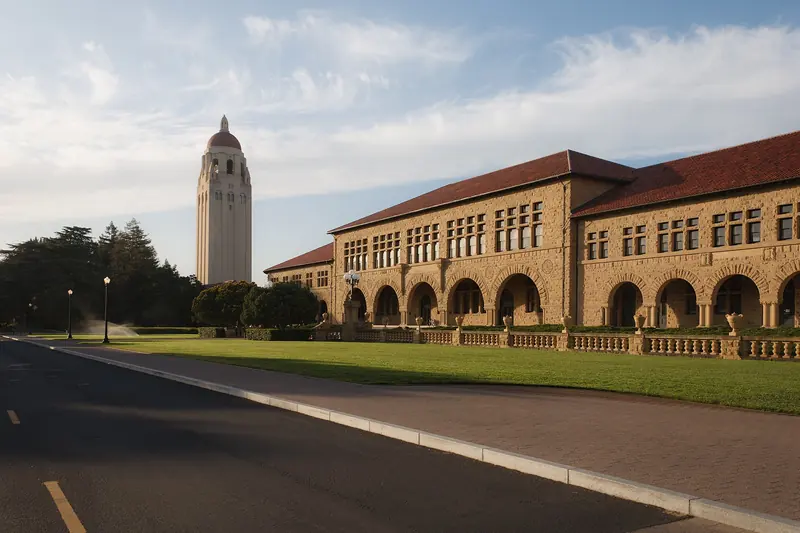

SAIL today
The lab's site describes McCarthy as "one of the founding fathers of the field of AI." It lists Professor Chris Manning as director and places the lab on the second floor of the Gates Computer Science Building. Its researchers work on machine learning, computer vision, robotics, natural language and game theory. Our Science and Engineering Quad guide covers the Gates building, which opened in 1996.
The lab's records, from 1963 to 2009, are held by Stanford's archives. Researchers can request them through Special Collections and University Archives.
Shakey at SRI
Stanford's AI story has a twin in Menlo Park. At the Artificial Intelligence Center of Stanford Research Institute, now SRI International, a team built Shakey from about 1966 to 1972. The project grew out of an April 1964 SRI proposal and was funded by DARPA. It was managed by Charles Rosen, Nils Nilsson and Peter Hart.
Shakey was a wheeled cart with a camera, a range finder and bump sensors, linked by radio to a large computer. It could look at a room, work out a plan and carry it out. The team named it after one member said it "shakes like hell and moves around." Life magazine called it the "first electronic person" in 1970.
Shakey mattered less for what it did than for the methods its team invented to make it work:
- The A* search algorithm, still used to find routes in maps and games.
- The STRIPS planner, short for Stanford Research Institute Problem Solver.
- The Hough transform as used to find lines in images. The team also developed the visibility graph method for path planning.
Shakey was inducted into Carnegie Mellon's Robot Hall of Fame in 2004 and is recognized with an IEEE Milestone. The robot itself is retired in a glass case at the Computer History Museum in Mountain View, which makes it the easiest piece of this history to see in person. SRI was part of Stanford when Shakey was begun and became independent in 1970. Our SRI International page covers that split and SRI's other computing firsts.
Two ideas a few miles apart
The Peninsula in the 1960s held two competing visions of what computers were for. At SAIL and at SRI's AI Center, researchers tried to make machines that could reason on their own. At the same institute, Douglas Engelbart's group argued for computers that would augment human intelligence, the thinking behind the mouse and the 1968 oN-Line System demo. Both lines of work fed into the personal computer and today's AI. Our page on research labs near Palo Alto maps where these labs sat.
| Year | Milestone |
|---|---|
| 1955 | McCarthy coins "artificial intelligence" |
| 1962 | McCarthy joins Stanford from MIT |
| 1963 | SAIL founded |
| 1965 | SAIL moves to the D.C. Power building in the foothills |
| 1966 to 1972 | Shakey built at SRI |
| 1980 | SAIL merges into Computer Science and moves to Margaret Jacks Hall |
| 2004 | SAIL reopens under Sebastian Thrun |
| 2005 | Stanley wins the DARPA Grand Challenge |
| 2019 | HAI launches in March |
HAI: the Institute for Human-Centered AI
Stanford launched the Institute for Human-Centered Artificial Intelligence, known as HAI, in March 2019. Its stated mission is to advance AI and data science research, education, policy and practice to improve the human condition. The computer scientist Fei-Fei Li was its founding director. HAI's about page in October 2026 listed her as founding director and senior fellow and as special advisor on AI to Stanford President Jonathan Levin. It listed James Landay as Denning Director and Russell Wald as executive director.
HAI works across schools rather than as a department of its own. Its best known products and programs include:
- The AI Index, which HAI describes as a global benchmark for tracking AI's progress and impact.
- Policy work, including policy briefs and training for lawmakers and their staff.
- The Stanford Digital Economy Lab, launched by the economist Erik Brynjolfsson, who joined HAI in 2020.
- Seed grants, a program begun in 2019 to fund early AI research.
- Computing, including the Marlowe GPU supercomputer mentioned on HAI's site.
HAI shares the Gates Computer Science Building with the Computer Science Department.
Public talks
HAI runs a regular seminar series in the Gates building, room 119, from noon to 1:15 p.m. on Wednesdays. Listings on Stanford's events calendar in late October 2026 included:
- November 4, 2026: HAI Seminar with Marcos Santiago Rojas Pino and Thomas Caruso.
- November 18, 2026: "The AI 100" with Mike Wooldridge.
- December 9, 2026: Angèle Christin in conversation with Hannah Zeavin.
Each listing showed a livestream and a registration link. The calendar does not say who may attend in person, so register and read the event page before you go. For other free talks, see our guide to public lectures at Stanford.
Seeing AI history
- The Computer History Museum in Mountain View, for Shakey and much more.
- The Gates Computer Science Building at 353 Jane Stanford Way, home of SAIL and HAI. Like most academic buildings, it is a workplace, so stay in public areas.
- Margaret Jacks Hall on the Main Quad, SAIL's home after 1980. Our Main Quad guide covers the buildings around the arcades.
Two Stanford Turing Award winners, John McCarthy and Edward Feigenbaum, built their careers in AI. Stanford's full list of top honors appears on our page about Stanford's Nobel laureates, which also notes the university's Turing count.
Frequently asked questions
When was the Stanford AI Lab founded?
Stanford's archives date the Stanford Artificial Intelligence Laboratory, known as SAIL, to 1963. John McCarthy started it after moving from MIT to Stanford in 1962. The lab's own site also gives 1963 as its founding year.
Who coined the term artificial intelligence?
John McCarthy coined the name artificial intelligence in 1955. He also invented the LISP programming language in 1958 and described general-purpose computer time-sharing in a January 1959 memo. He joined Stanford in 1962 and died on October 24, 2011, at 84.
Was Shakey the robot built at Stanford?
No. Shakey was built from about 1966 to 1972 at the Artificial Intelligence Center of SRI, then called Stanford Research Institute, in Menlo Park. SRI separated from Stanford in 1970. Shakey is now on display at the Computer History Museum in Mountain View.
What is Stanford HAI?
HAI is the Stanford Institute for Human-Centered Artificial Intelligence, launched in March 2019 with Fei-Fei Li as founding director. Its stated mission is advancing AI and data science research, education, policy and practice to improve the human condition. It publishes the annual AI Index and is based in the Gates Computer Science Building.
Can the public attend Stanford AI talks?
HAI lists weekly seminars in the Gates Computer Science Building with a livestream and online registration. Fall 2026 listings included talks on November 4, November 18 and December 9 from noon to 1:15 p.m. HAI does not say on its calendar whether in-person seats are open to everyone, so register and check the event page.