On this page
Cecil H. Green Library stands a short walk from the Main Quad. It is the largest library on campus and serves as the main library for the humanities and social sciences at Stanford. It is not a public library. Stanford's libraries exist to support students and faculty. Still, visitors are not shut out. You can register for a day pass, see free exhibitions in the historic Bing Wing and drop into the David Rumsey Map Center on its open days.
This page explains what you need to get in, what is on view in fall 2026 and how the other Stanford libraries fit in. If you are looking for a quiet place to read with a library card from town, our guide to Palo Alto's public libraries is the better starting point.
Two buildings in one
Green Library is really two connected buildings from different eras. The older part was approved in 1913 and completed in 1919, after an earlier library under construction was wrecked by the 1906 earthquake. In 1980 a much larger addition went up and the library took the name of Cecil H. Green, a founder of Texas Instruments and a major donor. The 1919 building was badly damaged in the 1989 Loma Prieta earthquake. Peter Bing gave a large gift to restore it and it is now called the Bing Wing.
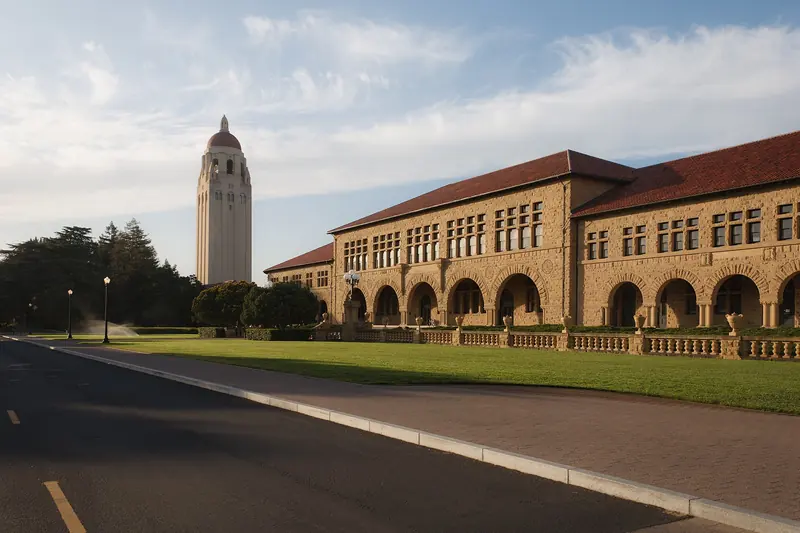
The two halves are still easy to tell apart. The Bing Wing has its own address on Lasuen Mall and hosts the library's exhibitions. Green East, the 1980 addition, faces Escondido Mall. Coupa Café runs a kiosk beside Green East at 571 Escondido Mall, which makes a handy meeting point. Our guide to Stanford architecture puts the building in context with the rest of campus.
How visitor access works
Stanford sets out its rules on the visitor access page. The basics:
- Day passes. Visitors can use the libraries for research or to attend a public event on up to seven days a year. Stanford alumni get 14 days.
- Where to register. Sign up in person at Green Library, the Art and Architecture Library (Bowes), the East Asia Library or the Music Library.
- What to bring. A valid, physical, original government-issued photo ID. Staff take your photo for the pass, ask you to describe your research purpose briefly and have you agree to the visitor terms.
- Minors. Anyone under 18 must stay with an adult or legal guardian who has acceptable ID.
Once inside, visitors can use open study areas on a first come, first served basis, public computers and the campus visitor Wi-Fi. Printing and copying run through Cardinal Print, which is available to guests. Group study rooms, study carrels, lockers and after-hours spaces are for Stanford students and ID holders only. Licensed databases and e-journals work only on designated public computers inside the libraries.
After your seven days
Researchers who need more time can buy a card. An access card lets you use collections on site. An access and borrowing card adds checkouts, with most loans running 28 days and a limit of 25 items. Fees depend on your affiliation and cards cannot be refunded or prorated. Stanford alumni get discounted rates. For example, an alumni access card was listed at $10 for two weeks or $100 a year in fall 2026. Faculty and graduate students at UC campuses and Ivy Plus schools have their own arrangements.
Good to know
- Visitor passes do not cover the Law Library, Lane Medical Library, the Hoover Library or the Graduate School of Business Library.
- Special Collections reading rooms follow their own rules. Contact them before a research trip.
- Hours change by quarter. In the last week of October 2026, Green Library listed 8 a.m. to midnight Monday through Thursday, 8 a.m. to 7 p.m. Friday, 10 a.m. to 6 p.m. Saturday and noon to midnight Sunday.
- Stanford's winter closure runs December 21, 2026 to January 1, 2027. Check the library hours page around holidays.
Exhibits in the Bing Wing
Stanford Libraries mounts exhibitions in the Bing Wing, with Hohbach Hall as a main venue. Stanford's events calendar lists them as open to everyone. In fall 2026 the main show is:
Text Machines: Scarlet Thread of the Digital Order (1883 to 2026). The exhibition runs from June 1 to December 22, 2026. It centers on an 1883 edition of Les laboureurs, a book whose text and ornaments were entirely woven on a Jacquard loom by the firm of the silk merchant Joseph-Alphonse Henry. The show looks at how the book was made and draws parallels between the technology-driven change of the late nineteenth century and today. It includes microscope images of the woven text, a woven enlargement that shows how it works and several related artworks. The Jacquard loom's punched cards are often cited as an ancestor of computer programming, which makes this a fitting show for a Silicon Valley campus.
The libraries also list a series of one-day pop-up displays of special, unique and rare items in the Bing Wing, each built around a theme. Themes and dates announced for the 2026 to 2027 season include:
| Date | Theme |
|---|---|
| November 10, 2026 | Cities |
| December 8, 2026 | Home |
| February 9, 2027 | The News |
| March 9, 2027 | Games |
| April 13, 2027 | Design |
| May 11, 2027 | The Bay Area |
These are one-day events, so check the libraries' events listing for times before you go.
The David Rumsey Map Center
On the fourth floor of Green Library, the David Rumsey Map Center is the best reason for a non-researcher to visit. It celebrates its tenth year in 2026. Its map collections span the fifteenth century to the present and reach well beyond California.
The current exhibition, Emergent Properties: Decennial Reflections on Collections, runs from September 9, 2026 to March 5, 2027. It brings together 40 objects that have driven the most scholarship and teaching at the center over its first ten years. Stanford's calendar lists viewing on Wednesdays and Thursdays from 1 p.m. to 5 p.m. and Fridays from 9:30 a.m. to 5 p.m. An exhibition reception with a tour by David Rumsey was announced for Friday, November 20 at 3 p.m. The center also runs guided tours on Friday afternoons. Hours can change from week to week, so check before you make the trip.
Other libraries on campus
Stanford Libraries holds roughly 12 million items across many branches. A few that visitors ask about:
- East Asia Library. On the second floor of Lathrop Library at 518 Memorial Way. It is Stanford's main home for Chinese, Japanese and Korean materials, with more than 780,000 print volumes and special collections that range from thirteenth century scrolls to modern ephemera. It traces its roots to Hoover Institution collecting that began in 1945 and moved to Lathrop when the old Meyer Library closed in 2014. It also hosts rotating exhibitions. Visitors can register for day passes here.
- Art and Architecture Library (Bowes). In the arts district near the Cantor Arts Center. Another registration point for visitors.
- Music Library. The fourth place visitors can register for a day pass.
- Hoover Institution Library and Archives. A separate library with its own reading room and reservation system. Read our Hoover Library and Archives guide.
- Coordinate libraries. Law, Lane Medical and the Graduate School of Business libraries serve their own schools and are not covered by visitor passes.
Green Library itself also houses Special Collections, the Media and Microtext Center with its film and video game collection and the Silicon Valley Archives, which documents the region's technology companies and people.

Jane Stanford's jewels
One piece of library lore is worth knowing before you go. In 1905 Jane Stanford directed that after her death her jewels should be sold and the money kept as a permanent endowment for buying books. The Jewel Fund was set up in 1908 and still adds to the collections. Books bought with it carry a bookplate showing Jane Stanford offering her jewels to Athena. For more on the founders, see our history of Stanford.
Planning your visit
Green Library is a few minutes' walk from the Oval and the Main Quad, so it fits easily into a campus walk. The free Marguerite shuttle from the Palo Alto Caltrain station serves central campus on weekdays. If you drive, visitor parking is paid by zone through ParkMobile on weekdays. Our Stanford parking and transit guide explains how it works.
For a quick visit, enter the Bing Wing from Lasuen Mall to see the exhibition, then head up to the Rumsey center if it is open. Grab a coffee at the Coupa kiosk outside Green East before you leave. Our page on eating on campus lists other nearby options.
Frequently asked questions
Can the public go into Green Library at Stanford?
Yes, with a visitor day pass for research or to attend a public event. Register in person at Green Library with an original government-issued photo ID. Public exhibitions in the Bing Wing are listed by Stanford as open to everyone.
How many days can a visitor use Stanford's libraries?
Day passes are limited to seven days a year, or 14 for Stanford alumni. After that, independent researchers can buy an access card or an access and borrowing card.
What exhibits are at Green Library now?
Text Machines: Scarlet Thread of the Digital Order (1883 to 2026) runs in the Bing Wing through December 22, 2026. Emergent Properties, a show of 40 highlights, runs at the David Rumsey Map Center through March 5, 2027.
Which Stanford libraries are not open to visitors?
Stanford's visitor passes and cards do not cover the coordinate libraries: the Law Library, Lane Medical Library, the Hoover Library and the Graduate School of Business Library. Each has its own rules.
Where is the East Asia Library at Stanford?
It is on the second floor of Lathrop Library at 518 Memorial Way. It holds more than 780,000 print volumes in Chinese, Japanese and Korean and is one of four places where visitors can register for a day pass.