On this page
The Cantor Arts Center is easy to enjoy without a plan. It is also easy to miss the best rooms. The museum holds more than 38,000 objects, with galleries on two floors and a sculpture garden outside. This page is a map of what is where, based on the museum's own gallery map and its exhibitions list as of late October 2026.
For the museum's history, hours, parking and cafe, start with our Cantor Arts Center visitor guide. This page assumes you are already through the door and wondering which way to turn.
Before you go
Admission is always free. The museum's visit page listed these hours in late October 2026:
| Day | Hours |
|---|---|
| Monday and Friday | 11 a.m. to 6 p.m. |
| Thursday | 11 a.m. to 8 p.m. |
| Saturday and Sunday | 10 a.m. to 5 p.m. |
| Tuesday and Wednesday | Closed |
The museum says it is open on Mondays, including federal holidays. It publishes a gallery map as a PDF on the visit page. The free Cantor Digital Guide works on your own phone. If you want to look up a particular object before a visit, the online collection database lives at cantorcollection.stanford.edu.
First floor: the world collections and Rodin
Most visitors enter on the first floor, which holds the older core of the museum and the galleries most people come for. The museum's map assigns the collection areas like this:
- Asian art: two galleries, the Khoan and Michael Sullivan Gallery (101) and the J. Sanford Miller Family Gallery (108).
- Oceanic art: gallery 106.
- New media art: the Madeleine H. Russell Gallery (105).
- African art: the Thomas K. Seligman Gallery (125).
- Rodin: galleries 127, 128 and 132, the Susan and John Diekman Gallery and the Eugénie B. Taylor Gallery.
- Contemporary art: the Pigott Family Gallery (142), which also hosts larger temporary shows.
- The Stanford Family Gallery: room 122, devoted to the founders.
- The Meier Family Galleria: room 134, home of the Ruth Asawa masks.
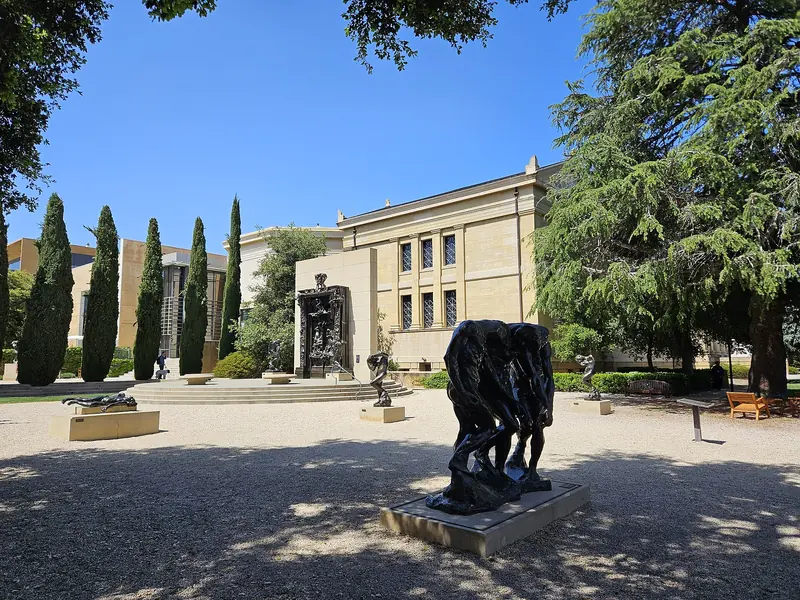
Outside, the first floor opens onto the B. Gerald Cantor Rodin Sculpture Garden. Across Museum Way, the map marks Andy Goldsworthy's Stone River in a courtyard. Our Rodin Sculpture Garden guide covers the bronzes outdoors and our page on public art on campus covers Stone River.

Second floor: Europe, America and the Americas
Upstairs is quieter and easy to skip, which is a mistake. The map places these collection areas on the second floor:
- Indigenous American art: the Carolyn Wiedemann Reller Gallery (201) and the Rehmus Family Gallery (205).
- European and American art: galleries 213 and 214.
- Ancient, medieval and early modern European art: a named section near the European galleries.
- Contemporary art: the Oshman Family Gallery (218).
- Temporary exhibitions: the Freidenrich Family Gallery (221), the Ruth Levison Halperin Gallery (211) and the Lynn Krywick Gibbons Gallery (210).
- The McMurtry Family Terrace (242): a sculpture terrace.
Gallery numbers and names come from the museum's map dated December 2024. Rooms are sometimes rehung, so check the printed map at the entrance on the day.
Long-term installations
The Cantor lists six ongoing installations and collection rotations. These are the safest bets if you visit months from now.
| Installation | On view since |
|---|---|
| Rodin: The Shock of the Modern Body | September 15, 2017 |
| In Dialogue: African Arts | September 15, 2017 |
| Richard Diebenkorn at the Cantor | September 4, 2019 |
| The Early Twentieth Century | September 1, 2021 |
| European and American Art: Late Renaissance through 1900 | January 19, 2022 |
| The Faces of Ruth Asawa | July 6, 2022 |
The Faces of Ruth Asawa
This is the room people photograph most. It shows 233 ceramic face masks that the San Francisco artist Ruth Asawa made from about 1966 to 2000. They once hung on the outside of her home in Noe Valley. The Cantor acquired them in 2020 and installed them in the Meier Family Galleria in July 2022. The installation explores Asawa's long relationship with clay, a side of her work less known than her hanging wire sculptures.
Diebenkorn and the Bay Area
Richard Diebenkorn studied at Stanford. The Cantor holds a large group of his sketchbooks. The ongoing Diebenkorn installation pairs well with the Anderson Collection next door, which focuses on postwar American painting. Our Anderson Collection guide covers that museum.
Exhibitions listed for fall 2026
The museum's exhibitions page listed these current and upcoming shows in late October 2026. Dates can change, so check before a special trip.
| Exhibition | Dates | Where |
|---|---|---|
| JANE! | July 2, 2026 to May 18, 2028 | Stanford Family Room (122) |
| Carolyn Lazard: Long Take | August 6 to December 13, 2026 | See museum |
| Archive Room: Amalia Mesa-Bains | August 6, 2026 to July 5, 2027 | Artist Archive Rooms |
| Archive Room: Irene Poon and Charles Wong | August 6, 2026 to July 5, 2027 | Artist Archive Rooms |
| In Focus: Asian American Art from the Collection | August 27, 2026 to February 22, 2027 | See museum |
| Solid Pictures: Photosculpture and the Making of Modern Likeness | September 17, 2026 to January 18, 2027 | Pigott Family Gallery (142) |
A sixth show, Modern and Contemporary American Abstraction, closed on October 26, 2026.
JANE!
The museum began as a memorial built by Jane and Leland Stanford, so a show about Jane Stanford belongs here. Curated by Patrick R. Crowley, JANE! looks at what the museum calls the "aesthetic and affective excesses" of her life and at her unsolved death in 1905. Objects include her French gowns, Astley D. M. Cooper's 1898 painting of her jewel collection, Egyptian artifacts she acquired for the museum and a container of her beauty cream recovered from the family's Palo Alto mansion, destroyed in the 1906 earthquake. Léon Bonnat's 1881 portrait of her hangs in the show. It runs until May 2028, so it will outlast most visitors' plans. Our page on Leland, Jane and Leland Jr. Stanford fills in the family story.
Solid Pictures
The museum bills this show as the first major exhibition on photosculpture, which it calls a precursor of 3D printing. The French artist and inventor François Willème came up with the process in 1859. An 1864 engraving in the show depicts a rotunda where a sitter was photographed from 24 angles. Mechanical instruments then turned those negatives into a solid portrait figure. The show includes Willème's own self-portrait, an unfinished photosculpture bust from around 1860 and a glass negative of Ulysses S. Grant posing for one. It also comes with a catalogue.
Stanford family objects and early photography
The Cantor still holds objects from the founding family and from Leland Stanford's farm. Its holdings include photographs by Eadweard Muybridge, who made his famous studies of horses in motion at the Palo Alto Stock Farm in 1878. Our page on the Stock Farm and Muybridge tells that story.

A note on covered objects
In some cases you may see a covered case. The museum says that following updated federal repatriation rules, some archaeological objects on display are covered while consultations with Native American communities continue. Gallery signs explain the reason.
A 90 minute plan
- Start in the Stanford Family Room for JANE! and the founding story.
- Walk through the Rodin galleries, then step outside to the garden.
- Return to the Meier Family Galleria for the Asawa masks.
- Head upstairs for the Indigenous American and European galleries.
- Finish at whichever temporary show is on, or walk next door to the Anderson Collection.
The museum also offers public tours and group visits through its tours page. For another free campus gallery with student and faculty shows, try the Stanford Art Gallery near the Main Quad.
Frequently asked questions
What exhibitions are at the Cantor Arts Center now?
In late October 2026 the Cantor listed JANE! (through May 18, 2028), Solid Pictures: Photosculpture and the Making of Modern Likeness (through January 18, 2027), In Focus: Asian American Art from the Collection (through February 22, 2027) and Carolyn Lazard: Long Take (through December 13, 2026). Two Archive Rooms run through July 5, 2027.
Where are the Ruth Asawa masks at Stanford?
The Faces of Ruth Asawa is a long-term installation in the Meier Family Galleria (gallery 134) on the Cantor's first floor. It shows 233 ceramic face masks Asawa made from about 1966 to 2000, which once hung on the outside of her Noe Valley home. The Cantor acquired them in 2020.
What is the JANE! exhibition at the Cantor?
JANE! is an exhibition about the life and death of Jane Stanford, in the Stanford Family Room (gallery 122) from July 2, 2026 to May 18, 2028. It includes her French gowns, a large painting of her jewels, Egyptian objects she bought for the museum and a jar of her beauty cream.
Can I search the Cantor's collection online?
Yes. The museum links to an online collection database at cantorcollection.stanford.edu. It also offers the Cantor Digital Guide and virtual tours from its visit page.
Why are some objects covered at the Cantor?
The museum says that following updated federal repatriation rules, some archaeological objects on display are covered while consultations with Native American communities continue. Signs in the galleries explain this.