On this page
Palo Alto is small. About 68,000 people live here and you can bike from the bay to the foothills in under an hour. Yet the city has produced or hosted an outsized share of the world's technology companies, from Hewlett-Packard in 1939 to the robotics and AI startups setting up in Stanford Research Park right now. This page explains why that keeps happening and where the action is today.
It is written for three kinds of readers. Founders want to know where to work, who to meet and how the local system fits together. Job seekers want to know which companies are actually here. Curious visitors want to see the places behind the headlines. Each group will find links below to deeper guides on famous tech addresses, coworking and office space and tech and startup events.
Why companies start in Palo Alto
Three ingredients sit within a few miles of each other. None of them is unique on its own. Together they create a loop that has been running for more than 80 years.
Stanford University
Stanford sits on the city's western edge. It trains engineers, scientists, designers and business students. Many of them stay. The university also licenses its research to companies. Google's search ranking method came out of a Stanford computer science project and the university licensed the patent to the young company. Faculty start companies too. Stanford Research Park says many of the startups in its newest incubator space were founded by Stanford professors.
Talent that stays
The second ingredient is a deep pool of experienced people. Engineers who helped build one company often leave to start the next. That pattern began with Frederick Terman, the Stanford engineering dean who urged students like Bill Hewlett and Dave Packard to start firms nearby instead of moving East. It continued through Fairchild Semiconductor, Xerox PARC, PayPal and Facebook. Each wave left behind people who knew how to grow a company from five employees to five thousand.
Capital next door
The third ingredient is money. Sand Hill Road starts at the edge of Stanford's campus and runs into Menlo Park, where many of the best known venture capital firms keep offices. Accel is headquartered right on University Avenue. A founder can pitch three investors in an afternoon without getting on a freeway. Our venture capital guide explains how that system works.
Stanford Research Park
In 1951 Stanford and the City of Palo Alto created the Stanford Industrial Park on university land along Page Mill Road. The idea came from Terman. Stanford could not sell its land under the terms of its founding grant, but it could lease it to technology firms and earn steady income. The city annexed about 700 acres for the park. Varian Associates moved into the first building in 1953. Hewlett-Packard followed and made 1501 Page Mill Road its headquarters in 1960.
Today the renamed Stanford Research Park holds more than 150 companies in roughly 140 buildings and about 10 million square feet of space. Past and present tenants include Xerox PARC, NeXT, Varian Medical, Lockheed Martin, SAP and Facebook during its Palo Alto years. Recent arrivals show where the money is going now:
- Tesla runs its global engineering headquarters at 3000 Hanover Street on the former Hewlett Packard Enterprise campus. Elon Musk and Governor Gavin Newsom announced it in February 2023.
- Rivian leases space in the park, including the former Varian site.
- 1X Technologies, which builds humanoid robots for the home, opened an 80,000 square foot headquarters with space for about 400 employees in summer 2025.
- General Motors leased nearly 340,000 square feet at 3411 Hillview Avenue in mid 2026, with room for up to 1,500 workers.
- Arc Institute, a nonprofit biomedical research group working with Stanford, UCSF and UC Berkeley, has been based in the park since 2023.
- Page Mill Labs at 950 Page Mill Road offers 77,300 square feet of flexible wet lab space for life science startups.
The park is not a tourist site. Buildings are private offices with badge access. You can still drive or bike along Page Mill Road, Hanover Street and Hillview Avenue to get a sense of its scale. The Marguerite shuttle connects the park with the University Avenue Caltrain station.
Major companies based in Palo Alto today
Headquarters move often in Silicon Valley, so this list sticks to what we could confirm in 2026. Always check a company's own site before you plan a visit or a job application.
| Company | Palo Alto presence | Notes |
|---|---|---|
| HP Inc. | Headquarters, 1501 Page Mill Road | The original Hewlett-Packard home base since 1960 |
| Broadcom | Headquarters on Hillview Avenue | Moved from San Jose after buying VMware in a deal valued around $69 billion |
| Tesla | Global engineering headquarters, 3000 Hanover Street | Corporate headquarters moved to Austin, Texas, in 2021 |
| SAP | Large campus in Stanford Research Park | Home to an SAP Experience Center for client visits |
| Siemens Healthineers (Varian) | Varian Medical Systems operations in the park | Siemens bought Varian Medical in 2020 |
| 1X Technologies | Headquarters in Stanford Research Park | Humanoid robotics, opened summer 2025 |
VMware and Broadcom
VMware was founded in 1998 by a group that included Stanford computer scientist Mendel Rosenblum. It grew into a large campus on Hillview Avenue. Broadcom completed its purchase of VMware in late 2023 and moved its own headquarters onto that campus. It then sold part of the property. The new owners, Harvest Properties and TPG Real Estate, have since leased a large share of it to General Motors.
Palantir
Palantir was founded in Palo Alto in 2003 and spent its first 17 years here. In 2020 it moved its headquarters to Denver, with CEO Alex Karp writing that the company's culture was drifting from Silicon Valley's. In February 2026 Palantir moved its headquarters again, to Aventura, Florida, north of Miami.
Companies that grew up here and left
Some of the most famous names passed through and moved on. Google worked out of 165 University Avenue in 1999 before outgrowing it within months. Facebook spent 2004 to 2011 in Palo Alto before moving to Menlo Park. PayPal's predecessor Confinity had its office at 165 University Avenue. The pattern is so common that locals barely notice. Our Silicon Valley history tells those stories in order.
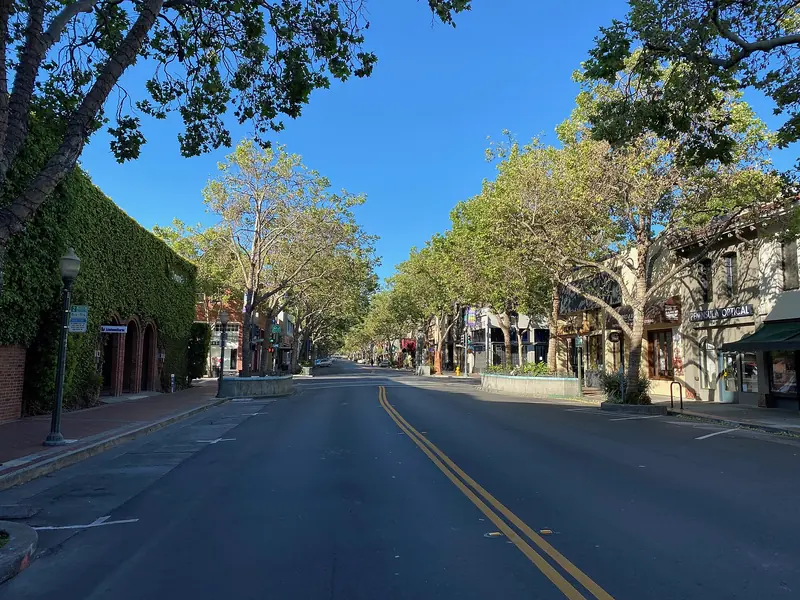

University Avenue offices
Downtown Palo Alto is where small companies go after the garage or the dorm room. The office buildings along University Avenue and its side streets are mostly two to four stories tall, with shops and restaurants on the ground floor. Leases are expensive by national standards, but the location is hard to beat. The Caltrain station is at the foot of the street, Stanford is a short bike ride away and investors can drop by between meetings.
Many startups here start in a shared or sublet space and move once they pass 30 or 40 people. Others keep a small downtown office for meetings and recruiting while engineering happens elsewhere. If you are visiting, a walk from the station up University Avenue to Emerson and Ramona Streets passes several buildings with famous former tenants.
Accelerators and Stanford programs
StartX
StartX is Stanford's nonprofit startup accelerator. Stanford alum Cameron Teitelman founded it in 2010. It takes zero equity and charges zero fees, which is unusual. Most founding teams have at least one member with Stanford ties, whether a student, alum or faculty member. Companies join from seed stage onward in fields like AI, medicine, energy and fintech. StartX is headquartered in Stanford Research Park near Page Mill Road and plans to move in early 2027 to anchor The Link, a new 10,000 square foot hub with event space and meeting rooms. It holds investor demo days three times a year.
Stanford Technology Ventures Program
The Stanford Technology Ventures Program, known as STVP, is the entrepreneurship center in Stanford's School of Engineering. It runs the Mayfield Fellows Program, a nine month work and study program started in 1996 that places a dozen students each year in early stage startups. It also hosts the Entrepreneurial Thought Leaders talks, which are open to everyone, on Wednesday afternoons during the school year and posts recordings on its eCorner site.
The d.school
The Hasso Plattner Institute of Design, known as the d.school, was founded in the mid 2000s by David Kelley, Bernard Roth and other Stanford faculty. It teaches design thinking in hands-on classes open to students from every major. Some companies began as class projects. Fellow, the coffee gear company, began in a d.school course before growing into a business that sells in 50 countries.
Other programs
Pear VC in nearby Menlo Park runs PearX, a 12 week early stage program. The Band of Angels, an angel investor group founded in 1994, screens dozens of startups each month and invites three to pitch its members. Stanford's Institute for Human-Centered Artificial Intelligence, launched in March 2019, brings AI researchers together with industry and policy makers.
Finding a job at a Palo Alto startup
There is no single job board for the city. Hiring happens through a mix of channels:
- Company career pages. Start with the firms above and with portfolio pages on investor websites, which list hundreds of funded startups.
- Referrals. Warm introductions still matter most. Former coworkers, classmates and investors are the usual path in.
- Events. Talks, hackathons and demo days are where founders recruit. See our events guide.
- Stanford connections. Students and alumni can use university career resources. StartX companies often hire from the Stanford network first.
Expect a high cost of living. Read our guide to living in Palo Alto and housing overview before you accept an offer. Many people who work here live in Mountain View, Redwood City or San Jose and ride Caltrain.
Meetups and community
Most tech meetups in the area are now listed on event platforms like Luma and Meetup rather than on a central calendar. Search for Palo Alto, Stanford or Menlo Park and filter by topic. Groups focused on AI, robotics, climate and biotech are easy to find. Stanford's public lectures are the easiest way in for newcomers because many are open to everyone.
Good to know
- Most offices in Stanford Research Park are closed to the public. Do not walk into lobbies without an invitation.
- Palo Alto requires businesses with a fixed location in the city to register within 30 days of opening. The city also collects a business tax based on square footage, with the first 10,000 square feet exempt. Details are on the City of Palo Alto business registry page.
- For a first visit, combine a walk down University Avenue with a stop at the HP Garage and a ride out to Sand Hill Road.
Tips for visiting founders
If you are flying in for a week of meetings, stay near the Palo Alto Caltrain station or along El Camino Real so you can reach downtown, Stanford and Sand Hill Road quickly. Compare hotels near Stanford early, because rates jump during Stanford events and big conferences. Book meetings in clusters by area: downtown in the morning, Sand Hill Road after lunch, Stanford Research Park late in the day. Our guides to getting here and where to stay cover airports and neighborhoods in detail.
In this section
Frequently asked questions
What big companies are headquartered in Palo Alto?
HP Inc. is headquartered at 1501 Page Mill Road. Broadcom moved its headquarters to the former VMware campus on Hillview Avenue after buying VMware. Tesla runs its global engineering headquarters on Hanover Street in Stanford Research Park even though its corporate headquarters is in Texas.
What is StartX?
StartX is a nonprofit accelerator for founders with ties to Stanford. It takes no equity and charges no fees. It is based in Stanford Research Park near Page Mill Road and plans to anchor a new hub called The Link in 2027.
Is Palantir still headquartered in Palo Alto?
No. Palantir was founded in Palo Alto in 2003 and moved its headquarters to Denver in 2020. In February 2026 it moved its headquarters again, this time to the Miami area.
What is Stanford Research Park?
It is a roughly 700 acre business park on Stanford land in Palo Alto that opened in 1951 as the Stanford Industrial Park. It now holds more than 150 companies in about 140 buildings, from Tesla and SAP to young robotics firms.
How do I find startup jobs in Palo Alto?
Most hiring happens on company career pages and through referrals. Stanford events, StartX programs and local meetups listed on event platforms are good places to meet founders. Many Palo Alto startups also list roles in San Francisco or allow hybrid work.