On this page
If you played with a synthesizer in the 1980s, or heard one on the radio, you heard an idea that came from Stanford. Frequency modulation synthesis, discovered by a Stanford composer in 1967, gave Yamaha its signature sound and earned the university one of its best known technology licenses. The research center that grew around that work, CCRMA, still sits on a hill on the west side of campus. It still gives free concerts that anyone can attend.
CCRMA is pronounced "karma." Its full name is the Center for Computer Research in Music and Acoustics. Composers, engineers, psychologists and computer scientists work there side by side. This guide covers its history, the building it lives in and how to catch a concert. For campus transit and parking, start with our Stanford visitor guide.
John Chowning and FM synthesis
John Chowning was born in Salem, New Jersey in 1934. After military service and a degree from Wittenberg University in Ohio, he studied composition in Paris with Nadia Boulanger. He came to Stanford for a doctorate in composition, which he received in 1966 after studying with Leland Smith.
In 1964, with help from Max Mathews of Bell Telephone Laboratories and David Poole of Stanford, Chowning set up a computer music program on the computer at the Stanford Artificial Intelligence Laboratory. He began research into how sound moves through space, which led to the first general algorithm for surround sound localization. While trying to understand how listeners judge distance, he found something bigger.
The discovery
In 1967 Chowning discovered the frequency modulation synthesis algorithm. FM radio uses the same basic math at frequencies far above hearing. Chowning applied it inside the range people can hear, letting one tone modulate another. The result, as his CCRMA biography puts it, was "a very simple yet elegant way of creating and controlling time-varying spectra." In plain terms, a computer could now make rich, evolving sounds like brass and bells with very little computing power. He used the technique in his own compositions, including Turenas and Stria.
The Yamaha license
Stanford patented the technique and licensed it to Yamaha. Chowning's CCRMA biography dates the license to 1973. Andrew Nelson's 2015 history of CCRMA, The Sound of Innovation, places Yamaha's signature in early 1975. Either way, Yamaha built the technique into its instruments, most famously the DX7 synthesizer of the 1980s. Chowning's CCRMA biography calls it "the most successful synthesis engine in the history of electronic musical instruments." Stanford's archives hold years of correspondence between Chowning, Yamaha and the university's licensing office, from patent disputes with other instrument makers to royalty schedules.
Later work and honors
Chowning retired in 1996 but stayed active. Since 2019 he has led an international project to recreate the acoustics of France's Chauvet Cave as they were when its prehistoric paintings were made. In January 2026 the Recording Academy gave him a Technical Grammy for FM synthesis and his pioneering compositions. The same year he became a Fellow of the Computer History Museum. Our Silicon Valley history page puts Stanford's other famous licenses in context.
The founding of CCRMA
Chowning's CCRMA biography says he founded the center in 1974 with John Grey, James (Andy) Moorer, Loren Rush and Leland Smith. Stanford's archives describe him as founding director in 1975, so you will see both years. Early funding was hard to come by. Nelson's history notes a quarter million dollar National Science Foundation award in 1975 and a five-year, $2.3 million grant from the System Development Foundation in 1982 that kept the center going.
CCRMA's work spans composition, synthesis algorithms, physical modeling of instruments, psychoacoustics, signal processing, audio coding, music information retrieval and sound for mobile devices. Its industrial supporters over the years included Yamaha, Apple, Hewlett-Packard, Xerox PARC, Sony and Fender. Our page on Xerox PARC covers one of those Palo Alto neighbors.
The center has also drawn crowds. Nelson records that a 1983 CCRMA concert featuring the saxophonist Stan Getz drew more than 2,000 people.
The Knoll
CCRMA's home is one of the odder buildings on campus. According to CCRMA's history of the building, the Knoll was built as the residence of Stanford president Ray Lyman Wilbur, who was elected in 1915. The architect, Louis Christian Mullgardt, designed a three-story Spanish Gothic fortress with wings that reach around the top of the hill at wide angles.
- 1946: The house became home to Stanford's music department.
- 1986: CCRMA moved in from the former Stanford Artificial Intelligence Laboratory.
- 1989: The Loma Prieta earthquake damaged much of the building and the third floor was declared unsafe. It stayed closed for close to 15 years.
- 2004 to 2005: A major renovation, finished in August 2005, rebuilt the Knoll for CCRMA.
The renovation added a 100-seat performance hall in one wing of the top floor, designed for contemporary music and placed to use the building's views of the bay and hills. It also created a Listening Room where speakers can surround listeners in a full sphere, recording studios, classrooms and a lobby with exhibits on the history of music technology. Because the building sits on a slope, both the first and second floors are "ground floors." Most public events happen in the Stage (room 317), the Classroom (room 217) or the Seminar Room (room 315).

Free public concerts
CCRMA's concert page describes its series as new and recent computer music by students, faculty, staff and alumni, plus regular performances by local and visiting artists working with computers, electronics, modular synthesizers and visuals. The listings mark nearly every event as free and open to the public. Many are streamed live as CCRMA LIVE and past streams are archived on Vimeo.
Fall 2026 shows the range. The season opened with Transitions on October 2 and 3, two evenings of outdoor concerts in the courtyard outside the Knoll on a 24.6-channel speaker system. September and October brought a Morton Feldman centenary concert, a Low Frequency Trio program of new works by Stanford graduate composers and guitarist Stefano Pilia. As listed on October 30, 2026, upcoming concerts are:
| Date | Concert | Where |
|---|---|---|
| Thursday, November 12, 2026, 7:30 p.m. to 9:30 p.m. | Immersive Listening: Dolby Atmos on the CCRMA Stage | CCRMA Stage and CCRMA LIVE |
| Thursday, December 3, 2026, 7:30 p.m. to 9 p.m. | Laetitia Sonami: Now | CCRMA Stage and CCRMA LIVE |
| Thursday, December 10, 2026, 7:30 p.m. to 9 p.m. | Vilbjørg Broch presents new spatial audio works | CCRMA Stage and CCRMA LIVE |
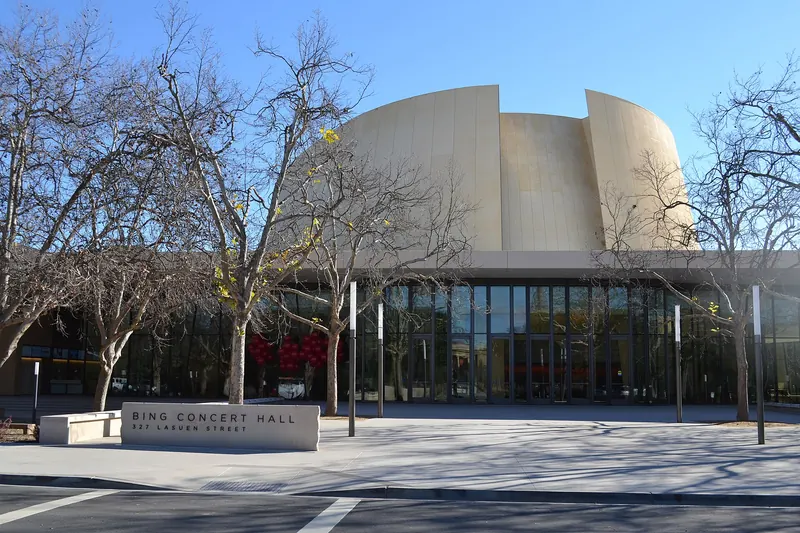
The Stanford Laptop Orchestra, known as SLOrk, is one of the best known CCRMA ensembles. Its annual spring concert, Saturday Night SLOrk, was held at Bing Concert Hall on June 6, 2026 and was free. CCRMA also runs a colloquium series, digital signal processing and hearing seminars and guest lectures, all listed on its events pages. For other local venues, see our guide to live music in Palo Alto.
Getting there and parking
The Knoll is at 660 Lomita Drive, on a rise above Florence Moore Hall and a short walk from Lake Lagunita. CCRMA's walking directions start at Tresidder Union: walk away from the union through the Tresidder parking lot, cross Mayfield Avenue and take the pathway to the left of Florence Moore Hall up the hill. At the top is Lomita Drive, with the Knoll on the left. Our guide to Tresidder Union and Old Union covers food before a show.
Driving is easy in the evening. CCRMA says the spaces in front of and behind the Knoll are zoned for Stanford C permits Monday to Friday from 6 a.m. to 4 p.m., which means parking around the building is free at all other times. The nearest visitor pay lot is at Tresidder Union off Mayfield Avenue. See our Stanford parking and transit guide for daytime visits.
Good to know
- Join CCRMA's events mailing list. It is how the center announces concerts and dates can appear with little notice.
- Outdoor shows like Transitions get cold after dark. Bring a layer.
- If you are not sure where to go inside, CCRMA suggests heading to the central second floor area or the third floor lounge, where someone can usually help.
- Cannot make it in person? Many concerts stream live on CCRMA LIVE.
Frequently asked questions
Are CCRMA concerts free?
Yes. CCRMA's concert listings mark its events as free and open to the public. Most take place at 7:30 p.m. on the CCRMA Stage in the Knoll and many are also streamed live. Concerts are announced through CCRMA's mailing list.
How do you pronounce CCRMA?
CCRMA is pronounced "karma." The first C is silent. The letters stand for the Center for Computer Research in Music and Acoustics.
What did John Chowning invent?
John Chowning discovered frequency modulation (FM) synthesis in 1967 while working on computer music at Stanford. Stanford licensed the patent to Yamaha, which turned it into what Chowning's CCRMA biography calls the most successful synthesis engine in the history of electronic instruments. He received a Technical Grammy in 2026.
Where is CCRMA at Stanford?
CCRMA is in the Knoll at 660 Lomita Drive, on a rise above Lake Lagunita and Florence Moore Hall. From Tresidder Union, cross Mayfield Avenue and take the path to the left of Florence Moore Hall up the hill.
Where do I park for a CCRMA concert?
CCRMA says the spaces in front of and behind the Knoll need a Stanford C permit only on weekdays from 6 a.m. to 4 p.m., so parking there is free at other times, including evening concerts. The nearest visitor pay lot is at Tresidder Union.