On this page
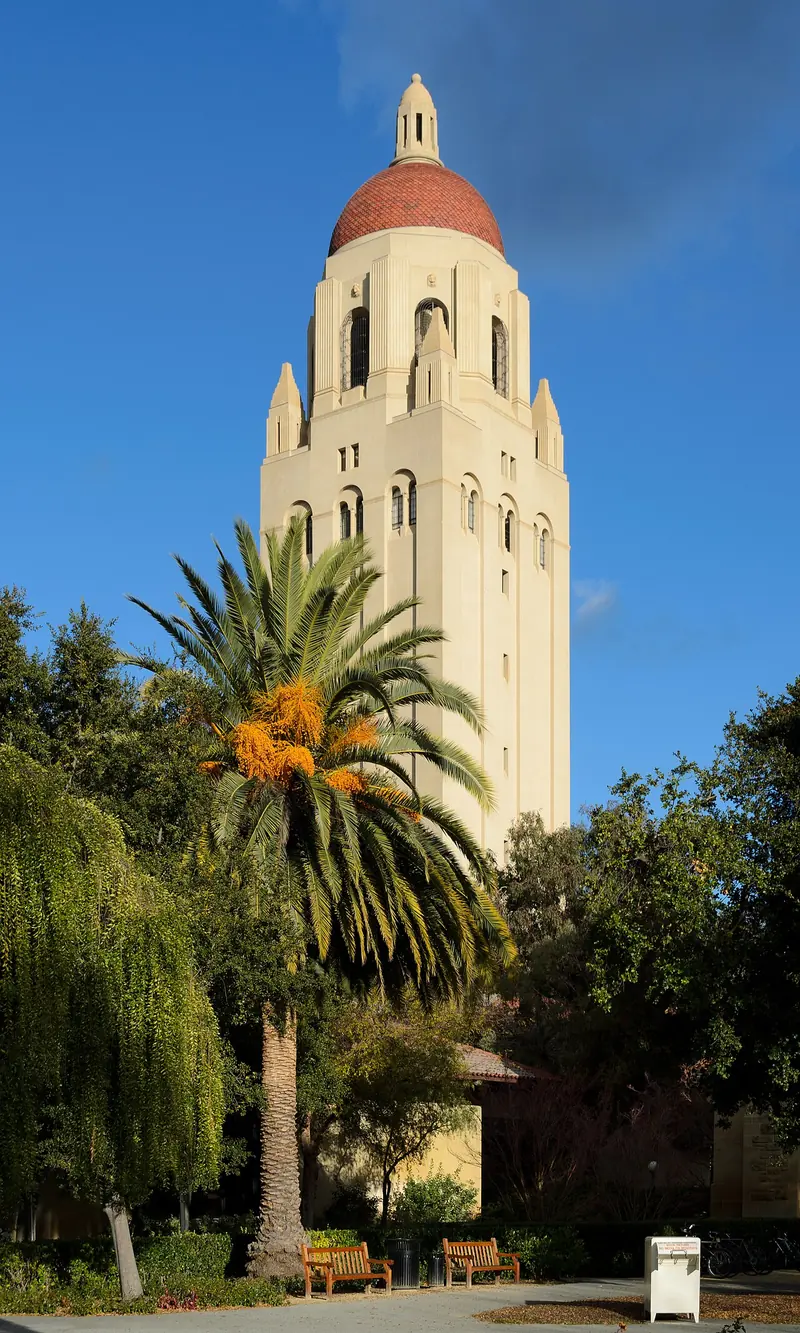
You can see Hoover Tower from almost anywhere in Palo Alto. The pale sandstone shaft with its red tile dome rises 285 feet above the Stanford campus and acts as a compass for anyone wandering the flat streets below. Most visitors know it as the place to get the best view of the Peninsula. Fewer know that it is also a working library and archive with millions of documents on war, revolution and peace.
This guide covers the tower's history, what the Hoover Institution does, how the observation deck works and when to go. One thing first: the observation deck is closed for an extended period in late 2026, so read the visiting section before you plan a trip around it.

A tower built for an archive
The story begins with Herbert Hoover, who graduated from Stanford with the Class of 1895. During the First World War he ran the Commission for Relief in Belgium, a huge effort to feed civilians in occupied territory. In 1915 his friend Ephraim D. Adams, a Stanford history professor, suggested that Hoover save the commission's records at the university.
In 1919 Hoover offered Stanford a personal check for $50,000 to collect primary materials on the Great War. President Ray Lyman Wilbur asked for clearer instructions before cashing it. Once Hoover explained what he wanted, Adams went to Europe and began gathering material. The result was the Hoover War Library.
The collection grew fast and needed a home. Hoover Tower was completed in June 1941, the year the university marked its 50th anniversary. Arthur Brown Jr., the architect of San Francisco's Coit Tower, designed it. Its form takes inspiration from the tower of the New Cathedral of Salamanca in Spain. At the dedication on June 20, 1941, Hoover said, "The purpose of this institution is to promote peace."
What the Hoover Institution does
The building houses two connected things. The first is the Hoover Institution Library and Archives, which holds more than 6,000 separate collections stored in more than 100,000 boxes. Highlights include the files of the Commission for Relief in Belgium and the American Relief Administration, records of the tsarist Okhrana secret police and papers of the economists Friedrich Hayek and Milton Friedman. The archives also hold film footage of the Russian Revolution shot by Herman Axelbank.
The second is the Hoover Institution as a public policy research center, often described as a think tank, with its own resident fellows. Its politics have drawn protests on campus at times. For the casual visitor, though, the tower is simply a place to look at exhibits and enjoy the view.
Inside, the first nine floors were built as library stacks, with mezzanines added between levels to increase capacity. The next three floors hold offices. The Russian writer Aleksandr Solzhenitsyn lived on the 11th floor at Stanford's invitation for a time in the 1970s.
Visiting the observation deck
The observation deck is the main draw. It sits about 250 feet above the ground and the public elevator labels it floor 14. A guest services representative is usually on hand to point out landmarks. Here is how it works according to the Hoover Institution's visitor page.
Closures in late 2026
- The observation deck is closed from August 14, 2026 to January 25, 2027.
- The tower is closed on weekends until January 25, 2027.
- Check the official page before you go, since dates can shift.
Tickets
- Tickets are $8 and children under 3 go free.
- Pay at the door by credit card or contactless payment. No cash is accepted.
- Stanford students, faculty, staff and alumni with a valid Stanford ID go up free and can bring one guest free.
- There are no reservations. Groups of 10 or more should email [email protected] ahead of time.
Hours and closures
The tower posts its daily hours on its website. The last elevator goes up 30 minutes before closing. It stays open on Martin Luther King Jr. Day, Presidents' Day, Memorial Day and Labor Day. It closes on other university holidays, during the campus winter closure and on Stanford home football game days. The deck also closes during carillon performances.
Accessibility and facilities
The Hoover Institution describes the tower as an ADA accessible building and an elevator serves the deck. There are no public restrooms in the tower, so plan a stop at the nearby Cantor Arts Center or a campus building before you go up.
Free exhibits on the ground floor
You do not need a ticket to see the exhibition galleries and the rotunda on the ground floor, which are free when the building is open. A Library and Archives docent in the lobby can lead a short gallery tour. The fall 2026 lineup includes Choosing Freedom: Lives That Defied Tyranny, which runs from June 17, 2026 to May 9, 2027 and presents first-hand accounts of people who fled authoritarian regimes. A second show, Hoover@100, looks back at the institution's history. These exhibits make the tower worth a short stop on a weekday even while the deck is closed.
The Lou Henry Hoover carillon
Near the top of the tower hangs a carillon named for Lou Henry Hoover, Herbert Hoover's wife. Its history is a small drama of its own. The original 35 bells were cast in Tournai, Belgium, for the Belgian Pavilion at the 1939 New York World's Fair. Belgium surrendered to Germany in May 1940 while the fair was still running. The Belgian American Educational Foundation gave the bells to Stanford, which received them in July 1940.
The bells were installed in March 1941 and first played that month. A renovation around 2001 and 2002 added new bells from the Royal Eijsbouts foundry in the Netherlands and recast several originals. The carillon now has 48 bells. The largest weighs about 2.5 tons and carries the inscription "For Peace Alone Do I Ring." If you hear it while on campus, the deck is closed for the performance, so time your visit around it.
What you see from the top
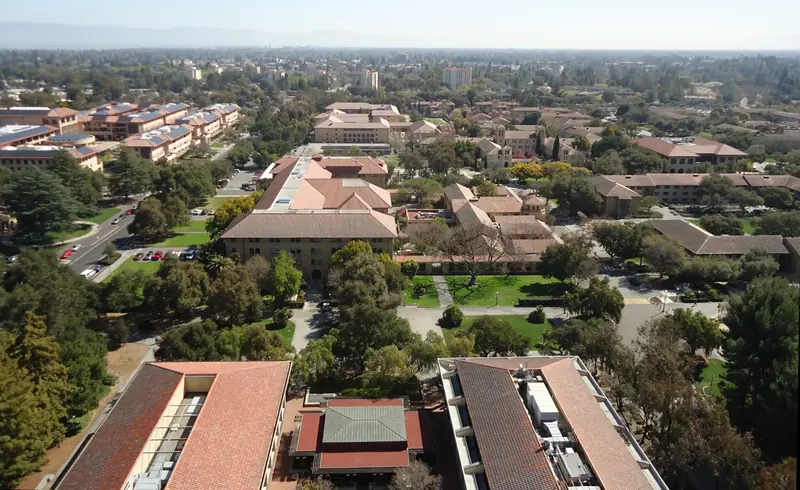
From 250 feet up the whole campus lays out like a map. Look down on the red tile roofs and sandstone arcades of the Main Quad and the gold mosaic of Memorial Church. Palm Drive runs straight toward downtown Palo Alto. Stanford Stadium sits to the northeast.
Turn west and you see the golden foothills, with the white curve of the radio antenna above the Dish trail. To the east the flat grid of Palo Alto stretches toward the bay and the marshes of the Baylands. On clear days you can pick out the San Francisco skyline far to the north. The views are sharpest on dry, breezy days after a storm.

Odd facts worth knowing
- Lightning has hit the tower's concrete ball finial more than once. In December 1970 a strike sent the 300-pound ball crashing down. Another strike in August 2020 shattered it again.
- The staff elevator stops at 21 levels because of the mezzanines between floors, while the public elevator shows the deck as floor 14.
- During World War II a first-floor room served as a radio room that monitored foreign military broadcasts.
- The library's shelving would stretch more than 25 miles if laid end to end, according to Stanford Magazine.
Tips for your visit
- Check the calendar first. Between the late 2026 deck closure, weekend closures, holidays and football days, this is the most important step. The official page is the only reliable source.
- Bring a card. The ticket desk does not take cash.
- Park once and walk. The closest visitor lots are about a 15 minute walk away. Visitor parking is paid through ParkMobile. Taking Caltrain and the free Marguerite shuttle is often easier, as our Stanford visitor guide explains.
- Go on a clear weekday. Morning fog sometimes hangs over the bay in summer. Afternoon light is often best for photos looking toward the foothills.
- Pair it with the museums. The Cantor Arts Center and the Anderson Collection are a short walk north and both are free.
Hoover Tower fits easily into a half day on campus. If you want context while you walk, a self-guided audio tour or a guided Silicon Valley tour can fill in the stories behind the buildings. For the rest of the city's sights, return to our attractions overview.
Frequently asked questions
How much does it cost to go up Hoover Tower?
The Hoover Institution lists observation deck tickets at $8, with children under 3 free. Payment is by credit card or contactless only and no cash is accepted. Stanford students, faculty, staff and alumni with a valid ID go up free with one guest.
Is the Hoover Tower observation deck open now?
The observation deck is closed from August 14, 2026 to January 25, 2027 according to the Hoover Institution. The tower is also closed on weekends until January 25, 2027. Check hoover.org before you go.
How tall is Hoover Tower?
Hoover Tower is 285 feet tall. The observation deck sits about 250 feet above the ground and is listed as floor 14 in the public elevator.
Do you need a reservation for Hoover Tower?
No. Access is first come, first served. Groups of 10 or more should email [email protected] in advance.
Why is Hoover Tower closed on football days?
The tower closes on Stanford home football game days, on most university holidays and during the campus winter closure. Crowds and traffic around the stadium make game days a poor time to visit campus anyway.