On this page
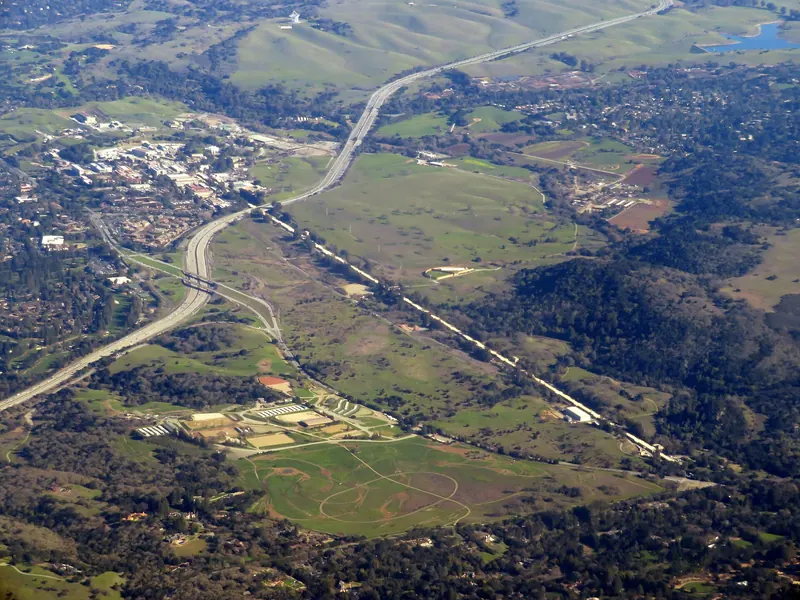
Drive west on Sand Hill Road past the venture capital offices and you pass the gate of one of the most productive physics labs in the world. SLAC National Accelerator Laboratory sits on Stanford land in the foothills, a few minutes from campus. Stanford runs it for the U.S. Department of Energy. Its best known feature is a straight accelerator about 2 miles long that you can pick out on any aerial photo of the Peninsula.
Most people in Palo Alto know SLAC only as a name on a sign. Yet the lab offers free public tours twice a month and its history touches three Nobel Prizes, the early web and the biggest digital camera ever built. This page goes deeper than our overview of research labs near Palo Alto. It covers the history, the machine, the science and the details you need to book a tour.

From Project M to a national lab
The lab opened in 1962 as the Stanford Linear Accelerator Center. Its founding director was the physicist Wolfgang Panofsky, who led it from 1961 to 1984. Stanford physicists already had a strong tradition of building electron accelerators. The new lab was designed to push electrons to far higher energies, which meant a much longer machine than the campus could hold.
The answer was a long strip of university land in the foothills west of the main campus. Construction ran through the mid 1960s and the linear accelerator, or linac, began operating in 1966. In October 2008 the Department of Energy announced a new name, SLAC National Accelerator Laboratory, which reflected work that had spread well beyond particle physics.
The lab covers about 426 acres and employs roughly 1,700 people. Its current director, John Sarrao, took over on October 2, 2023.
| Year | Milestone |
|---|---|
| 1962 | Stanford Linear Accelerator Center founded |
| 1966 | The two-mile linac begins operating |
| 1976 | Burton Richter shares the Nobel Prize in Physics |
| 1990 | Richard Taylor shares the Nobel Prize in Physics |
| 1991 | First web server outside Europe goes online in December |
| 1995 | Martin Perl shares the Nobel Prize in Physics |
| 2008 | Renamed SLAC National Accelerator Laboratory |
| 2009 | The LCLS X-ray laser first lases in April |
| 2024 | The camera for the Rubin Observatory is completed in April |
The two-mile linac
The linac is the reason SLAC looks the way it does. It is about 3.2 kilometers long. It also has to be straight. Electrons in a linear accelerator gain energy as they ride radio waves down a long copper pipe. Any bend would cost energy, so the builders laid it out as a single line from the hills toward the bay side of the site.
The beam line runs underground. Where it passes beneath Interstate 280 it is buried about 30 feet below the surface. Drivers on the freeway cross over it with no hint of the machine below. From the air, or from the photo above, the long building above the tunnel makes a clean stripe through the oak grassland.
The machine has been rebuilt and repurposed many times. For decades it fed beams into collider rings. From 1999 to 2008 it injected particles into PEP-II, a pair of storage rings about 2.2 kilometers around that hosted the BaBar experiment. Today part of the linac drives the X-ray laser described below. SLAC's tour page describes the accelerator as "nearly 2 miles long." It is the first thing the tour guides show visitors.
Three Nobel Prizes
Work at SLAC contributed to three Nobel Prizes in Physics. Each one changed the picture of what matter is made of.
- 1976, Burton Richter. Richter's team found a new particle, now called the J/psi, at SLAC's SPEAR collider in 1974. A team at Brookhaven led by Samuel Ting found it at the same time and the two men shared the prize. The particle showed that a fourth kind of quark, charm, exists.
- 1990, Richard Taylor. Taylor shared the prize with Jerome Friedman and Henry Kendall of MIT. Their experiments at SLAC fired electrons at protons and neutrons and found hard, pointlike parts inside. That was the first direct evidence for quarks.
- 1995, Martin Perl. Perl shared the prize for discovering the tau lepton, a heavy cousin of the electron, in experiments at SLAC in the mid 1970s.
Physicists sometimes call the burst of discoveries in late 1974 the "November Revolution." It turned the quark model from a useful idea into accepted physics.
What SLAC does today
Particle physics is now only part of the work. The lab's biggest draw for scientists is the Linac Coherent Light Source, or LCLS. It first lased in April 2009. It produces extremely short, bright pulses of X-rays that let researchers film chemical reactions and see the structure of proteins and new materials. LCLS-II adds a superconducting accelerator of 4 GeV along with two new X-ray laser beams. Scientists from around the world apply for time on these machines.
Other work on the site includes:
- SSRL, the Stanford Synchrotron Radiation Lightsource, a ring that began in particle physics and now serves materials science and biology.
- KIPAC, the Kavli Institute for Particle Astrophysics and Cosmology, which SLAC runs with Stanford.
- Space and sky. SLAC plays a primary role in the Fermi gamma-ray space telescope, launched in August 2008. It also built the camera for the Vera C. Rubin Observatory in Chile, described as the largest digital camera in the world. SLAC completed it in April 2024 after about two decades of work and it went into operation in 2025.
- Cryo-electron microscopy for imaging proteins and viruses.
There is also a piece of internet history. In December 1991 SLAC put the first web server outside Europe online, so a physics lab beside Sand Hill Road was among the first places in America to host a web page.
Public tours
SLAC's free on-site tours are the best way to see a working national lab near Palo Alto. The details below come from SLAC's public tours page and its registration page as checked in late October 2026.
- Watch the calendar. Tours usually run on the last two Fridays of the month. Registration usually opens at 9 a.m. on the first Friday of the month. The late October 2026 tours had a late morning slot and an early afternoon slot. Registration for November tours opens Friday, November 6, 2026, at 9 a.m.
- Register online. Sign up through Eventbrite. SLAC does not take phone calls or email requests. Each ticket must carry the correct name of the person attending.
- Check the age rule. Visitors must be 12 or older. A parent or legal guardian must register anyone from 12 to 17 and stay with them throughout.
- Bring ID and your QR code. Adults need a valid government-issued photo ID. You also show the SLAC QR code that arrives by email. The names must match.
- Dress for walking. Closed-toe shoes are required. SLAC also suggests comfortable clothes and long pants. Bags larger than 12 by 6 by 12 inches are not allowed.
- Arrive early. Tell security at the main gate you are there for a tour and park where they direct you. Meet in the Orientation Theater in Building 53, Room 1010, 15 minutes before start time.
The tour lasts about 90 minutes and uses shuttle buses between stops. Stops change with facility schedules but can include the linac, LCLS and LCLS-II, the FACET-II accelerator test facility, SSRL, KIPAC and the cryo-EM center. Photography is allowed, though tripods are not. Tours involve walking and stairs. SLAC says it can make adjustments for visitors with disabilities if you email the tours office in advance.
Good to know
- Spots go quickly. Set a reminder for the first Friday of the month.
- SLAC can cancel a tour and will tell you by email.
- Adults without photo ID are turned away at the gate, even with a ticket.
- Stay with your guide and do not touch equipment unless invited to.
School groups and the virtual tour
SLAC runs separate educational tours for school and education groups of students 12 and older. These run on Tuesdays and Wednesdays, depending on site availability, with one group per date. Teachers submit a request form at least one to two months ahead and groups must arrive by bus. Students under 18 need waivers signed by a parent or guardian.
If you cannot make a Friday, SLAC's interactive virtual tour covers the main facilities online with no registration. It is a good primer before an in-person visit too.
Getting there and making a day of it
SLAC's main entrance is at 2575 Sand Hill Road in Menlo Park, west of Interstate 280. From downtown Palo Alto it is a short drive out Sand Hill Road past Stanford Shopping Center and the venture firms. Our Sand Hill Road guide explains who works along the way. Most visitors drive. Follow SLAC's directions to the main gate rather than a map pin for the general site.
A tour pairs well with other science stops nearby. On campus, the Science and Engineering Quad shows where much of today's Stanford research happens. The Stanford Student Observatory holds public viewing nights. A short drive south, the Computer History Museum in Mountain View tells the wider story of the machines SLAC helped make possible. For background on how labs like this shaped the region, read our Silicon Valley history.
If you are coming from out of town for a tour, the hotels along Sand Hill Road and El Camino Real are closest. See staying near Stanford or compare hotels near Stanford for the Thursday night before.
Frequently asked questions
How do I book a SLAC public tour?
Register online through the Eventbrite links on SLAC's tour registration page. SLAC says registration usually opens at 9 a.m. on the first Friday of each month for tours on the last two Fridays of that month. Registration for November 2026 tours opens Friday, November 6. Phone and email requests are not accepted.
How much does a SLAC tour cost?
Nothing. SLAC's on-site public tours and its educational tours for school groups are free. The online virtual tour is free too and needs no registration.
Can children go on the SLAC tour?
Only if they are 12 or older. A parent or legal guardian must register anyone aged 12 to 17 and stay with them for the whole tour. Adults need a valid government-issued photo ID that matches the name on their SLAC QR code.
How long is the SLAC linear accelerator?
About 2 miles, or 3.2 kilometers. It began operating in 1966 and passes under Interstate 280. Today part of it powers the Linac Coherent Light Source, SLAC's X-ray laser.
Is SLAC part of Stanford?
Yes and no. Stanford operates SLAC for the U.S. Department of Energy, which makes it one of the national laboratories. It sits on Stanford land west of the main campus with a Menlo Park address.