On this page
A hackathon packs a startup's first month into a weekend. Teams form, pick a problem, build something that works and demo it to judges before the clock runs out. The Bay Area runs more of them than anywhere else, from Stanford's TreeHacks to small weekend events in company offices. Some founders met their cofounders at one. Many engineers use them to try a new tool or meet recruiters.
This guide covers the recurring student hackathons near Palo Alto, with dates only where organizers have published them. It also explains how working engineers find open hackathons. For talks, demo days and conferences, see our guide to tech and startup events.
TreeHacks at Stanford
TreeHacks is Stanford's student-run hackathon and the big one closest to Palo Alto. Its website lists the 2027 event for February 12 to 14, 2027, a Friday to Sunday, on the Stanford campus. Applications are open now.
What TreeHacks says about itself
- It is a 36 hour hackathon, in its 13th year in 2027.
- Its site lists figures of more than 1,000 hackers, 505 universities, 36 sponsors, more than $1 million in prizes and 378 projects.
- It has eight main tracks, all judged by the same panel and criteria. Recent tracks include cloud AI, edge AI, education, healthcare, inference and sustainability.
- It covers flights for accepted hackers up to regional caps, along with food and swag. It also sets aside sleeping space.
Who can hack
TreeHacks says applications are open to any enrolled college student, undergraduate or graduate, from anywhere in the world. Stanford students do not get automatic acceptance because of venue limits. Those who apply by the priority deadline receive priority consideration. If you work at a company, the way in is through sponsorship, judging or mentoring. Recruiters attend because the event draws strong engineers from hundreds of schools.
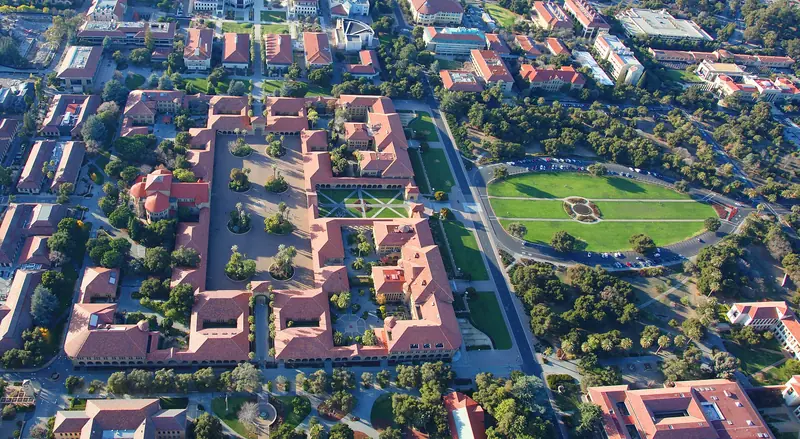
The 2026 edition ran in mid-February at the Jen-Hsun Huang Engineering Center, as our events guide describes. Visitors who want to see the campus around the event can use our Stanford visitor guide.

Cal Hacks and the Berkeley events
Cal Hacks is run by Hackathons @ Berkeley, a UC Berkeley student group that also runs the UC Berkeley AI Hackathon. Its site calls Cal Hacks the world's largest collegiate hackathon. Key points from the site:
- It is a three day hackathon with cash prizes, workshops and panels.
- The venue is the Palace of Fine Arts, 3601 Lyon Street, San Francisco.
- It is open to undergraduate and graduate students plus new graduates of less than one year from any college or university.
- For Cal Hacks 13.0, applications were due September 13 for the priority round and September 20 for the regular round.
- Only accepted and confirmed hackers are admitted. There are no walk-ins.
Cal Hacks falls in the fall term, so plan for applications in late summer. From Palo Alto, the venue is a Caltrain ride to San Francisco and then a Muni connection across the city.
SJHacks at San Jose State
SJHacks is a 24 hour in-person hackathon at San José State University. Its site lists the 2026 edition on April 25 and 26, 2026, at Guildhouse in San Jose. Tracks in 2026 focused on creative tools, including 3D and CGI pipelines, digital content creation and game development. SJHacks describes itself as open to changemakers from all backgrounds, including designers and people who do not code. Check its site in early 2027 for the next date. Our guide to San Jose covers getting there.
HackDavis
HackDavis at UC Davis focuses on building for social good. Registration for HackDavis 2026 has closed and the organizers are recruiting directors for 2027. Some prizes are limited to UC Davis teams. Davis is about two hours from Palo Alto by car, so most Peninsula students who go plan an overnight trip.
At a glance
| Hackathon | Host | Who can hack | Published dates |
|---|---|---|---|
| TreeHacks | Stanford students | Enrolled college students worldwide | February 12 to 14, 2027 |
| Cal Hacks | Hackathons @ Berkeley | College students and grads of under one year | Fall each year; 13.0 applications closed in September |
| UC Berkeley AI Hackathon | Hackathons @ Berkeley | See organizer | Check the site |
| SJHacks | San José State | Open to all backgrounds, per the site | 2026 edition April 25 and 26 |
| HackDavis | UC Davis students | Students; some prizes for UC Davis only | 2027 dates not yet posted |
Hackathons for working engineers
Most hackathons that accept people with full-time jobs are run by companies, investors and community groups. AI labs and developer tool companies host many of them to get people building on their platforms. Investors host some to meet technical founders. They are usually free, often a single day or weekend and sometimes invitation only.
Finding them takes a little routine:
- Search Luma and Devpost for Palo Alto, Stanford, Mountain View, Menlo Park and San Francisco.
- Follow the developer relations teams of the tools you use. They announce events first.
- Join local founder and engineering groups. Our guide to where founders meet lists regular gatherings.
- Check the venue and host. Read the rules on who owns what you build, especially at company-hosted events.
Employees should also check their employment agreements. California law limits what an employer can claim, but invention assignment clauses still matter. Our patents and trademarks guide explains Labor Code Section 2870.
If it is your first hackathon
Most student hackathons welcome beginners and say so on their sites. TreeHacks tells first-timers to apply even if they have never attended a hackathon. A few things make the first one easier:
- Come with an idea, but hold it loosely. Team formation sessions often produce better ideas than any one person brings.
- Learn the starter tools in advance. Set up your laptop, accounts and API keys before you arrive. Wi-Fi gets slow when a thousand people log in.
- Go to the workshops. Sponsors run short sessions on their tools. They are a fast way to learn and to meet the people judging sponsor prizes.
- Ask the mentors. Mentors are there to unblock teams. Asking for help early saves hours.
- Practice the demo. Judges see dozens of projects. A clear two minute demo that shows the product working stands out.
Accessibility needs, dietary restrictions and travel questions usually go through the organizers' email listed in each FAQ. Ask well before the event.
Tips for a good weekend
- Form a balanced team. One person on the front end, one on the back end or model and one who can talk to users and pitch.
- Scope down. A working demo of one feature beats slides about ten.
- Read the judging criteria. Many events reward use of a sponsor's tools in separate prize categories.
- Sleep a little. Teams that rest usually present better.
- Follow up. Message the judges and mentors you met within a week. Many startups began as weekend projects that someone kept working on.
If a project takes off, the next steps are a company and a first check. See our guides to accelerators and pitch competitions.
Good to know
- Student hackathons check enrollment. Bring a student ID.
- Bring chargers, an extension cord and layers. Engineering buildings get cold at night.
- Dates for 2027 events other than TreeHacks were not posted when we checked in November 2026.
Frequently asked questions
When is TreeHacks 2027?
The TreeHacks website lists February 12 to 14, 2027, on the Stanford campus. That is a Friday to Sunday. TreeHacks describes a 36 hour event in its 13th year, with eight main tracks that share the same judges and criteria. Applications are open on its site.
Who can attend TreeHacks?
TreeHacks says applications are open to any enrolled college student, undergraduate or graduate, from anywhere in the world. Stanford students are not accepted automatically because of venue limits, but those who apply by the priority deadline get priority consideration. People who are not students usually take part as sponsors, judges or mentors.
Does TreeHacks pay for travel?
TreeHacks says it covers flights for accepted hackers, subject to regional caps, along with food and swag. It also provides designated sleeping spaces. Read the travel rules on the TreeHacks site after you are accepted, since reimbursement limits depend on where you are flying from.
Are there hackathons near Palo Alto for people who are not students?
Yes, but most are run by companies, investors and community groups rather than universities. They are posted on event sites such as Luma and Devpost, often only a few weeks ahead. Search for Palo Alto, Stanford, Mountain View and San Francisco to find them.
Who can attend Cal Hacks?
Cal Hacks, run by the student group Hackathons @ Berkeley, says it is open to undergraduate and graduate students and to new graduates of less than one year from any college. It is held at the Palace of Fine Arts in San Francisco. Only accepted and confirmed hackers are admitted; there are no walk-ins.