On this page
Palo Alto's startups did not appear out of nowhere. Many trace back to big research labs a few miles away: a national particle physics lab on Sand Hill Road, a research institute in Menlo Park that helped invent the internet and a corporate lab in the hills that designed the modern personal computer. Those labs still work today. Some of them even let the public in.
This guide covers the major research labs around Palo Alto, what each is known for and how to visit when that is possible. For the companies that grew out of this work, see our Silicon Valley history.
SLAC National Accelerator Laboratory
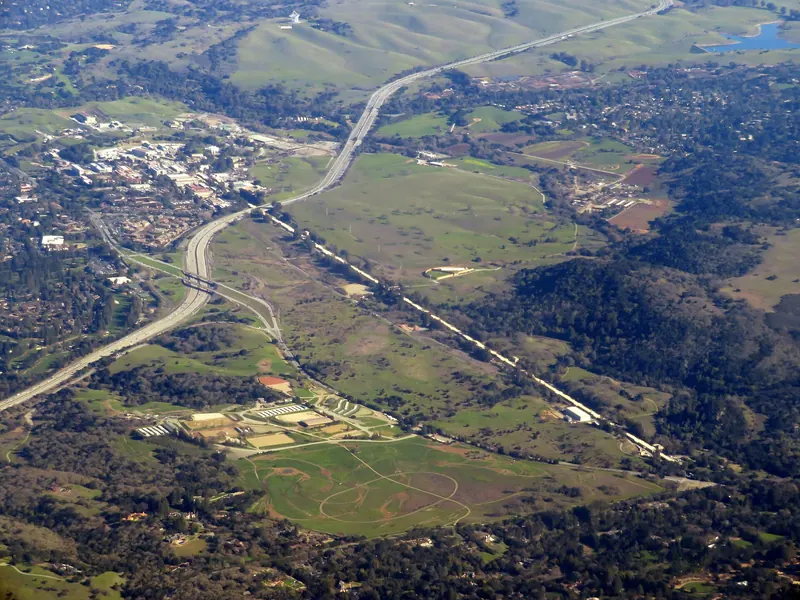
SLAC sits at 2575 Sand Hill Road in Menlo Park, just west of the main Stanford campus. Stanford operates it for the U.S. Department of Energy. It opened in 1962 as the Stanford Linear Accelerator Center. Its signature machine is a linear accelerator about two miles long, which began operating in 1966. From the air it looks like a straight line drawn across the foothills. Interstate 280 passes right over it.
What it is known for
- Nobel Prizes. Research at SLAC contributed to the Nobel Prizes in Physics in 1976 for the charm quark, in 1990 for the quark structure of protons and neutrons and in 1995 for the tau lepton.
- The first web server outside Europe. SLAC put it online in December 1991.
- X-ray lasers. Its Linac Coherent Light Source, or LCLS, first lased in April 2009. LCLS-II adds a superconducting accelerator and new X-ray beams. Scientists from around the world book time on it to study molecules, materials and chemical reactions.

Public tours
SLAC runs free public tours. According to its public tours page:
- Tours last about 90 minutes and are offered twice a month, usually on Fridays.
- Visitors must be 12 or older. Teens from 12 to 17 must be registered by a parent or guardian who stays with them.
- Registration is online only, through Eventbrite. SLAC does not take phone or email requests.
- Bring a valid government-issued photo ID. The name must match the SLAC QR code emailed to you.
- Wear closed-toe shoes. Bags larger than 12 by 6 by 12 inches are not allowed.
- Tours meet in the SLAC Orientation Theater in Building 53, 15 minutes before start time.
When we checked in late October 2026, SLAC listed tours on October 30 and said registration for November tours would open on Friday, November 6, at 9 a.m. Spots go fast, so set a reminder. Check the registration page for current dates.
SRI International
SRI International is a nonprofit research institute on a 63 acre campus at 333 Ravenswood Avenue in Menlo Park. Stanford's trustees founded it in 1946 as the Stanford Research Institute. It formally separated from Stanford in 1970, during protests over university ties to defense research. It became SRI International in 1977.
SRI's history reads like a list of computing firsts:
- The computer mouse. Bill English built the first prototype in 1964 from Douglas Engelbart's design.
- The ARPANET. In fall 1969 SRI and UCLA made the first link on the network that became the internet; the first message is usually dated October 29, 1969.
- Siri. SRI spun out Siri Inc., which Apple bought in April 2010.
- Intuitive Surgical. The surgical robot company is among SRI's spinoffs.
SRI still licenses technology and spins out companies, which makes it a useful partner for startups in AI, robotics, health and materials. Its campus is a working research site, not a visitor attraction.
PARC, now part of SRI
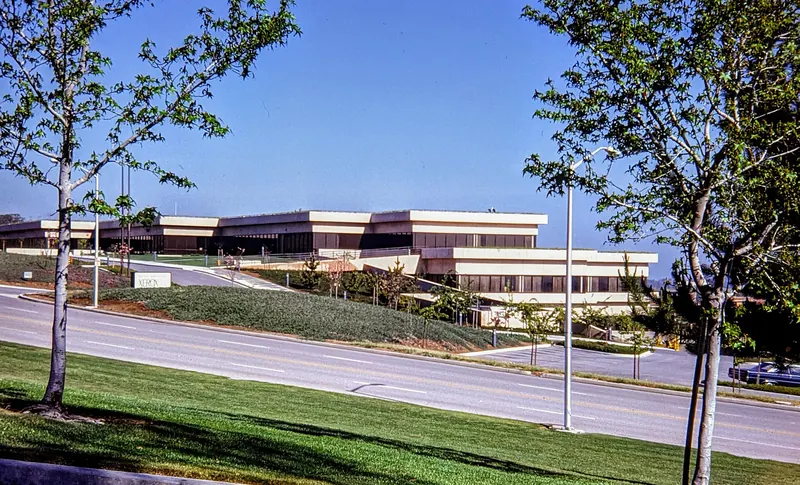
Xerox opened its Palo Alto Research Center, known as PARC, in 1970. Its long, low building at 3333 Coyote Hill Road sits in the hills of Stanford Research Park. Researchers there built the Alto personal computer, developed Ethernet and laser printing and shaped the graphical user interface. Steve Jobs's visit to PARC and the ideas Apple took from it became one of the best known stories in tech history.
In April 2023 Xerox announced it would donate PARC to SRI International. Xerox kept most of PARC's patents along with a research agreement with SRI. PARC is a working lab, so you can only see it from the road. Our Xerox PARC page tells the full story.

Labs in Stanford Research Park
Stanford Research Park was built for research. Varian Associates, the first tenant in 1953, developed microwave tubes there. Today the park holds a mix of corporate labs and nonprofits:
- Arc Institute. A nonprofit biomedical research institute working with Stanford, UCSF and UC Berkeley, based in the park since 2023.
- Lockheed Martin. Research and technology facilities that the park credits with work on the International Space Station.
- Tesla. Its global engineering headquarters at 3000 Hanover Street.
- Page Mill Labs. Shared wet labs at 950 Page Mill Road for life science startups, many founded by Stanford faculty.
- Stanford School of Medicine. The park lists it among the neighbors of The Hub on Porter Drive.
None of these labs are open to walk-in visitors.
NASA Ames Research Center
NASA's Ames Research Center sits at Moffett Field in Mountain View, about 15 minutes southeast of downtown Palo Alto along Highway 101. Its history goes back more than 80 years. From the freeway you can see the huge hangars at Moffett Field, including Hangar One.
NASA says Ames is an active research laboratory and does not host public tours. The official NASA Ames Visitor Center is in Oakland, at Chabot Space and Science Center, with spacecraft models, Mercury and Gemini spacesuits and Artemis artifacts. The Ames gift shop near Mountain View, off Highway 101, is open in person Tuesday through Saturday from 10 a.m. to 5 p.m. Check the NASA Ames visit page before you go.
How startups work with these labs
For founders, these labs are sources of people, technology and equipment.
- Licensing. Stanford's Office of Technology Licensing handles inventions from Stanford researchers. SRI and the national labs have their own licensing teams. Our Stanford entrepreneurship guide explains how OTL works.
- Hiring. Lab scientists and engineers often move to startups, especially in AI, quantum, materials and biotech.
- Shared facilities. Lab incubators such as Page Mill Labs rent equipment and bench space by the month.
- Funding. Many investors on nearby Sand Hill Road back companies built on lab research.
Planning a lab day
Good to know
- SLAC's free tours are the easiest way to see inside a major lab near Palo Alto. Book as soon as registration opens.
- Bring ID to any lab visit. Federal sites check it at the gate.
- Pair a SLAC tour with the Computer History Museum in Mountain View. Our tech events guide covers its talks.
- Prefer a guide? A Silicon Valley tour often covers Stanford and the big campuses in one day.
- Never photograph security gates or enter lab grounds without a reservation.
Frequently asked questions
Can you tour SLAC National Accelerator Laboratory?
Yes. SLAC offers free public tours of about 90 minutes, usually on Fridays and about twice a month. Visitors must be 12 or older, register online through Eventbrite, bring a government-issued photo ID and wear closed-toe shoes. Spots fill quickly, so watch for each month's registration opening.
Is SRI International part of Stanford?
Not anymore. Stanford's trustees founded it in 1946 as the Stanford Research Institute. It formally separated from the university in 1970 and took the name SRI International in 1977. It is an independent nonprofit research institute in Menlo Park.
What happened to Xerox PARC?
Xerox announced in April 2023 that it would donate PARC to SRI International. Xerox kept most of PARC's patents and a research agreement with SRI. PARC's building on Coyote Hill Road in Stanford Research Park is a working lab and is not open to visitors.
Can you visit NASA Ames Research Center?
NASA says Ames is an active research lab and does not host public tours. The NASA Ames Visitor Center is at Chabot Space and Science Center in Oakland. The Ames gift shop near Mountain View is open to the public.
What is SLAC known for?
SLAC opened in 1962 and built a two-mile linear accelerator that began operating in 1966. Research there contributed to three Nobel Prizes in Physics. It now runs the LCLS X-ray laser, which first lased in 2009. It also hosted the first web server outside Europe in 1991.