On this page
Robotics has come back to the Peninsula in a big way. Humanoid robots, warehouse arms, drones and self-driving cars are all being built within a half hour of downtown Palo Alto. The draw is the same one that pulled in software companies: Stanford's labs, engineers who can move between hardware and AI and investors who will fund expensive machines before they earn money.
This guide lists robotics companies whose own sites or legal pages show offices in Palo Alto or nearby. It also covers the research labs and investors. For AI companies without physical products, see our guide to AI startups in Palo Alto.
In Palo Alto: 1X
1X Technologies is the best known robot maker headquartered in Palo Alto. It started in Norway in 2014 as Halodi Robotics, founded by Bernt Øivind Børnich, who is still chief executive. Its main product is NEO, a two-legged humanoid robot designed for household tasks.
- In October 2025 the company opened preorders for NEO at $20,000, or $499 a month by subscription.
- In April 2026 it announced a 58,000 square foot factory in Hayward, California.
- Its website gives Palo Alto as its headquarters but no street address. It offers no public tours.
Our company profile covers its funding and history in more detail.
On the Peninsula and in the South Bay
| Company | What it builds | Address on its site |
|---|---|---|
| Toyota Research Institute | AI and robotics research for Toyota | 4440 El Camino Real, Los Altos |
| Nuro | Licensed self-driving system, the Nuro Driver | 1290 Terra Bella Avenue, Mountain View |
| Figure | General purpose humanoid robots | 3960 North First Street, San Jose |
| Skydio | Autonomous drones | 3000 Clearview Way, San Mateo |
| Dexterity | AI robots for warehouses and logistics | Redwood City |
Toyota Research Institute
Toyota Research Institute started in 2016 as a subsidiary of Toyota Motor Corporation, with an initial budget announced as $1 billion over five years. Dr. Gill Pratt leads it. Its Los Altos office on El Camino Real sits just past the Palo Alto line. It also has an office in Cambridge, Massachusetts. Its website lists robotics alongside automated driving, energy and materials and human-centered AI as research areas.
Nuro
Nuro was founded in September 2016 by Jiajun Zhu and Dave Ferguson, both from Google's self-driving project. It started with small delivery robots and moved to licensing its self-driving system to carmakers and fleets. A Series E round that closed in August 2025 was reported at $203 million and a $6 billion valuation.
Figure, Skydio and Dexterity
Figure lists its address at 3960 North First Street in San Jose in its privacy policy. It builds general purpose humanoid robots. Skydio, which builds autonomous drones, gives its headquarters as 3000 Clearview Way, San Mateo. It says its drones are assembled in the United States. Dexterity describes itself as a platform for enterprise "physical AI" and lists Redwood City as its location.

The Stanford Robotics Center
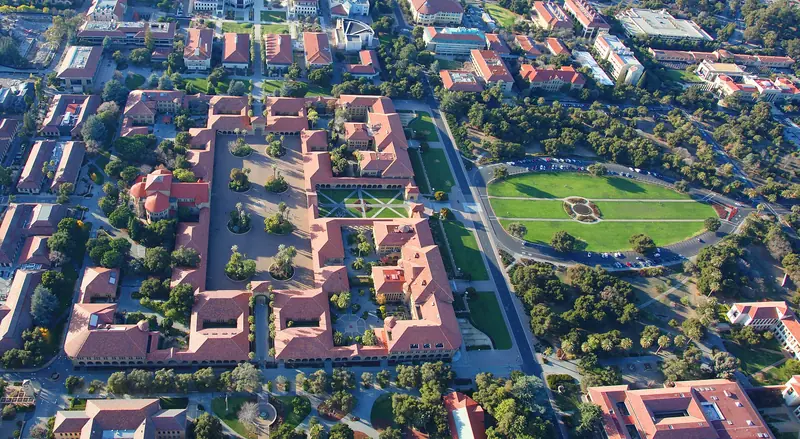
Stanford brought its robotics researchers together in 2024. According to the School of Engineering, the Stanford Robotics Center officially opened with a reception on November 1, 2024, in the renovated basement of the Packard Electrical Engineering Building. The space has research bays side by side, where teams work on surgical robots, robot arms that do household tasks and motion capture of human movement.
The center's director is Oussama Khatib, a computer science professor who came to Stanford in 1981. He is known for OceanOne, a humanoid diving robot used to explore a shipwreck. Khatib has said robotics draws on engineering, computer science, materials science, electrical engineering and AI, so the researchers needed one place to call home.
For students and founders, the center is part of a larger Stanford pipeline. Our guide to Stanford entrepreneurship programs covers licensing, StartX and student groups.
A long local history
Robotics here is not new. SRI International in Menlo Park built Shakey between about 1966 and 1972, an early mobile robot that could plan its own moves. Stanford's AI lab, founded by John McCarthy in 1963, made robotics part of AI research from the start. Our pages on SRI International and Stanford's AI history tell those stories.
Self-driving cars are the most visible modern chapter. Sebastian Thrun led Stanford's team to victory in the 2005 DARPA Grand Challenge with a robot car named Stanley. He went on to help start Google's self-driving program, which became Waymo. Today Waymo robotaxis serve Palo Alto. Our guide to robotaxis and rideshare explains how to ride one.
Working in robotics here
Robotics companies hire a wider mix of people than software startups. Mechanical and electrical engineers, firmware developers, controls engineers and machine learning researchers work side by side with technicians, test operators and supply chain managers. Many roles require being on site with the hardware, so remote work is less common than in software.
Job boards on company sites are the most reliable listings. Stanford's career fairs, including the BASES startup career fair, draw robotics startups looking for interns and new graduates. Meetups on robot learning, humanoids and autonomy are posted on Luma for Palo Alto, Menlo Park and Mountain View. Our guide to finding a tech job in Palo Alto covers the wider job market.
Investors who back robots
Hardware takes more money and time than software, so robotics founders tend to seek investors who know factories and supply chains. Several have Palo Alto offices:
- Eclipse, at 514 High Street, says it invests in the physical economy, including manufacturing, robotics, energy, defense and compute.
- Playground Global, at 380 Portage Avenue, names automation among its focus areas and invests at the earliest stages.
- DCVC, at 270 University Avenue, calls itself a deep tech firm.
Our AI investors guide covers the larger firms funding the AI models that now drive many robots.
Tips for robotics founders here
- Find space early. Robots need room to move, power and loading docks. Stanford Research Park and the industrial areas of Menlo Park, Redwood City and Mountain View are common first homes. Many companies later move manufacturing to the East Bay.
- Buy the right insurance. Product liability matters as soon as a robot leaves the lab. Our startup insurance guide explains the policies.
- Mind safety rules. Testing robots near people brings workplace safety duties under Cal/OSHA. Drones and vehicles have their own federal and state rules.
- Use non-dilutive money. Federal agencies fund robotics research through SBIR and STTR awards. See our SBIR guide.
Good to know
- None of the companies on this page offer public tours.
- Addresses come from each company's own site or legal pages, checked in November 2026. Robotics companies move often as they grow.
- Pages for 1X, Toyota Research Institute and Nuro in our company section have more detail.
Frequently asked questions
What robotics companies are in Palo Alto?
1X, the company behind the NEO home humanoid robot, gives Palo Alto as its headquarters. Toyota Research Institute is just south in Los Altos and Nuro is in Mountain View. Figure lists a San Jose address, Skydio is in San Mateo and Dexterity is in Redwood City.
Is there a robotics lab at Stanford?
Yes. The Stanford Robotics Center opened with a reception on November 1, 2024, in the basement of the Packard Electrical Engineering Building. It brings robotics researchers from several departments into one space with side-by-side research bays. Computer science professor Oussama Khatib directs it.
Can I see a robot in Palo Alto?
Most robotics companies do not offer tours. You can see autonomous vehicles on local streets, since Waymo robotaxis serve Palo Alto. SRI's Shakey robot, built in Menlo Park in the late 1960s, is a famous early example of the field's local roots.
Who invests in robotics startups near Palo Alto?
Eclipse at 514 High Street in Palo Alto says it backs the physical economy, including robotics and manufacturing. Playground Global at 380 Portage Avenue lists automation among its focus areas. DCVC on University Avenue calls itself a deep tech firm.
Where do Palo Alto robotics companies build their robots?
Usually somewhere with more space. 1X, for example, announced a 58,000 square foot factory in Hayward in April 2026, while keeping its headquarters in Palo Alto. Robotics startups often start with engineering offices near Stanford and move manufacturing to the East Bay or South Bay.