On this page
Palo Alto has a tidy, serious image: tech offices, good schools, a famous university. Look a little sideways and the town turns out to be full of odd corners. There is a pasture with donkeys in the middle of a suburb. There is a cactus garden from the 1880s hiding in a grove of trees and a scout hall built to look like a ship. A two-mile particle accelerator runs under the foothills and its operators will show you around for free.
This list collects the quirkiest sights in and right around town. Most are free and outdoors, which makes them good fillers between bigger plans. Hours come from the official pages linked from our guides to each place. For the main attractions, start with our attractions guide.
Animals and trees with stories
1. The Barron Park donkeys
Donkeys have grazed in a pasture beside Bol Park for most of the time since 1934. Volunteers with the Barron Park Donkey Project look after them. The most famous was Perry, whom DreamWorks animators watched and filmed while designing the Donkey in Shrek. He died in January 2025 at 30. Reports at the time named Buddy and April as the donkeys still in the pasture. You can see them from the Bol Park bike path. Please do not feed them. The project says sugary treats, even carrots and apples, are bad for donkeys. Our Bol Park guide explains how to visit kindly.
2. The Tree of 40 Fruit
Beside the Rodin Sculpture Garden at Stanford grows a single tree grafted to bear many kinds of stone fruit. It is a work by artist Sam Van Aken, planted in 2022 according to the Almanac. The idea is that one trunk carries peaches, plums, apricots, cherries and more on different branches. It is still young, so think of it as a slow art project rather than an orchard. Find it on the way into or out of the Cantor.
3. The Arizona Cactus Garden
Planted between 1880 and 1883 for Leland and Jane Stanford, this desert garden holds about 500 cacti and succulents in 58 beds. It sits in the Stanford Arboretum off Quarry Road, a strange sight among the oaks and eucalyptus. Entry is free. See our Arizona Cactus Garden guide.
Campus oddities
4. The Angel of Grief and the Stanford Mausoleum
A short walk from the cactus garden, a weeping marble angel lies draped over an altar. The first Angel of Grief, from 1901, was wrecked in the 1906 earthquake. The one you see is a 1908 replacement. Nearby stands the granite tomb of Leland, Jane and Leland Stanford Jr., completed in 1889 and guarded by sphinxes. The tomb is sealed, but the lawn around it is open. Our Mausoleum guide has the history.
5. The Papua New Guinea Sculpture Garden
At Santa Teresa Street and Lomita Drive, carved posts, figures and drums stand among the trees. Iatmul and Kwoma carvers from the Sepik River region made them on site in 1994. The garden is free and outdoors, with a free tour on the fourth Sunday of the month at 11:30 a.m.
6. Stone River
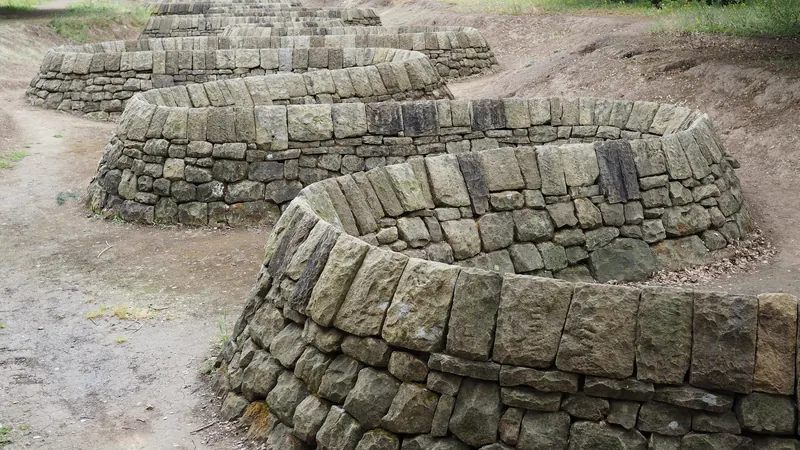
Just northeast of the Cantor Arts Center, Andy Goldsworthy's Stone River snakes through a shallow trough. The sandstone came from campus buildings damaged in earthquakes. It is easy to miss and better for it.
7. The Windhover labyrinth
The Windhover Contemplative Center at 370 Santa Teresa Street is open only to Stanford ID holders, but its outdoor labyrinth is open to everyone at any hour. Walking it slowly is a calm break between museums.

Baylands curiosities
8. The ship-shaped Sea Scout Building
At 2560 Embarcadero Road stands a 1941 Streamline Moderne building by Birge Clark, shaped like a ship, with Lucie Stern paying the bill. It was built for the Palo Alto Sea Scouts back when boats could reach the Baylands. Today it is the Environmental Volunteers EcoCenter, with free drop-in hours on Fridays and Saturdays from 10 a.m. to 1 p.m. as posted. See our Sea Scout Building guide.
9. A duck pond that was a swimming pool
Across the road, the Baylands Duck Pond began as a saltwater swimming pool in the 1930s. It became a bird sanctuary, dedicated in 1948 according to a historical marker. A flat loop of about 0.7 mile circles it. Feeding birds is banned by city code.
10. Plane watching at Palo Alto Airport
The small airport at 1925 Embarcadero Road has one runway and no airline service, which means a steady stream of small planes taking off and landing close up. The city lists terminal hours of 7 a.m. to 9 p.m. daily. Our airport guide covers parking and the best viewing spots.
Downtown surprises
11. Greg Brown's fake-window murals
In 1975 and 1976 artist Greg Brown painted a set of trompe l'oeil murals downtown that look like windows and doors with people behind them. Five of the nine survive. Look for Boy Fishing on the post office at 380 Hamilton Avenue and Woman Watering at 526 Waverley Street. Garbage Man with Venusian in Can is at 136 Hamilton Avenue. They are free to see at any hour.
12. The Mighty Wurlitzer
The Stanford Theatre at 221 University Avenue shows classic Hollywood films in a 1925 movie palace. A Mighty Wurlitzer theater organ rises to play during intermissions before and after the 7:30 p.m. show. Tickets are $7 for adults and $5 for seniors and youth, per the theater's site. See our Stanford Theatre guide.
Big science you can visit
13. A tour of SLAC
Up Sand Hill Road, SLAC National Accelerator Laboratory runs a linear accelerator about two miles long that has operated since 1966. Free public tours last about 90 minutes and are open to ages 12 and up. They usually run on the last two Fridays of the month and fill early, so register on SLAC's tour page. Our SLAC guide covers ID rules.
An offbeat day in order
Most of these sights cluster in three areas, so you can string them together without much driving:
- Morning at Stanford. Park near the Cantor on a weekend, when many central zones are free. Walk to the Tree of 40 Fruit and Stone River, then cross Palm Drive to the Arboretum for the cactus garden, the Mausoleum and the Angel of Grief.
- Late morning on Santa Teresa Street. Walk or drive to the Papua New Guinea Sculpture Garden and the Windhover labyrinth, a few minutes apart.
- Lunch downtown. Hunt for the Greg Brown murals on Hamilton Avenue and Waverley Street, then check the Stanford Theatre's schedule for the evening.
- Afternoon at the Baylands. Drive out Embarcadero Road to the Sea Scout Building on a Friday or Saturday morning, or come for the Duck Pond loop and the airport in the afternoon.
- Barron Park on another day. The donkey pasture pairs well with a walk or bike ride along the Bol Park path.
Good to know
- Do not feed the donkeys or the ducks. Both rules protect the animals.
- The Baylands spots follow preserve hours of 8 a.m. to sunset.
- The Stanford Mausoleum and Hanna House are not open inside. Hanna House tours are paused for repairs.
- For a narrated walk across campus between these stops, try a self-guided audio tour.
Frequently asked questions
Are there still donkeys in Palo Alto?
Yes. Donkeys have lived in a pasture beside Bol Park in Barron Park for most of the time since 1934, cared for by volunteers with the Barron Park Donkey Project. Perry, the best known, died in January 2025. Reports at the time named Buddy and April as the donkeys still there.
Was a Palo Alto donkey the model for Donkey in Shrek?
Yes. DreamWorks animators spent time watching, sketching and filming Perry, one of the Barron Park donkeys, while creating the Donkey character for Shrek. Perry lived beside Bol Park from 1997 until his death in early 2025.
Where is the Tree of 40 Fruit at Stanford?
It grows beside the Rodin Sculpture Garden next to the Cantor Arts Center. Artist Sam Van Aken grafts many kinds of stone fruit onto a single tree. The Almanac reported that the Stanford tree was planted in 2022.
Can you go inside the Stanford Mausoleum?
No. The tomb of Leland, Jane and Leland Stanford Jr. is sealed and visitors see it from the lawn and paths. The Angel of Grief statue nearby is a 1908 replacement for one wrecked in the 1906 earthquake. Both sit in the Stanford Arboretum and are free to visit.
Can the public tour SLAC?
Yes. SLAC National Accelerator Laboratory on Sand Hill Road runs free public tours of about 90 minutes for ages 12 and up. Tours usually run on the last two Fridays of the month and need advance registration on SLAC's website.