On this page
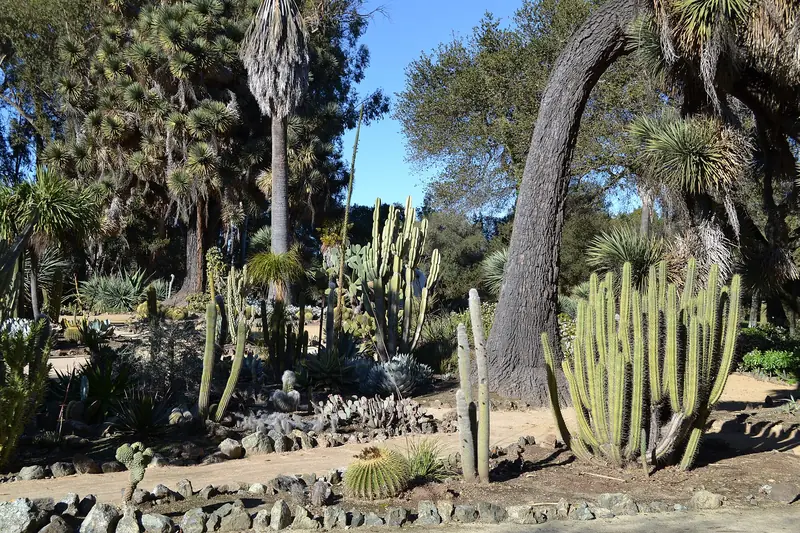
Most visitors to Stanford see the Main Quad, Hoover Tower and the museums, then leave. A short walk past the museums into the Arboretum leads to something stranger: a garden of giant agaves, towering columnar cacti, spiky yuccas and fat aloes, planted for the Stanford family more than 140 years ago. The Arizona Cactus Garden is free, rarely crowded and one of the oldest landscapes on campus.
This guide covers why the garden exists, how it nearly disappeared, what grows there today and how to find it among the trees of the Arboretum.

A garden for a mansion that was never built
In the early 1880s Leland and Jane Stanford were developing their Palo Alto estate, a horse farm where the campus now stands. They hired the landscape architect Rudolph Ulrich, who specialized in what the era called Arizona gardens. The term had nothing to do with the state. It described gardens of drought-tolerant plants suited to a dry climate, a fashionable style at the time.
Ulrich laid out the garden between 1880 and 1883. It was meant to sit beside a grand family mansion. Then, in 1884, the Stanfords' only child, Leland Stanford Jr., died of typhoid fever at age 15 while traveling in Italy. The mansion was never built. Instead, the grieving parents founded a university in their son's name on the same land and it opened in 1891.
The garden carried on. Two gardeners, Chung Wah and Ah Wah, cared for it for decades. In the university's early years it became a favorite spot for courting students, who could find privacy among the tall plants.
Decline and restoration
When Chung Wah and Ah Wah retired in 1925 and returned to China, nobody took their place. The garden slid into serious disrepair. Weeds and overgrowth covered the beds and many plants died, though the toughest specimens survived on their own.
In 1997 a group of volunteers began restoring it and the work has continued ever since. Stanford's Land, Buildings and Real Estate department now manages and maintains the garden, which the university describes as a historical garden in the process of renovation and preservation. A dedicated volunteer crew still meets once a month to weed, plant and repair beds. Anyone who wants to donate time, plants or money can reach the coordinator through Stanford's Arizona Garden page.
What grows there
The garden covers about 17,000 square feet, a little under half an acre. It holds roughly 500 cacti and succulents in 58 beds, divided into two sections by origin:
- The Eastern Hemisphere section holds aloes, jade plants and other succulents from Europe, Asia and Africa.
- The Western Hemisphere section holds cacti native to the Americas, from columnar giants to squat barrels.
Around 10 to 15 percent of the plantings are historic plants that still grow where Ulrich's crew put them. Among the species recorded in the garden are:
| Plant | What to look for |
|---|---|
| Century plant | A huge gray-green agave rosette that sends up a single tall flower stalk late in life |
| Golden barrel cactus | Round, ribbed cactus covered in yellow spines |
| Cholla | Branching cactus with jointed, very spiny stems |
| Mojave yucca and other yuccas | Stiff, sword-shaped leaves on trunks |
| Peruvian apple cactus | Tall, columnar cactus that can reach well above head height |
| Soap aloe and flat-flowered aloe | Fleshy rosettes that send up tall orange, red or yellow flower spikes |
| Boojum tree | An odd, carrot-shaped trunk from Baja California |
| Ponytail palm, aeonium and torch lily | Mixed in among the beds for texture and color |
Stanford's page also notes monstrose cacti, which grow in strange lumpy shapes and rosette-forming agaves and crassulas. The plants have not been labeled in recent years, so a phone plant identification app or the map with plant photos linked from Stanford's page will help you put names to what you see.
Finding the garden
The garden is in the Stanford Arboretum on the south side of the Stanford Family Mausoleum, off Quarry Road between Campus Drive and Arboretum Road. From the Cantor Arts Center or the Anderson Collection, it is about a 10 to 15 minute walk through the trees. From the Main Quad, allow a little longer.
The mausoleum makes a good landmark. It is a small granite temple where Leland, Jane and Leland Jr. are entombed, guarded by stone sphinxes. Nearby stands the Angel of Grief, a marble memorial sculpture. The cactus garden lies just beside them.
Good to know
- There is no admission fee and no gate. The garden is on open university land.
- Wear closed shoes. Fallen spines and cactus pads can end up near the paths.
- Stay on the paths. Many plants have sharp spines and some beds are fragile restoration areas.
- Visitor parking on campus is paid, usually through the ParkMobile app. See Stanford's visitor parking page for current rules.
When to go
The garden looks good in every season, which is the point of a desert planting. Palo Alto's dry summers suit the cacti, while winter and spring rains bring flushes of growth. Several of the aloes send up bright orange and red flower spikes in the cooler months, which makes winter an underrated time to visit. Our weather guide explains the local seasons.
Morning and late afternoon light is best for photos, when low sun picks out the spines and casts long shadows across the paths. Midday in summer can feel hot and exposed in the open beds, so bring water and a hat.
Tips for your visit
- Give it 30 minutes. The garden is compact, but the details reward a slow lap. Read the beds one by one rather than taking it in from the edge.
- Watch small children. Many plants sit at a child's eye level and the spines are sharp. Hold hands near the barrel cacti and chollas.
- Look for the old giants. The largest, most weathered agaves and cacti are often the historic survivors from the 1880s planting.
- Respect the work in progress. Bare patches or fenced beds are usually part of the ongoing restoration, so do not step into them.
- Mind the setting. The mausoleum is a family tomb. Keep voices low near it and skip climbing on the sphinxes.
- Bring a camera. The sculptural shapes and strong shadows make the garden one of the most photogenic corners of campus.
Combine it with a campus walk
The cactus garden fits easily into a half day at Stanford. A simple loop:
- Start at the Cantor Arts Center and the Rodin Sculpture Garden.
- Walk west into the Arboretum to the mausoleum and the cactus garden.
- Head back toward Palm Drive and continue to the Main Quad and Memorial Church.
- Finish at Hoover Tower for the ground floor exhibits, or for the view once the deck reopens in late January 2027.
Want a longer walk? The Dish trail in the foothills is a short drive away. Our Stanford visitor guide covers parking, the free Marguerite shuttle and the rest of the campus sights. For background as you walk, a self-guided audio tour can add the stories behind the buildings.
Frequently asked questions
Where is the Arizona Cactus Garden at Stanford?
It is in the Stanford Arboretum on the south side of the Stanford Family Mausoleum, off Quarry Road between Campus Drive and Arboretum Road. It is about a 10 to 15 minute walk from the Cantor Arts Center.
Is the Stanford cactus garden free?
Yes. The garden is on open university land and there is no admission fee. Visitor parking on campus is paid, usually through the ParkMobile app.
Why is it called the Arizona Garden?
Arizona garden was a nineteenth century term for a garden of drought-tolerant desert plants. The name describes the style, not the plants' origin. Many of the plants come from Mexico, South America and Africa.
How old is the Arizona Cactus Garden?
It was planted between 1880 and 1883 for Leland and Jane Stanford, before the university opened in 1891. Some historic plants, around 10 to 15 percent of the plantings, still grow in their original spots.
Can I volunteer at the Arizona Cactus Garden?
Yes. A volunteer group meets about once a month to work in the garden. Stanford's facilities page lists a contact for anyone who wants to donate time, plants or funds.