On this page
Walk down University Avenue after dark and one sign outshines the rest: the neon marquee of the Stanford Theatre. Behind it is a 1925 movie palace that has been restored to its first-night look and shows nothing but classic films. You can see Casablanca, Vertigo or a silent comedy on a big screen with hundreds of other people, then listen to a theater organ rise out of the orchestra pit between shows. For many locals it is the best night out in town.
The name confuses visitors. The theater is not part of Stanford University. The name simply reflects a town that grew up beside the campus. Since the late 1980s it has been run by a foundation tied to the Packard family. This guide covers its history, the restoration, what it shows, the organ and how to plan a visit.
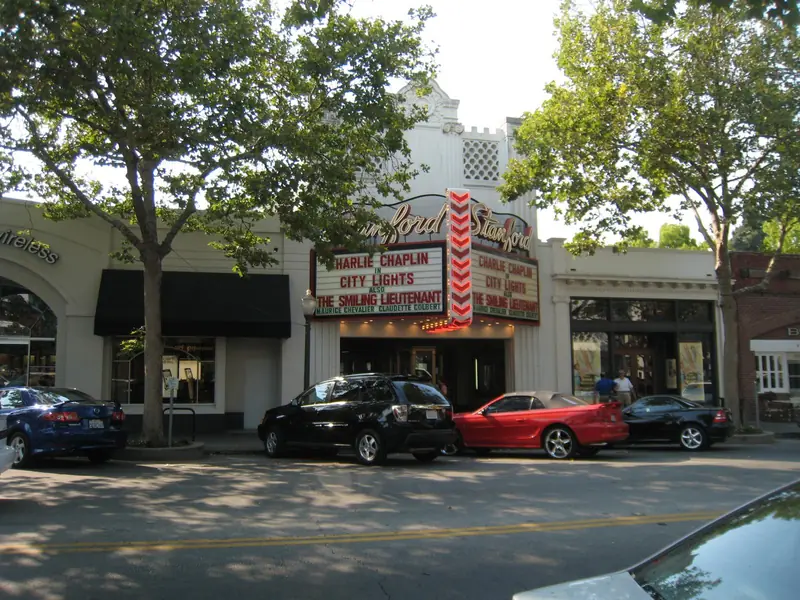

Opening night in 1925
The Stanford Theatre opened on June 9, 1925 as the New Stanford, part of the Peninsula Theatre Company chain. It cost about $300,000 to build. The architects were the San Francisco firm Weeks and Day, who gave it a neoclassical design with Persian and Moorish touches. Opening night drew about 1,400 people. The program featured Reginald Denny's comedy I'll Show You the Town, with an appearance by Denny himself and an address by the mayor.
For decades it was downtown Palo Alto's main movie house. Like many grand single-screen theaters, it struggled after television took hold. By the late 1960s attendance had dropped and the original organ had been removed. Experiments with live performance did not save it. By the early 1980s the theater was showing second-run films for 50 cents a ticket and a "For Sale" sign had gone up.
The Packard rescue
The turnaround came from an unexpected direction. In 1987, after Fred Astaire died, David Woodley Packard rented the theater to show a run of Astaire films. More than 1,000 people came each night. His father, David Packard, co-founder of Hewlett-Packard, saw the crowds and agreed to buy the building through the David and Lucile Packard Foundation. Reports put the purchase price at about $7.7 million.
The restoration ran from 1987 to 1989 and aimed to bring back the 1925 interior in detail. The team studied thousands of original sketches to match the color scheme. Workers restored the ceiling paintings 50 feet above the seats, the handmade tiles on the stairs, seven chandeliers, the stage pillars and urns and even the snack bar and ticket booth. The theater reopened in 1989 with The Wizard of Oz.
The Packard connection runs deeper than the building. David Woodley Packard also funded the preservation of old Hollywood films at the UCLA Film and Television Archive, paying to copy movies whose only surviving prints were on fragile nitrate stock. A refresh in 2017 added new carpets, repainted surfaces and reupholstered seats and the theater reopened that December with The Wizard of Oz once again. If the HP story interests you, the HP Garage where Packard and Bill Hewlett started their company is about a mile away.
What it shows
The Stanford Theatre specializes in films made from the silent era through roughly 1970. Programs come as themed seasons that run for weeks at a time. Past seasons have focused on directors such as Alfred Hitchcock and Satyajit Ray and on stars such as Bette Davis and Cary Grant. The theater is run by the Stanford Theatre Foundation, so programming follows its own long view of film history rather than new releases.
The audience is loyal. Palo Alto historians note that the 50th anniversary release of Casablanca drew more people at the Stanford than at any other theater in the country. Some counts credit the theater with as much as a quarter of all classic film attendance in the United States.
On the calendar in fall 2026
- An Eva Marie Saint series ran October 16 to 25, 2026.
- Mary Poppins and The Wizard of Oz play October 29 to November 8, 2026.
- A Christmas Eve showing of It's a Wonderful Life has long been a local tradition. Confirm this year's plans on the theater's website.
The theater marked its 100th birthday on June 9, 2025, with a silent film festival that opened by screening the same film shown on opening night a century earlier.
The Mighty Wurlitzer
The organ is half the fun. The original instrument was removed decades ago, so the restoration team assembled a replacement Mighty Wurlitzer. It took two years to find and restore the parts, which included a 1926 console from Grauman's Chinese Theatre in Hollywood and 1928 pipes from a Loew's theater. The console rises from the orchestra pit, plays and then sinks out of sight again.
According to the theater, the organ is played during the intermissions before and after the 7:30 p.m. show. Silent films are accompanied live on the Wurlitzer, most often by Dennis James, who has played silent film scores at the Stanford since 1993. Other regular organists have included David Hegarty and staff organist Jerry Nagano. Bill Taylor, who had played there since the 1989 reopening, retired in June 2023 and holds the title of organist emeritus.
Tickets and practical details
Tickets are sold at the box office on the day of the show. The visitor page does not list advance sales, so arrive early for popular titles and holiday screenings. The theater's visitor page lists these prices:
| Ticket | Listed price |
|---|---|
| Adult | $7 |
| Senior (65 and over) | $5 |
| Youth (18 and under) | $5 |
| Gift certificate, four admissions | $24 |
The box office takes cash and credit cards. Prices and policies can change, so check the theater's visitor information before you go. Off the main lobby, a small gallery displays original movie posters and other memorabilia, so arrive a few minutes early to look around.
Getting there
The theater is at 221 University Avenue in the middle of downtown Palo Alto. Two public parking garages sit within two blocks: one on Bryant Street north of University Avenue and one on High Street south of it. Our getting around guide explains downtown parking rules.
The Palo Alto Caltrain station is an easy walk, which makes the theater a realistic night out from San Francisco or San Jose. Check the last train times before the late show. Our getting to Palo Alto page covers the train in detail.
Tips for a great night
- Catch the organ. Sit down before the 7:30 p.m. show starts so you hear the Wurlitzer during the intermission.
- Choose a silent night. A silent film with live organ accompaniment is the most distinctive experience the theater offers.
- Eat first. University Avenue has dozens of restaurants within a block or two. Our food and drink guide has ideas and bakeries and desserts covers a sweet stop afterward.
- Bring the kids. Family classics like The Wizard of Oz return to the screen from time to time and the low prices make it an easy outing.
- Make a weekend of it. If you are coming from out of town, compare hotels in downtown Palo Alto or read our guide to staying downtown.
For more concerts, galleries and performances around town, see our arts and culture guide.
Frequently asked questions
What movies does the Stanford Theatre show?
The Stanford Theatre shows classic Hollywood and international films, mostly made between the silent era and the 1960s. Programs run as themed seasons built around stars, directors or genres, such as Alfred Hitchcock, Bette Davis or Cary Grant.
How much are tickets at the Stanford Theatre?
The theater's website lists adult tickets at $7 and $5 for seniors 65 and over and youth 18 and under. Tickets are sold at the box office on the day of the show. Check stanfordtheatre.org for current prices.
When is the organ played at the Stanford Theatre?
The Mighty Wurlitzer theater organ is played during the intermissions before and after the 7:30 p.m. show. Silent films are accompanied live on the organ, most often by Dennis James.
Who owns the Stanford Theatre?
The theater was bought in 1987 with support from the David and Lucile Packard Foundation and is run by the Stanford Theatre Foundation, led by David Woodley Packard. It is not part of Stanford University despite the name.
Where do you park for the Stanford Theatre?
Two public parking garages sit within two blocks, one on Bryant Street north of University Avenue and one on High Street south of it. The downtown Caltrain station is also an easy walk.