On this page
A short walk from the Cantor Arts Center, under oaks and old eucalyptus, stands a small temple of gray granite. Sphinxes guard its doors. This is the tomb of the family that founded Stanford University: Leland Stanford, Jane Stanford and the son whose death led them to build a university in his name. A few steps away a marble angel slumps over an altar with her face hidden in her arm.
The two memorials are free to see, quiet on most days and easy to add to a campus walk. Our Arboretum guide covers the trees, the walking routes and the cactus garden next door. This page goes deeper into the tomb and the angel themselves: how they were built, what happened to them in two earthquakes, the student traditions that grew up around them and how to visit respectfully.
Why the tomb is in the Arboretum
The grove west of Palm Drive was meant to be the Stanfords' backyard. Before their son died, the family planned a country mansion here and planted the cactus garden that still grows beside the tomb. Stanford Magazine notes that early plans by Frederick Law Olmsted placed the family tomb at more dramatic focal points on the estate. The final choice was this calmer spot near the planned house site.
Leland Stanford Jr. died of typhoid fever in Florence in March 1884, at 15. His parents turned their grief into the founding of the university, which opened in 1891. The mausoleum was part of that same act of mourning, completed in 1889 while the Main Quad was still rising.
How the mausoleum was built
The tomb is a classical box of granite with white marble details. Stanford Magazine puts the cost at more than $100,000 in its day. Wikipedia reports that the granite was quarried and dressed in Barre, Vermont, shipped across the country by rail and assembled on site. The marble came from Carrara, Italy. No architect is recorded. The design may have come from a monument company's catalog.
The first tomb
The present mausoleum was not Leland Jr.'s first resting place. According to Stanford Magazine, his body went first to a vault on the East Coast. In the fall of 1884 it came west to a smaller brick tomb on the family estate. That earlier tomb had a gold and purple sitting room, a fresco of two angels carrying the boy to heaven and a stained glass ceiling. The family hired a watchman and wired the building with an alarm.
Who went in first
Planning for the big tomb began after Leland Jr. died, yet his father was the first of the three to be placed in it. Senator Stanford died in June 1893. His funeral filled the grounds with floral tributes, including a topiary of his favorite horse. On June 29, 1893, five days after the burial, Leland Jr.'s lead-lined casket was moved in beside him. Jane Stanford died in 1905 and joined them. Our page on the Stanford family tells their wider story.
Guards and sphinxes
Stanford Magazine reports that after the 1893 burial Jane Stanford skipped a new electrical alarm and built a guardhouse near the front steps instead. The sphinxes have their own tale. She first commissioned Greek-style female sphinxes for the front, then found the effect "not pleasing." They were moved to the back of the tomb. The Egyptian-style figures at the doors today replaced them. Walk all the way around to compare the two pairs.
Two earthquakes and later care
The 1906 earthquake wrecked much of the young campus. A reporter who checked the tomb afterward wrote "Not a crack," as quoted by Stanford Magazine. The angel nearby was not so lucky. Our 1906 earthquake page covers the damage on campus.
The tomb has needed steady upkeep since. In the late 1990s it was cleaned, coated with an anti-graffiti sealant and fitted with zinc strips on the roof to keep lichen and fungus from taking hold. The mausoleum and the angel were both restored again around 2001. Vandalism has been a recurring problem, which is one reason to treat the site as the grave it is.
The Angel of Grief
North of the tomb, the marble angel kneels over an altar with her wings drooping and her face buried in her arm. She is a memorial to Henry Clay Lathrop, Jane Stanford's brother. The figure copies the Angel of Grief that the American sculptor William Wetmore Story carved in 1894 for his wife's grave in the Protestant Cemetery in Rome.
Stanford's first copy was put up in 1901. The 1906 earthquake destroyed it. A replacement was installed in 1908 and that is the angel you see now. Wikipedia sums it up as a 1908 copy of a 1901 copy of an 1894 original. Charles Lathrop, Jane Stanford's business manager, arranged the replacement. The Story design became one of the most copied grave monuments in the world, so travelers sometimes recognize her from cemeteries elsewhere.
Photographers love the angel in soft late afternoon light. Keep a respectful distance, do not climb the base and never pose props on the altar. Our guide to public art at Stanford lists other sculpture within walking distance.

Founders' Day, shrines and student traditions
The tomb has drawn Stanford people for more than a century. Stanford Magazine describes a yearly procession with speeches and flowers to honor the founders. Speakers have included the philosopher William James in 1906 and the novelist Wallace Stegner in 1991. In 1919 a biplane hired for the occasion had trouble on the way and its pilot looped the loop over the procession while dropping flowers. Wikipedia reports that the tomb is opened once a year for a wreath laying, usually in October around reunion weekend as part of Founders' Day activities.
Not every tribute is official. In 1996 the campus archaeologist Laura Jones found a small shrine west of the tomb with candles, incense, plaster saints and prayers written on homework. Students in a 1920s handbook were described laying flowers on the tomb every Sunday.
Halloween at the Mausoleum
The tradition most alumni remember is the Halloween party, known simply as "Maus." Stanford Magazine says it had become a fixture of the student calendar by the mid to late 1980s. Wikipedia describes it as planned by the sophomore class, called off from 2002 to 2005 and revived in 2006.
Here is what Stanford itself has documented most recently. Its events calendar listed "Mausoleum," a decorated spooky walk to the tomb on Saturday, October 29, 2022, from 7 to 10 p.m., run by the Office of Student Engagement and marked free to all Stanford students. A Stanford Report photo story described about 700 students walking a fog-filled path from Palm Drive to the crypt that night, followed by a Halloween Jam at Tresidder Union. We found no Stanford listing for a 2026 Mausoleum event. It has always been a student event, not a public one. For public Halloween options, see our Halloween in Palo Alto guide and the wider list of Stanford traditions.
Visiting rules and etiquette
There is no ticket, gate or posted schedule for the grounds. The tomb itself stays sealed. A few simple rules keep the site in good shape:
- View the tomb from the lawn and paths. Do not climb the steps, the sphinxes or the angel's base.
- Keep voices low. This is a family grave and a place people come to reflect.
- Leave flowers if you like, but take any wrapping and trash with you.
- Commercial photo shoots on campus need Stanford's written approval and visitor drones are banned.
- Visit in daylight. The grove is dim and paths under the trees are uneven after dark.
Good to know
- The closest restrooms are inside the Cantor Arts Center and the Anderson Collection during museum hours.
- Paths under the trees are partly unpaved. Wheelchair users and strollers should expect uneven ground near the tomb.
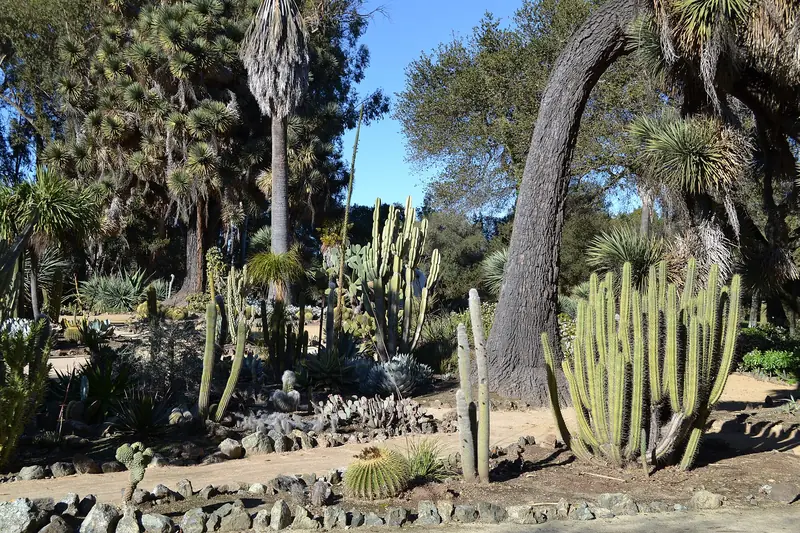
- The Arizona Cactus Garden is right next door. Closed shoes help, since spines drift onto paths.
- Check events.stanford.edu before an October visit in case a student event is scheduled.
Getting there and parking
The tomb sits west of Palm Drive near Quarry Road, north of Campus Drive. From the Cantor Arts Center it is about a 10 to 15 minute walk west through the trees. From the Palo Alto Caltrain station you can walk up Palm Drive in about 20 to 25 minutes or ride the free Marguerite shuttle on weekdays and walk in from the museum stop.
Drivers pay for visitor parking through ParkMobile in signed zones around the museums. Weekends are the easiest time to find a space. Our Stanford parking and transit guide explains the zones and payment.
What is nearby
Pair the tomb with the Arizona Cactus Garden, which takes 20 minutes to wander. Then move on to the Cantor Arts Center and its Rodin garden. The Stanford Family bronze, a group of the three Stanfords cast in 1899, stands near the tomb. If you would rather have a narrated walk, look for a self-guided Stanford audio tour that covers the Arboretum along with the Main Quad.
Frequently asked questions
Can you go inside the Stanford Mausoleum?
No. The tomb is sealed and visitors see it from the lawn and paths around it. Wikipedia reports that it is opened once a year for a wreath laying, usually in October during reunion weekend, but Stanford does not run public visits inside.
Who is buried in the Stanford Mausoleum?
Leland Stanford, Jane Lathrop Stanford and their only son, Leland Stanford Jr. The senator was the first of the three placed in the tomb in 1893. Leland Jr.'s casket was moved there from an earlier family tomb five days later.
What is the Angel of Grief at Stanford?
It is a marble memorial to Henry Clay Lathrop, Jane Stanford's brother. It copies William Wetmore Story's Angel of Grief in Rome. Stanford's first copy went up in 1901 and was wrecked in the 1906 earthquake, so the angel you see today dates from 1908.
Is the Stanford Mausoleum Halloween party open to the public?
No. It is a student tradition. Stanford's most recent calendar listing for a Mausoleum Halloween event, a decorated walk on October 29, 2022, was free to Stanford students. Stanford had not published a 2026 event when this page was updated.
Is the Stanford Mausoleum free to visit?
Yes. The Arboretum grounds around the tomb and the Angel of Grief are open and free. You only pay for parking if you drive, through Stanford's ParkMobile visitor zones.