On this page
Palo Alto's historic places come with a confusing mix of labels. A plaque might say California Historical Landmark, National Register of Historic Places or Point of Historical Interest. A house might be on the city's own Historic Inventory without any plaque at all. Each list has different rules and different protections.
This guide sorts it out. It explains each registry, lists Palo Alto's state landmarks and National Register entries with their numbers and dates and points out which places you can visit. Registry data comes from the California Office of Historic Preservation, the National Park Service listings summarized by Wikipedia and the City of Palo Alto. Addresses are given only as the registries publish them.
How the registries work
- California Historical Landmarks are numbered sites of statewide significance. They are registered through the state Office of Historic Preservation. Most have a bronze state plaque.
- California Points of Historical Interest are sites of local or county significance registered with the state. They have letter and number codes such as P327.
- The National Register of Historic Places is the federal list kept by the National Park Service. Each entry has a reference number. National Register properties are automatically listed on the California Register of Historical Resources.
- The Palo Alto Historic Inventory is the city's own list, "originally adopted in 1979" according to the city. The City Council designates properties on the advice of the Historic Resources Board.
The city's inventory sorts buildings into four categories. Category 1 is an "Exceptional Building" of national or state importance. Category 2 is a "Major Building" of regional importance. Categories 3 and 4 are "Contributing Buildings," good local examples that fit their neighborhood. The inventory also covers two locally designated districts, Professorville and Ramona Street. By the city's count, Palo Alto has at least 16 individually listed National Register properties and 4 National Register historic districts. Check the city's historic registers page for the current property list, since nominations continue.
California Historical Landmarks
These are the state landmarks in and right next to Palo Alto, in number order.
| No. | Name | Location as listed | Notes |
|---|---|---|---|
| 2 | Portolá Journey's End | E. Creek Dr. and Alma St., Menlo Park | Registered June 1, 1932. Marks the 1769 camp by El Palo Alto. |
| 524 | Site of Juana Briones de Miranda Home | Old Adobe Rd., Palo Alto | Plaque placed March 12, 2007. The house was demolished in 2011. |
| 834 | Eadweard Muybridge and the development of motion pictures | Campus Dr. West, Stanford | Plaque placed April 30, 1983. |
| 836 | Pioneer Electronics Research Laboratory | SE corner of Channing Ave. and Emerson St. | Registered 1969. Federal Telegraph and Lee de Forest. |
| 857 | John Adams Squire House | 900 University Ave. | Built 1904. National Register 1972. |
| 895 | Hostess House | 27 University Ave. | Julia Morgan, 1918. Plaque placed November 11, 1976. |
| 913 | Lou Henry Hoover House | 623 Mirada Rd., Stanford | National Register 1978. |
| 969 | Sarah Wallis Mayfield Farm | La Selva Dr., Palo Alto | Plaque dedicated October 11, 1986. |
| 976 | Birthplace of Silicon Valley (HP Garage) | 367 Addison Ave. | Registered 1987, dedicated 1989. |
| 1000 | Site of the first commercially practicable integrated circuit | 844 E. Charleston Rd. | Fairchild Semiconductor, 1959. |
Published street numbers for two of these differ between sources. Landmark No. 524 appears as both 4155 and 4157 Old Adobe Road. Landmark No. 969 appears as both 3880 and 3899 La Selva Drive. We give street names only.
State landmark highlights
El Palo Alto and the Portolá camp
The city's namesake redwood is a state Point of Historical Interest, code P327, registered March 15, 1974. The camp it marked is Landmark No. 2, one of the first numbered landmarks in California. Its plaque stands on the Menlo Park bank. A second plaque there says Father Palóu put up a cross at the site in 1774. Visit the tree in El Palo Alto Park at Alma Street and Palo Alto Avenue. Our El Palo Alto page has the details.
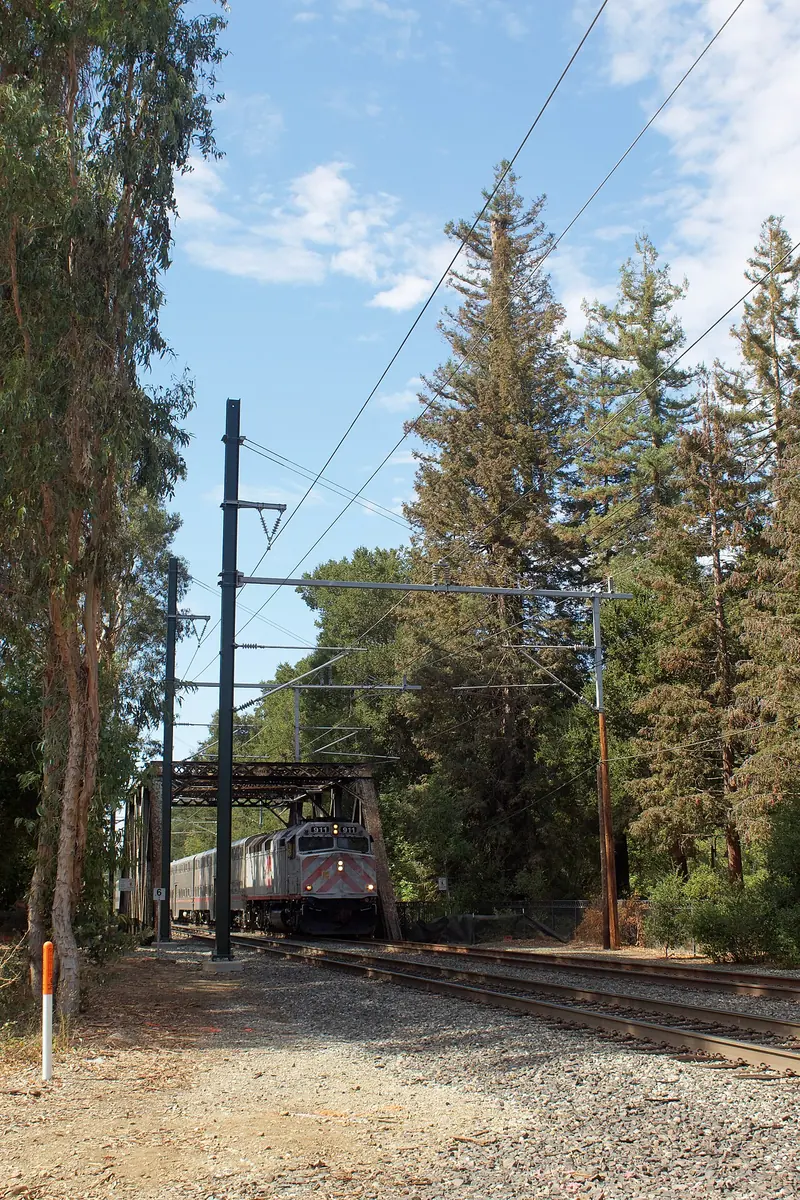

The Hostess House
Julia Morgan, the architect of Hearst Castle, designed this building in 1918. It served Camp Fremont, the World War I Army training camp in Menlo Park, as a place where soldiers could meet visiting families. Sources disagree on whether it was built for the YWCA, as the building's history says, or the YMCA, as the state plaque says. After the war it was moved to Palo Alto and became, in the plaque's words, the nation's first municipally sponsored community center. It was dedicated in 1919 to those who died in the war. The plaque calls it the only remaining structure from California's World War I training camps. From 1981 it housed the MacArthur Park restaurant. Check current listings before planning a meal there.
The Squire House
The John Adams Squire House at 900 University Avenue is a 1904 Classical Revival mansion designed by T. Paterson Ross and built by George W. Mosher. The state calls it a notable example of California's interpretation of the Greco-Roman Classic Revival movement. It joined the National Register on March 6, 1972, under the name John Adam Squire House. It later became Landmark No. 857. It is a private home. View it from the sidewalk in Crescent Park.
Tech landmarks
Palo Alto has three state landmarks tied to electronics. No. 836 marks the Federal Telegraph lab where Lee de Forest developed the vacuum tube amplifier and oscillator between 1911 and 1913. No. 976 is the HP Garage, which also joined the National Register on April 20, 2007. No. 1000 marks Fairchild Semiconductor, where Robert Noyce conceived the practical integrated circuit. The full story is on our Shockley and Fairchild page.
Stanford's landmarks
Landmark No. 834 honors Muybridge's 1878 and 1879 photographs on the Palo Alto Stock Farm. Landmark No. 913 is the Lou Henry Hoover House, the home Lou Henry and Herbert Hoover built on campus. It now serves as the residence of Stanford's president and is not open for casual visits.
National Register listings
The National Register includes four historic districts and many individual buildings in Palo Alto. Dates and reference numbers below come from the National Park Service records as summarized by Wikipedia.
| Listing | Address as listed | Listed | Ref. no. |
|---|---|---|---|
| Professorville Historic District | Roughly Embarcadero Rd., Addison Ave., Emerson and Cowper Sts. | Oct. 3, 1980 | 80000861 |
| Ramona Street Architectural District | 518 to 581 Ramona St. and 255 to 267 Hamilton Ave. | Mar. 27, 1986 | 86000592 |
| Greenmeadow | Nelson Dr., El Capitan Pl., Adobe Pl., Creekside Dr. | July 28, 2005 | 04000862 |
| Green Gables | Channing Ave., Ivy Ln., Greer Rd., Wildwood Ln. | July 28, 2005 | 04000863 |
| Hostess House | University Ave. at El Camino Real | July 30, 1976 | 76000528 |
| Palo Alto Southern Pacific Railroad Depot | 95 University Ave. | Apr. 18, 1996 | 96000425 |
| U.S. Post Office | 380 Hamilton Ave. | Apr. 5, 1981 | 81000175 |
| Palo Alto Medical Clinic | 300 Homer Ave. | June 21, 2010 | 10000357 |
| Woman's Club of Palo Alto | 475 Homer Ave. | Jan. 7, 2015 | 14001114 |
| Dunker House | 420 Maple St. | Feb. 19, 1982 | 82002264 |
| Theodore Zschokke Cottages | 617 and 621 High St. | May 26, 2020 | 100005218 |
| Palo Alto Stock Farm Horse Barn | Fremont Rd., Stanford | Dec. 12, 1985 | 85003325 |
| Hanna-Honeycomb House | 737 Frenchman's Rd., Stanford | Nov. 7, 1978 | 78000780 |
Other individual listings include the T. B. Downing House (706 Cowper St., 1973), the Pedro de Lemos House (100 to 110 Waverley Oaks, 1980), the Norris House (1247 Cowper St., 1980), the Pettigrew House (Cowper St., 1980), the Wilson House (860 University, 1980), the Kee House (2310 Yale St., 1985), the Fraternal Hall Building (140 University Ave. and 514 High St., 1990) and the Theophilus Allen House (601 Melville Ave., 1999). A 2019 listing for an archaeological site at the Veterans Affairs hospital has a restricted address, as is standard for archaeological sites.
The historic districts
Professorville covers 34.4 acres of shingled and Colonial Revival houses built for Stanford's early faculty from the 1890s on. See our Professorville guide.
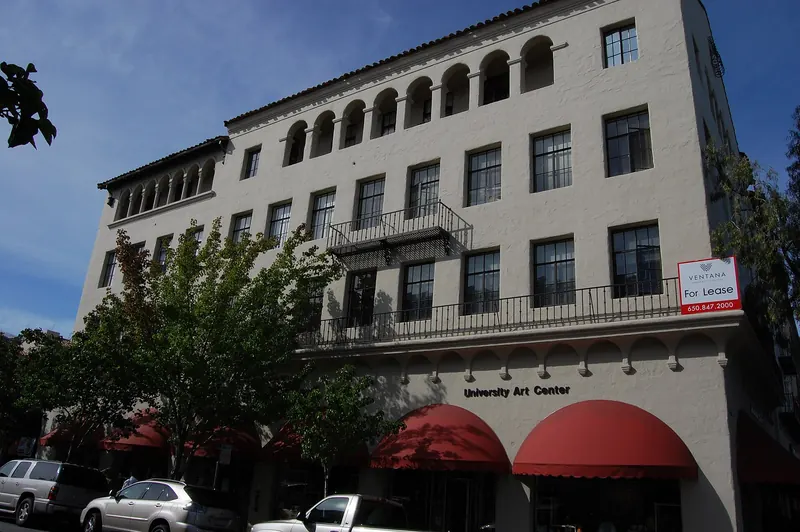

The Ramona Street Architectural District is the 500 block of Ramona Street between University and Hamilton avenues, built mostly in the 1920s and 1930s in the Spanish Colonial style by Birge Clark and Pedro de Lemos. The Cardinal Hotel is part of it. Our architecture guide covers the buildings one by one.
Greenmeadow is a 1954 and 1955 Eichler tract of 243 homes designed by A. Quincy Jones and Frederick Emmons, with a community center and pool. Green Gables, also an Eichler tract, was listed the same day. Read more on our Greenmeadow page.
Local landmarks without a plaque
Some of the city's most loved buildings are known locally rather than through state or federal registries. The Lucie Stern Community Center at 1305 Middlefield Road, built in the 1930s with Lucie Stern's support to Birge Clark's design, holds the Lucie Stern Theatre. The Children's Library at 1276 Harriet Street opened in 1940 as another Stern gift and the city calls it the oldest freestanding children's library in the country. Our theater guide covers shows at the Lucie Stern.
The state also lists two more Points of Historical Interest in Palo Alto: "First Community Center and Palo Alto City Flag Pole" (P161, November 3, 1969) and "Old Palo Alto Fire Department, Senior Citizens Center" (P508, July 28, 1977).
The 1932 Palo Alto Medical Clinic, now called the Roth Building, is set to become the Palo Alto History Museum. Its opening, planned for February 2026, was postponed in January 2026 after water leaks were found. Check the museum's website for news.
A landmark walk
You can see a dozen listed places in a two to three hour walk from the Palo Alto Caltrain station:
- The 1941 depot at 95 University Avenue, then El Palo Alto at Alma Street and Palo Alto Avenue.
- The Hostess House near University Avenue and El Camino Real.
- The Ramona Street district and the post office at 380 Hamilton Avenue.
- The Roth Building and Woman's Club on Homer Avenue.
- The Channing and Emerson plaque, then Professorville and the HP Garage.
- Finish at the Squire House at 900 University Avenue.
Prefer company? A guided Silicon Valley walking tour covers the tech sites. For dates in order, use our Palo Alto timeline.
Frequently asked questions
How many California Historical Landmarks are in Palo Alto?
Seven state landmarks sit inside Palo Alto city limits: Nos. 524, 836, 857, 895, 969, 976 and 1000. Two more, Nos. 834 and 913, are on the Stanford campus. No. 2, Portolá Journey's End, is just across San Francisquito Creek in Menlo Park.
Is El Palo Alto a California Historical Landmark?
The tree itself is a California Point of Historical Interest, registered on March 15, 1974. The nearby Portolá camp site is California Historical Landmark No. 2, registered on June 1, 1932, with its plaque on the Menlo Park side of the creek.
What is the Hostess House in Palo Alto?
The Hostess House is a 1918 Julia Morgan building first used at Camp Fremont during World War I. After the war it was moved to Palo Alto and became the nation's first municipally sponsored community center. It is California Historical Landmark No. 895 and on the National Register. A restaurant used it from 1981.
What does a Category 1 or 2 building mean in Palo Alto?
These are categories in the city's Historic Inventory, adopted in 1979. Category 1 is an exceptional building of national or state importance. Category 2 is a major building of regional importance. Categories 3 and 4 are contributing buildings that are good local examples of a style.
Can I go inside Palo Alto's historic landmarks?
Some, yes. The Lucie Stern Theatre, the downtown post office and the Palo Alto Caltrain depot are public buildings. Many others, including the HP Garage and the Squire House, are private and can only be seen from the sidewalk.