On this page
University Avenue is short. From the Caltrain station to Webster Street it takes about 15 minutes to walk. Yet few main streets in America have changed character as many times. It began as a dirt road in a town where alcohol was banned. It became a Spanish Revival shopping street, a Depression-era civic showpiece, a battleground in the counterculture years and finally the place where some of the biggest technology companies in the world rented their first offices.
This page follows the street era by era. Many of the buildings mentioned are listed landmarks, covered in detail on our historic landmarks page. For a visitor's view of the street today, see our downtown guide.
1887 to 1905: a street to the university
In 1887 Timothy Hopkins laid out University Park on land north of the Stanford campus. University Avenue was its spine. It ran from the railroad toward the bay, while across the tracks the same line led straight to the university's front door. The deeds banned the making or selling of alcohol. Cross streets such as Emerson, Bryant and Waverley are widely assumed to honor writers (Waverley is the title of a Walter Scott novel), but no record documents who chose the names. Our street names page has more on the downtown names. The story of the town's birth is on our founding of Palo Alto page.
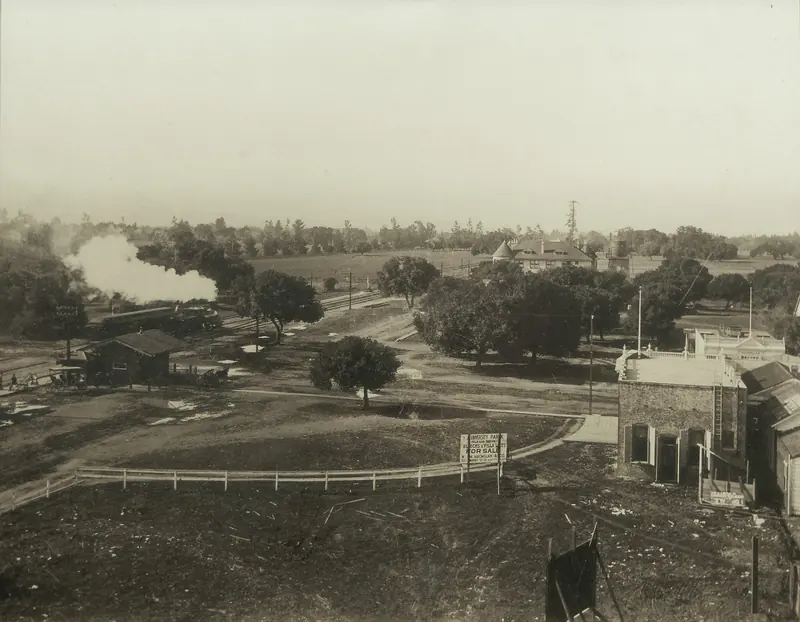
The first station was a simple shelter built for an auction of town lots. A larger depot with arches replaced it on the Stanford side of the tracks. Lumber dealer J. F. Parkinson brought the first load of lumber to his yard in March 1892, the year University Park took the name Palo Alto. Early photographs show a wide dirt road lined with wooden storefronts and young street trees. An open space near the station, known simply as the Circle, served as a public gathering place. In 1906 the town's earthquake relief committee met there.

1906: the street falls down
By 1906 merchants had started building in brick. The earthquake of April 18 punished them for it. F. C. Thiele's new $30,000 store collapsed. The Simkins Building lost its ground-floor walls and leaned about three feet. At 140 University Avenue, Fraternal Hall lost its cornice and part of its second-story wall, which fell onto a bicycle shop. Fraternal Hall survived and joined the National Register in 1990. Most merchants reopened within two weeks. Our 1906 earthquake page has the full account.
The rebuilt street soon gained civic touches. From 1911 to 1925 an electric arch lit up University Avenue. In 1917 Woolworth's opened its first Palo Alto store at 222 University Avenue with an orchestra playing at the preview.
The 1920s: stucco and tile
Most of the older buildings you see today date from a burst of building in the 1920s. Two projects set the tone.
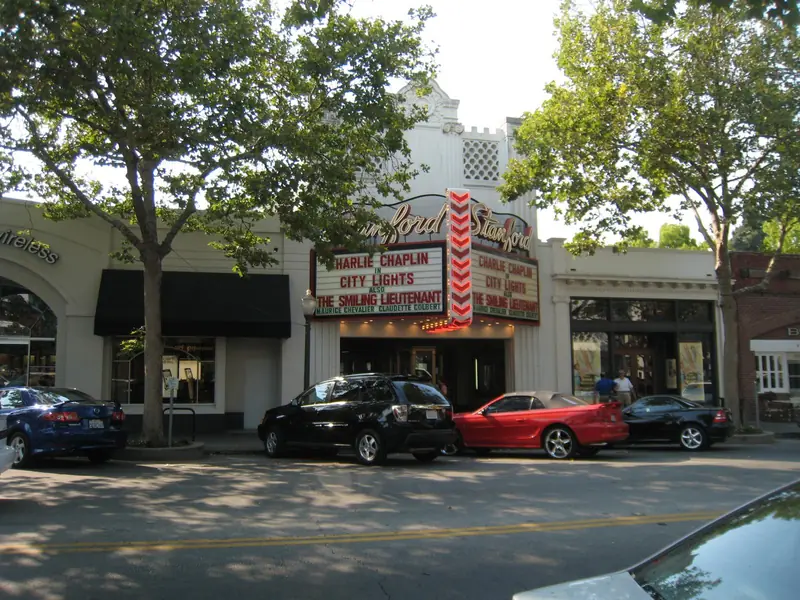
- The Stanford Theatre, 221 University Avenue. Opened in 1925 to designs by Weeks and Day, with Persian and Moorish details inside. See our Stanford Theatre guide.
- Birge Clark's storefronts. The local architect designed buildings at 125 and 323 University in 1925, then much of the 400 block in 1926 and 1927. His six-story Hotel President at 480 to 498 University opened in 1929 with 125 rooms and a roof garden. Our Birge Clark page lists them all.
The look was Spanish Colonial Revival: white stucco, red tile roofs, arches and wrought iron. It spread from University Avenue to Ramona Street and Hamilton Avenue and gave downtown the unified character it still has.

1941: a new gateway
For years the Palo Alto Times had complained about the old station. In 1934 editor Dallas E. Wood attacked its "antiquity" and "architectural unloveliness." Southern Pacific finally built a new one. Architect John H. Christie designed a Streamline Moderne depot inspired by the railroad's sleek Daylight trains, along with an underpass that carried University Avenue beneath the tracks. The depot opened in January 1941. On March 8, 1941, a parade of 2,000 people and 400 horses, led by a 40-by-75-foot flag, marched down University Avenue to dedicate it. Photos of that day show the giant rooftop sign of the Hotel President. The depot joined the National Register in 1996. Our Caltrain guide covers using it today.
The war years
World War II changed the street's traffic. Tires were rationed so strictly that the whole city was allowed just 18 car tires in February 1942. Bicycles returned and bike racks overflowed along University Avenue. When word of Japan's surrender spread on the afternoon of August 14, 1945, the street filled with people. Young people waved flags pulled from J. C. Penney's and the Hotel President and the Stanford Band marched down University Avenue to play "The Star-Spangled Banner" at the Stanford Theatre.
1949 to 1985: competition and protest
In 1949 Woolworth's moved into a new store at 352 University Avenue with air conditioning, fluorescent lights and a lunch counter. Its frontage was the longest on the street and it anchored downtown shopping for about four decades.
The car era brought trouble. Stanford Shopping Center opened across El Camino Real in 1955 and motels along El Camino drew travelers away from downtown hotels. Downtown merchants and city leaders worried about decline. A brief experiment with one-way traffic on University Avenue and new sign rules hurt business at the Hotel President, which became apartments in 1968.
Lytton Plaza
In 1964 banker Bart Lytton built an 8,500-square-foot plaza at University Avenue and Emerson Street, on the site of the old American Trust Company bank, across from his savings bank. Because it was private and unfenced, it fell outside park rules. From 1968 it became the stage for the Midpeninsula Free University, rock concerts and radical groups. On July 11, 1970, police arrested 263 people when music ran past an 11 p.m. limit. In August 1971 rioters broke more than $24,000 worth of windows along University Avenue. Things began to calm down in 1972. The city later bought the plaza. See our 1960s page for the wider story.
The dry era ended in the same years. A judge ruled the old Hopkins liquor clauses unenforceable in 1970 and downtown marked its first legal public drink in May 1971.
The late 1980s: decline and rebirth
The University Avenue Woolworth's made its last sale in 1989. That same year the Stanford Theatre reopened after the David and Lucile Packard Foundation bought and restored it. A new luxury hotel, the Garden Court, opened in 1985 next to the faded President apartments. It is now el Prado. In 1988 Saeed Amidi's family bought the office building at 165 University Avenue and began renting to young companies.
The dot-com era and after
From the 1990s University Avenue became startup territory. Second-floor offices, the train at the foot of the street and Stanford a bike ride away made it ideal for small teams.
- 165 University Avenue. Google moved in in February 1999 with a handful of employees. Confinity, the startup that built PayPal, also worked here. Locals call it the lucky building.
- Emerson Street and Hamilton Avenue. Facebook's first real office was at 471 Emerson Street from 2005 to 2006. Palantir later spread across Hamilton Avenue.
- 500 University Avenue. Accel's headquarters, a short walk from the station.
Our University Avenue tech history tells this chapter in full and our famous addresses guide maps it. In 2023 the Hotel President reopened as the Graduate by Hilton Palo Alto, bringing guests back to Clark's building after 55 years.
A walk through the eras
| Address | Era | What to look for |
|---|---|---|
| 95 University Ave. | 1941 | Streamline Moderne depot, National Register |
| 140 University Ave. | Pre-1906 | Fraternal Hall, damaged in 1906 |
| 165 University Ave. | 1990s | The lucky building |
| 221 University Ave. | 1925 | Stanford Theatre marquee |
| 323 University Ave. | 1925 | Birge Clark storefront |
| 352 University Ave. | 1949 | Former Woolworth's, 1949 to 1989 |
| University Ave. at Emerson St. | 1964 | Lytton Plaza |
| 480 to 498 University Ave. | 1929 | Hotel President, now a hotel again |
| 900 University Ave. | 1904 | Squire House, California Historical Landmark No. 857 |
The full walk takes about an hour at an easy pace, longer if you stop for coffee. For today's shops along the way, see our University Avenue shopping guide.
Frequently asked questions
Why is it called University Avenue?
The street was laid out in 1887 to link the railroad station with the entrance to the new Stanford University. It was the spine of University Park, the townsite that was renamed Palo Alto in 1892. On the Stanford side of El Camino Real the same line becomes Palm Drive.
What are the oldest buildings on University Avenue?
Few buildings from before the 1920s survive on the main blocks. Fraternal Hall at 140 University Avenue survived the 1906 earthquake with damage and is on the National Register. Most of today's older storefronts date from the 1920s, including the 1925 Stanford Theatre and Birge Clark's buildings from 1925 to 1929.
When was the Palo Alto train station built?
The current depot at 95 University Avenue opened in 1941. Southern Pacific architect John H. Christie designed it in the Streamline Moderne style. It was dedicated on March 8, 1941, with a parade down University Avenue and joined the National Register in 1996.
What is the lucky building on University Avenue?
165 University Avenue earned the nickname after early Google, PayPal's predecessor Confinity and other startups rented space there. Google moved in in February 1999 and left for Mountain View within months. The building is a private office with no plaque.
What happened at Lytton Plaza?
Banker Bart Lytton built the plaza at University and Emerson in 1964. From 1968 to 1972 it was the scene of rallies, rock concerts and clashes with police, including 263 arrests on July 11, 1970. The city later bought it and it remains downtown's traditional protest spot.