On this page
When people picture the 1960s in the Bay Area they think of Haight-Ashbury and Berkeley. Palo Alto rarely makes the list. It should. Some of the decade's defining figures got their start within a few miles of University Avenue: a novelist who turned a psychology experiment into a bestseller, a banjo player who became the leader of the Grateful Dead and a folk singer who refused to leave her high school classroom during an air raid drill.
This page walks through those stories, from a bookstore in Menlo Park to the protests that changed Stanford. Most of the places are gone, so it also explains what you can still see. For the computer side of the same era, see Silicon Valley history.
Kepler's Books and Roy Kepler
Roy Kepler was a pacifist and conscientious objector who had been interned during World War II. He had worked at KPFA, the listener-supported radio station in Berkeley. In 1955 he opened a bookstore on El Camino Real in Menlo Park, next to the Guild Theater, just over the line from Palo Alto. Wikipedia gives the opening as May 14, 1955, though its own infobox says May 25.
The store became a place to read, argue and meet people. Its first employee was Ira Sandperl, a fellow pacifist who talked politics and books with customers.
The store's back room became a daytime hangout for poets, students and musicians. The Palo Alto Historical Association writes that Jerry Garcia spent nearly every day there in the early 1960s. In 1960 Garcia and lyricist Robert Hunter played as a folk duo at Kepler's, according to Wikipedia, citing a 1992 book. Kepler and Sandperl mentored young antiwar activists who later led protests across the region.
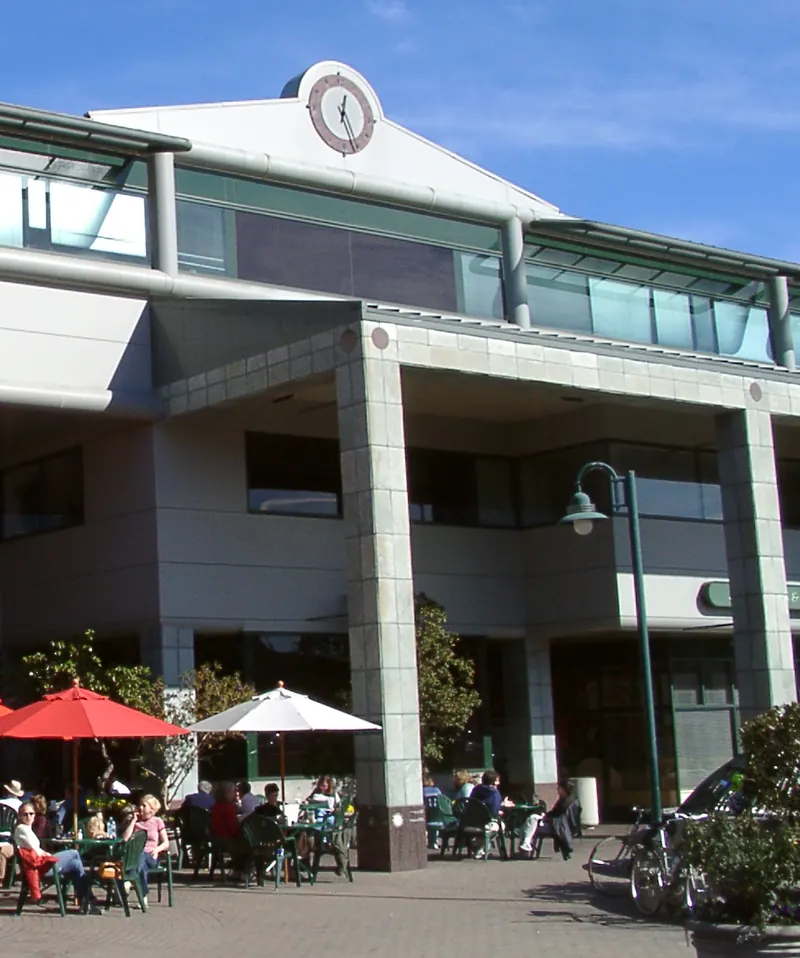

Kepler's moved to its present home in the Menlo Center on El Camino Real in 1989. Roy Kepler died in 1994. The store closed on August 31, 2005. It reopened that October with money and work from the community. Today a nonprofit, the Kepler's Literary Foundation, runs its author events. Our bookstores guide covers a visit.
Perry Lane and Ken Kesey
Ken Kesey came to Stanford in 1958 from Oregon with a Woodrow Wilson fellowship to attend the Creative Writing Center. Wallace Stegner, its director, turned down his applications for a Stegner Fellowship and once called him "a sort of highly talented illiterate." Kesey kept attending seminars anyway. In a class taught by Malcolm Cowley he began the manuscript that became One Flew Over the Cuckoo's Nest.
From about 1959 Kesey lived on Perry Lane, a short street of cottages beside the Stanford golf course. It was a bohemian enclave of writers and graduate students. A neighbor, psychology graduate student Vic Lovell, told Kesey about paid drug experiments at the Veterans Administration hospital in Menlo Park. The study was secretly financed by the CIA's MKUltra program. Kesey volunteered, took hallucinogens under observation and later worked night shifts as an aide on a psychiatric ward. Those nights fed directly into his novel.
One Flew Over the Cuckoo's Nest was published in 1962. In August 1963 the Perry Lane cottages were demolished. With his book money Kesey moved to a log house in La Honda in the hills to the west. In 1964 he and the Merry Pranksters drove a painted school bus named Furthur across the country. In 1965 and 1966 they staged the Acid Tests around the Bay Area.
The Grateful Dead's Palo Alto beginnings
Jerry Garcia arrived in Palo Alto in 1960, at 18, after a discharge from the Army. The Palo Alto Historical Association's account follows him through a string of local places.
- February 20, 1961: A car crash on Junipero Serra Boulevard after a party at The Chateau in Menlo Park kills his friend Paul Speegle. Garcia later called it the moment "where my life began."
- Dana Morgan Music on Bryant Street: Garcia teaches guitar and banjo at this downtown shop.
- The Tangent at 117 University Avenue: A folk club upstairs from a pizza parlor where Garcia's bluegrass band, the Wildwood Boys, played in 1963.
- December 31, 1963: Garcia meets 15-year-old Bob Weir, who joins his jug band.
- Mother McCree's Uptown Jug Champions: The Palo Alto jug band that included Garcia, Weir and Ron "Pigpen" McKernan.
The Beatles pushed them toward electric rock. "The Beatles were why we turned from a jug band into a rock 'n' roll band," Weir said, as quoted by the historical association. In early 1965 they formed the Warlocks with Garcia, Weir, Pigpen, drummer Bill Kreutzmann and bassist Dana Morgan Jr., son of the music store's owner. Phil Lesh soon took over on bass.
The Warlocks played their first show on May 5, 1965, at Magoo's Pizza Parlor at 639 Santa Cruz Avenue in Menlo Park. Learning that another band already recorded as the Warlocks, they needed a new name. Garcia found "Grateful Dead" in a dictionary. Accounts differ on which dictionary and whose home they were in. The band played its first show as the Grateful Dead on December 4, 1965, at one of Kesey's Acid Tests in San Jose.
Carolyn "Mountain Girl" Garcia summed it up for the historical association: "Palo Alto was the magic carpet. It was where everything happened." Our live music guide covers where to hear music in town today.
Joan Baez and nonviolence
Joan Baez grew up partly in Palo Alto. Her father, physicist Albert Baez, earned his doctorate at Stanford in 1950. At Palo Alto High School she refused to leave her classroom during an air raid drill, her first act of civil disobedience. She graduated in 1958 and the family moved to Boston, where her singing career took off.
Baez stayed tied to the Peninsula. She met Ira Sandperl of Kepler's and became his student in nonviolence. In 1964 she withheld 60 percent of her income taxes in protest of military spending. Around 1965 the two founded the Institute for the Study of Nonviolence in Carmel Valley. Sources give 1964 or 1965. The institute later moved to Palo Alto and ran there until 1976.
In October 1967 Baez, her mother and dozens of other women were arrested at the Oakland Armed Forces Induction Center. In jail she met David Harris, a former Stanford student body president and draft resister. She moved into his draft resistance commune in the hills above Stanford. They married in March 1968 and later that year moved to Struggle Mountain, a commune in Los Altos Hills.
Protest at Stanford
The Vietnam War brought protest to a campus that had long been quiet. Much of it focused on Stanford's military research and its ties to the Stanford Research Institute.
| Date | Event |
|---|---|
| May 19, 1966 | 35 students occupy President Wallace Sterling's office for 50 hours over a draft deferment exam. |
| 1968 | Arsonists burn the Navy ROTC building and destroy Sterling's office. |
| April 3, 1969 | About 700 people meet in Dinkelspiel Auditorium and form the April Third Movement. |
| April 1969 | About 400 students occupy the Applied Electronics Laboratory for nine days. Stanford Magazine dates the start to April 9 and the Stanford Daily to April 11. |
| May 1, 1969 | Protesters occupy Encina Hall overnight over war research at SRI. |
| April 29, 1970 | An anti-ROTC sit-in at the Old Union turns into a clash with police and tear gas. |
The protests had results. Within days of the laboratory sit-in, the Faculty Senate banned classified research. Stanford separated from SRI in 1970. The Faculty Senate voted in 1970 to end academic credit for ROTC, which did not return to campus until 2011. Our Stanford history page places these years in the longer story of the university.
The Midpeninsula Free University
Not all the energy went into protest. In 1966 a group of activists started the Midpeninsula Free University, a school without a campus. Roy Kepler helped start it. Classes met in living rooms and storefronts in Palo Alto, Menlo Park and Mountain View. Members paid a nominal $10 and any member could offer a course.
The quarterly catalogs listed 150 to 300 courses, from encounter groups and crafts to politics and "Whole Earth Studies." Enrollment ran from about 1,000 to 1,275 per quarter in 1968 and 1969. Teachers and visitors included Paul Goodman, Joan Baez, Stewart Brand and Richard Alpert. Computer scientists Larry Tesler and John McCarthy were among its members, a hint of how the counterculture and the computer world overlapped here. When the city tried to deny the group a park for a Be-In, it went to court, won and held the event.
The FBI watched the Free U from 1968 to 1971. A right-wing group firebombed it. New leadership took control in 1970. Enrollment fell to about 700 that year and about 70 in 1971. The organization disbanded in July 1971.
What you can still see
Much of 1960s Palo Alto has been rebuilt, but a few places still carry the story:
- Kepler's Books in Menlo Park, still selling books and hosting author talks.
- University Avenue, where the Tangent stood at number 117. Walk it with our downtown guide.
- Bryant Street, home of Dana Morgan Music in the early 1960s.
- Santa Cruz Avenue in Menlo Park, site of Magoo's Pizza Parlor at number 639.
- White Plaza and the Old Union at Stanford, the center of campus protest.
For the San Francisco side of the decade, a Haight-Ashbury walking tour pairs well with a Palo Alto day. Dates for the whole period are on our Palo Alto timeline.
Frequently asked questions
Did the Grateful Dead start in Palo Alto?
Largely, yes. Jerry Garcia lived in Palo Alto from 1960, taught guitar at Dana Morgan Music downtown and met Bob Weir there. The band grew out of Palo Alto jug band Mother McCree's Uptown Jug Champions. As the Warlocks they played their first show on May 5, 1965, at Magoo's Pizza Parlor in neighboring Menlo Park.
Where was Perry Lane?
Perry Lane was a small street of cottages next to the Stanford golf course, just outside Palo Alto. Ken Kesey lived there from about 1959 while in Stanford's writing program. The original cottages were torn down in August 1963.
Is Kepler's Books still open?
Yes. Kepler's is on El Camino Real in Menlo Park, just north of Palo Alto. Roy Kepler opened the store in 1955 and it moved to its current location in 1989. It closed briefly in 2005 and reopened with community support.
Did Joan Baez live in Palo Alto?
Yes. Joan Baez graduated from Palo Alto High School in 1958, where she refused to leave class during an air raid drill. In the 1960s she worked with Ira Sandperl of Kepler's on nonviolence. In 1968 she moved to Struggle Mountain in Los Altos Hills.
What was the Midpeninsula Free University?
It was a member-run alternative school active from 1966 to 1971 in Palo Alto, Menlo Park and Mountain View. Members paid about $10 and anyone could teach a class. It offered 150 to 300 courses a quarter at its peak and disbanded in July 1971.