On this page
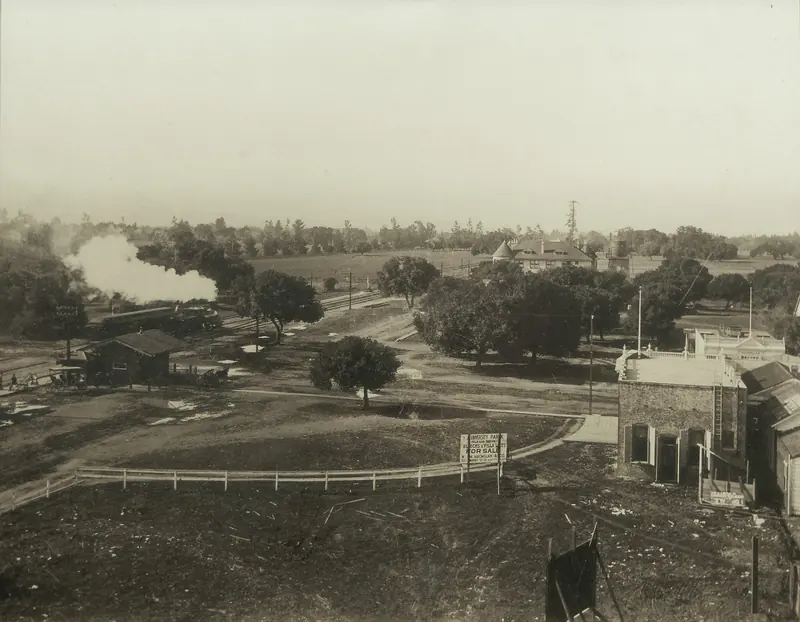
Palo Alto did not grow up around a crossroads like most towns. It was planned on purpose, for one customer: a university that had not opened yet. Within a few years of the first lot sale, it had a lumber yard, a post office, a school and enough residents to vote itself into existence as a city.
This page covers the founding years from 1887 to 1894, with a look at the decade after. It explains who laid out the town, why every deed carried a ban on liquor, how the name changed and how the 1894 incorporation actually happened. The town's older neighbor and rival is covered on our Mayfield page. The university's side of the story is on our history of Stanford.
Why Stanford needed a town
Leland and Jane Stanford signed the founding grant of their university on November 11, 1885. The grant said the farm land could not be sold. Faculty could build houses on campus, but only on leased land. Staff, tradespeople and professors who wanted to own a home needed somewhere else to live.
The nearest town was Mayfield, at the southern edge of the farm. Stanford asked it to close its saloons and become the university's gateway. Mayfield refused in 1886. So the Stanfords turned to a trusted insider to build a dry town of their own.
There was also a naming tangle. In 1887 a developer named Alexander Gordon laid out a tract beside the campus to the south and called it Palo Alto. Stanford wanted that name for the new town to the north. Gordon agreed to rename his tract College Terrace, today's College Terrace neighborhood.
Timothy Hopkins and University Park
Timothy Hopkins was born Timothy Nolan in Augusta, Maine, in 1859. As a boy he was taken in by the family of Mark Hopkins, one of the four partners behind the Central Pacific Railroad. Mark's widow, Mary Hopkins, adopted him in 1879. In 1885 the Stanfords named him to the board of trustees of their planned university. He was 26.
In 1887 Hopkins bought farmland north of the campus, across the railroad from the stock farm. It came from the old Rancho Rinconada del Arroyo de San Francisquito. Hopkins bought it from Thomas Seale, who with his brother Henry had acquired a large share of the rancho. Sources give different sizes. Wikipedia's rancho article says Seale sold Hopkins 697 acres. Wikipedia's Palo Alto article and the Stanford Daily say 740 acres. Wikipedia's Hopkins biography says 737 and the Palo Alto History Museum rounds to 700. Those numbers may reflect separate purchases or different surveys.
The land, later called the Hopkins Tract, was bounded roughly by San Francisquito Creek, Embarcadero Road, today's Alma Street and Middlefield Road. Hopkins laid out a grid of streets and called the town University Park. University Avenue ran straight from the railroad toward the university's entrance on Palm Drive.
Street names
Many downtown streets honor writers and thinkers: Emerson, Bryant, Waverley, Kipling, Tennyson and others. Walk the grid on our downtown guide and you are walking Hopkins's 1887 plan.
The temperance clause
The point of University Park was to be dry. According to the Palo Alto History Museum, in 1889 Hopkins wrote deeds stating that a property would revert if liquor was sold on it. KQED's history of the town quotes Stanford archaeologist Laura Jones putting it simply: "If you bought one of the lots from Timothy Hopkins, you were not allowed to sell liquor on it."
The rule outlasted everyone who wrote it. Key dates:
- 1889: Liquor clauses appear in University Park deeds.
- 1909: A state law bans intoxicating liquor within a mile and a half of the Stanford campus.
- 1953: A south Palo Alto store outside the restricted area receives permission to sell hard liquor.
- 1970: In a suit brought by Barry Amato, Judge Peter Anello rules the Hopkins restrictions invalid and unenforceable.
- May 1971: Downtown celebrates its first legal public drink (accounts give May 21 or 22). The museum notes that the ceremonial toast was later revealed to be water.
Today downtown is full of bars and restaurants. Our guide to bars and wine in Palo Alto covers the modern scene.
From lots to a village (1888 to 1893)
The town filled in as the university neared opening. A few markers of that growth survive in local records:
- October 1, 1891: Stanford opens to students. Stanford sources count 555 in the first class. The City of Palo Alto's history gives 465.
- March 1, 1892: J. F. Parkinson hauls the first load of lumber for his new University Park lumber yard from Santa Clara, according to a 1922 county biography. By January 1, 1893, the yard had done $70,000 in business.
- 1892: The town is renamed Palo Alto. Parkinson donates lumber for the first school the same year and becomes the town's first postmaster.
The Stanford Daily, writing on the city's 125th anniversary, described University Park as a growing village by the time classes began. Many of the first residents were tied to the university as faculty, staff or suppliers.

Incorporation in 1894
By 1894 the town had grown enough to want its own government. Leland Stanford had died in June 1893 and his estate was tied up in court during the Panic of 1893. The university's future looked uncertain, yet the town kept growing.
The steps are laid out in a 2018 City Council resolution:
- April 9, 1894: Male residents vote 98 to 21 to incorporate and elect a five-member Board of Trustees. Women could not yet vote in California elections.
- April 16, 1894: The election results are filed with the State of California. Most histories, including this site, give this as incorporation day.
- April 21, 1894: The state approves the incorporation. Palo Alto becomes a California city of the sixth class, a category based on population.
In 2018 the council designated April 9 as Palo Alto Day. The Palo Alto Daily Post reported that one council member objected to celebrating the sixth class label, saying Palo Alto is a first-class city. The resolution does not name the first trustees. We have not found a reliable list to print here.
The city seal adds a fourth date. As defined in Municipal Code 2.06.010 (Ord. 5204, 2013), it reads "Incorporated April 23, 1894", which differs from the dates other sources give. Our city seal and symbols page has more on the seal.
The young city
The new city moved quickly on services. Around the turn of the century it built its own water, electric and gas utilities, which it still runs today. Residents planted street trees by the thousands. In 1904 a Carnegie library opened, helped by a $10,000 Carnegie grant that Parkinson and others secured.
Timothy Hopkins stayed involved. In 1907 he and his wife gave the city parkland along San Francisquito Creek, now Hopkins Creekside Park. A 2001 creek marker at El Palo Alto Park tells it differently, saying he left the land to the city at his death in 1936. He served as president of the Stanford board of trustees from 1908 to 1914 and remained a trustee until his death on January 1, 1936.
In 1909 voters adopted a city charter that created a 15-member city council. The system lasted until 1950, when the city switched to the council and city manager structure it uses today.
Professorville takes shape
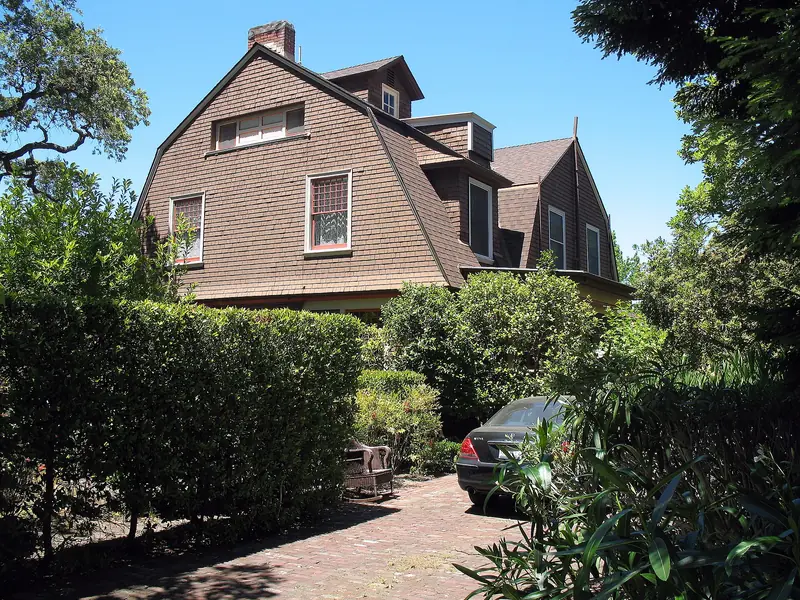
Professors were among the most eager buyers. They could only lease land on campus, so many bought lots in the blocks south of University Avenue. The area became known as Professorville. Early houses include:
- The Wing home on Lincoln Avenue, built in 1893 for civil engineering professor Charles Benjamin Wing to a design by Arthur Bridgman Clark.
- The Sanford home on Kingsley Avenue, built in 1894 for Fernando Sanford, a physics professor on Stanford's original faculty.
- The Abbott home on Lincoln Avenue, built in 1901 for Nathan Abbott, the first dean of Stanford Law School.
- The Frank Angell House at 1005 Bryant Street, built for the founder of Stanford's psychology department.
Most early houses were brown shingle, Colonial Revival or Craftsman designs. The neighborhood was listed on the National Register of Historic Places on October 3, 1980, as a 34.4 acre historic district. Our Professorville walking guide maps the best houses.

Seeing the founding today
The Hopkins Tract was proclaimed a local heritage district during the city's centennial in 1994. Much of it is easy to explore on foot from the Palo Alto Caltrain station:
- Walk up University Avenue, the spine of Hopkins's plan.
- Turn onto Ramona Street to see the 1920s Spanish Revival block.
- Continue south into Professorville along Bryant and Kingsley.
- Stop at 367 Addison Avenue for the HP Garage, where Hewlett-Packard began in 1939.
- Finish at Hopkins Creekside Park along the creek at the north edge of the tract.
Prefer a guide? A Silicon Valley walking tour often covers downtown Palo Alto. For dates at a glance, see our Palo Alto timeline.
Frequently asked questions
Who founded Palo Alto?
Timothy Hopkins, a Stanford trustee and adopted son of railroad partner Mark Hopkins's widow, laid out the townsite in 1887 with the Stanfords' backing. He called it University Park. The town took the name Palo Alto in 1892 and incorporated in 1894.
When was Palo Alto incorporated?
Male residents voted 98 to 21 for incorporation on April 9, 1894. The results were filed with the state on April 16, the date the city has long used as its birthday. State approval followed on April 21, 1894. In 2018 the City Council named April 9 Palo Alto Day.
Why was alcohol banned in Palo Alto?
Leland Stanford wanted a dry town beside his university. Timothy Hopkins wrote deeds saying a lot would revert if liquor was sold on it. A 1909 state law also banned liquor sales within a mile and a half of campus. A court ruled the deed restrictions unenforceable in 1970.
How big was the original Palo Alto?
Sources give between about 697 and 740 acres. The Hopkins Tract ran roughly from San Francisquito Creek to Embarcadero Road and from Alma Street to Middlefield Road. Downtown, Professorville and Crescent Park all sit on it.