On this page
Palo Alto entered the 20th century as a small dry town at the gates of a young university. It left the 1910s as a place with paved ambitions: a city charter, streetcars, its own power and gas, a radio company that would matter to the whole world and an Army camp of tens of thousands just across the creek. The census tells the scale of it. Palo Alto had 1,658 residents in 1900, 4,486 in 1910 and 5,900 in 1920.
This overview runs theme by theme from 1900 to 1919. Each big event has its own page on this site and the links lead there for the full story.
Two towns, two charters
Palo Alto had incorporated in April 1894. Mayfield, the older settlement a couple of miles south on El Camino Real, waited until 1903. County supervisors approved the step that May and residents voted 102 to 26 in favor that July. Arthur Bridgman Clark, an architect who had designed early Professorville houses, became Mayfield's first mayor.
Incorporation gave Mayfield the power to do what Leland Stanford had demanded in 1886. Voters banned saloons in 1904 and the ban was in force by January 1905. Some owners ignored it until ten days in jail changed their minds. In 1909 a state law barred liquor sales within a mile and a half of the Stanford campus, which settled the question for the whole area. Our Mayfield page covers the rival town in depth.
Palo Alto, meanwhile, rewrote its own government. In 1909 voters adopted a city charter that replaced the five trustees with a 15-member council. That system lasted until 1950.
Stanford loses its founder
Jane Stanford spent the early 1900s putting the university on a firm footing. In 1900 she demanded the dismissal of economics professor Edward A. Ross over his political views, a case that drew national criticism. In 1903 she handed her powers to the trustees. The Palo Alto Stock Farm closed the same year.
She died in Honolulu on February 28, 1905. A coroner's jury found strychnine poisoning by a person or persons unknown, while university president David Starr Jordan said she died of heart disease. No one was ever charged. Our Jane Stanford page lays out the evidence and the books that argue each side.
The 1906 earthquake
Just after 5 a.m. on April 18, 1906, the great San Francisco earthquake struck. At Stanford it killed two people. Student Junius Hanna died when a chimney fell through the roof of Encina Hall. Campus fireman Otto Gerdis died at the power house after shutting off steam and electricity. It brought down the spire of Memorial Church and wrecked the new gymnasium and library. Estimates of the university's losses run from about $1.75 million to $2.8 million in 1906 dollars.
The town fared better but not well. About half the chimneys in Palo Alto fell. Several new brick stores on University Avenue and High Street collapsed. Quick action at the power plant prevented the fires that destroyed San Francisco and most merchants reopened within two weeks. Memorial Church was rebuilt between 1908 and 1917 without its spire. Our 1906 earthquake page has the details, including the statue of Louis Agassiz that landed headfirst in the ground.
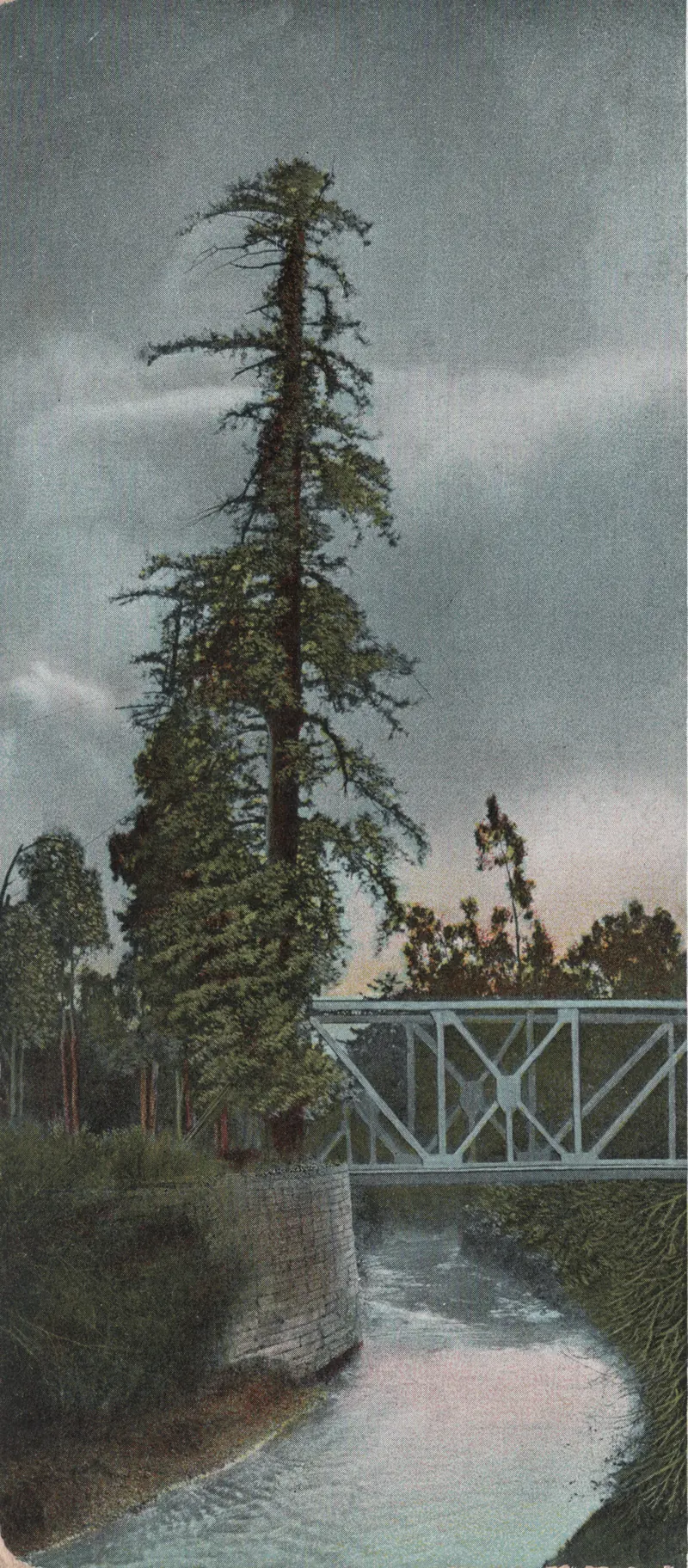

A growing town
The decade after the quake was one of steady building:
- 1902 and 1904: The Woman's Club gave its library to the city on October 1, 1902. A Carnegie library opened in 1904 with help from a $10,000 Carnegie grant.
- November 15, 1906: Local electric streetcars began running. The Peninsular Railway took over in 1909 and its interurban cars reached San Jose from March 5, 1910. See our streetcars page.
- 1907: Timothy Hopkins and his wife gave the city parkland along San Francisquito Creek, by most accounts.
- 1910: The Tower Well at Alma Street and Hawthorne Avenue was built for the city water system.
- 1911 to 1925: An electric arch lit up University Avenue.
- 1914: El Camino Park, the city's oldest park, was established.
- 1916: The Woman's Club built its hall at 475 Homer Avenue.
- 1917: Natural gas joined water, sewer and electricity as a city-owned utility.
California men approved women's suffrage in 1911, so Palo Alto women voted in local and state elections nine years before the 19th Amendment. At Stanford, Jordan became chancellor in 1913 and Ray Lyman Wilbur began a long presidency in 1916.
Radio comes to Emerson Street
The most consequential business of the period started small. In 1909 Cyril Elwell, an Australian-born Stanford graduate, founded the Poulsen Wireless Telephone and Telegraph Company at 913 Emerson Street. It licensed a Danish arc transmitter and was soon renamed Federal Telegraph. From 1911 to 1913 Lee de Forest worked there with assistants Herbert Van Etten and Charles Logwood. They found that de Forest's Audion tube could amplify weak signals and then made it oscillate, which meant a tube could generate radio waves too.
By 1917 the company employed more than 300 people and had moved into a long corrugated iron building between El Camino Real and Alma Street. Its alumni later shaped firms such as Magnavox and Litton. Our Federal Telegraph page explains why historians treat it as an early root of Silicon Valley.
The war next door
When the United States entered World War I, the Army chose land just across San Francisquito Creek for a training camp. Construction of Camp Fremont began in late July 1917 on about 7,000 acres of what is now central Menlo Park. At its peak it held about 27,000 to 28,000 soldiers, mostly of the 8th Division, in roughly 1,125 temporary buildings. Its training ranges reached into the Stanford foothills.
The camp changed Palo Alto overnight. Soldiers filled downtown on weekends. At the War Department's request the YWCA built a Hostess House, designed by Julia Morgan, where soldiers could meet visiting families. When the camp closed in 1919 the building was moved to Palo Alto and dedicated on November 11, 1919, to those who died in the war. It still stands at 27 University Avenue. Our Hostess House page follows its later lives.
Stanford sent students and faculty to the war effort too. Lou Henry Hoover urged American women to conserve food after 1917. In June 1919 Herbert Hoover founded the war collection that grew into the Hoover Institution. See our page on Herbert Hoover in Palo Alto.
The 1918 flu
Influenza reached Camp Fremont in late September 1918. Accounts of how many soldiers were treated differ widely, but both main sources agree that 147 died. Stanford checked students' temperatures every night, isolated anyone above 99.3 degrees and required masks from October 24 until early November. Stanford Magazine counts 14 deaths tied to the campus. The last, Professor Henry Lewin Cannon, came on January 5, 1919. Our 1918 flu page notes what is still unknown about the town's own response.
New schools, new arrivals
Palo Alto High School moved to its campus at Embarcadero Road and El Camino Real in December 1918, though some sources say 1919. That same year Thomas Foon Chew opened a cannery in Mayfield that would become the area's biggest employer. His story is on our Thomas Foon Chew page. The University AME Zion Church, the city's oldest Black congregation, was also founded in 1918.
1900 to 1919 timeline
| Year | Event |
|---|---|
| 1900 | City electric service begins January 16. The Ross affair at Stanford. |
| 1903 | Mayfield incorporates. The stock farm closes. |
| 1905 | Mayfield's saloon ban takes effect. Jane Stanford dies February 28. |
| 1906 | Earthquake on April 18. Streetcars start November 15. |
| 1909 | New city charter. Federal Telegraph founded. State liquor law passes. |
| 1911 to 1913 | De Forest's amplifier and oscillator work. Women win the vote in California. |
| 1917 | City gas service. Camp Fremont construction begins. |
| 1918 | Flu reaches the camp. Paly's new campus. Chew's cannery opens. |
| 1919 | Camp Fremont closes. Hostess House dedicated November 11. |
The 1920s would bring the merger with Mayfield and a new look for downtown, covered on our page about Palo Alto in the 1920s.
Frequently asked questions
When did Mayfield incorporate compared with Palo Alto?
Palo Alto incorporated in April 1894. Mayfield, the older town to the south, did not incorporate until 1903, when residents voted 102 to 26 in favor. Mayfield then banned its saloons, a ban voted in 1904 and in force by January 1905. The two towns merged in 1925.
How did the 1906 earthquake affect Palo Alto?
About half the town's chimneys fell and nearly every business was damaged. Several new brick stores on University Avenue and High Street collapsed. Quick action at the power plant prevented fires and most merchants reopened within two weeks. Stanford suffered far worse, with two deaths and heavy damage.
What was Federal Telegraph?
It was a radio company founded in Palo Alto in 1909 by Stanford graduate Cyril Elwell, first as Poulsen Wireless. Lee de Forest worked there from 1911 to 1913 and developed the vacuum tube amplifier and oscillator. A sidewalk plaque at Channing Avenue and Emerson Street marks state landmark No. 836.
What was Camp Fremont?
It was a World War I Army training camp built from late July 1917 in what is now Menlo Park, just across San Francisquito Creek. At its peak it held about 27,000 to 28,000 soldiers, mainly of the 8th Division. It closed in 1919. Its Hostess House was moved to Palo Alto and still stands.
Did the 1918 flu reach Palo Alto?
Yes. It reached Camp Fremont in late September 1918 and 147 soldiers there died. Stanford required masks from October 24 until early November and counted 14 deaths tied to the campus. We have found no published account of specific Palo Alto city orders.