On this page
In the summer of 1917 the U.S. Army began building a training camp on the oak-studded flats just across San Francisquito Creek from Palo Alto. For about two years Camp Fremont turned the quiet Peninsula into a military town. Tens of thousands of soldiers drilled where downtown Menlo Park now stands. They dug practice trenches in Stanford's foothills and fired artillery into the hills above Portola Valley. Then the war ended and the camp disappeared almost as fast as it had arrived.
This page covers why the Army came, how big the camp grew and what it meant for Palo Alto and Stanford. It ends with the few traces you can still find. The best of them is in Palo Alto itself: Julia Morgan's Hostess House near the foot of University Avenue. For the wider story of the city, start with our history of Palo Alto.
Why the Army chose the Peninsula
The United States declared war on Germany in April 1917. The Army had to train hundreds of thousands of men at once and it needed camps quickly. In July 1917 the War Department chose a site beside Palo Alto as one of 16 camps for National Guard troops called into federal service, according to the Menlo Park Historical Association.
Stanford made the plan possible. Its trustees agreed in late July to lease about 6,000 acres to the government. Historian Barbara Wilcox, whose 2016 book is the standard account of the camp, has pointed out that no other landowner nearby held land on that scale. KQED reported that officials also liked the rolling foothills because they looked like the terrain soldiers would meet in France.
The camp took the name of John C. Frémont, the explorer and army officer who played a large part in California's early American years. Construction began in late July 1917. Sources give both July 24 and July 27 as the first day of work.
How big was Camp Fremont?
The answer depends on what you count. The core camp was a town of wooden barracks, mess halls and stables. Around it lay a much larger area of leased land used for marches, trenches and artillery practice. Published figures differ, so the table gives ranges with their sources.
| Measure | Figure | Where it comes from |
|---|---|---|
| Main camp | About 7,000 acres in today's central Menlo Park | Barbara Wilcox, as reported by the Almanac |
| All leased land | Up to 68,000 acres, from San Carlos to Los Altos | KQED |
| Stanford land leased | About 6,000 acres | Menlo Park Historical Association |
| Buildings | About 1,125, nearly all temporary wood | Army post summary |
| Peak strength | About 27,000 to 28,000 soldiers | Wilcox and other accounts |
| Horses and mules | 5,000 authorized, about 2,300 on average | 332nd Auxiliary Remount Depot records |
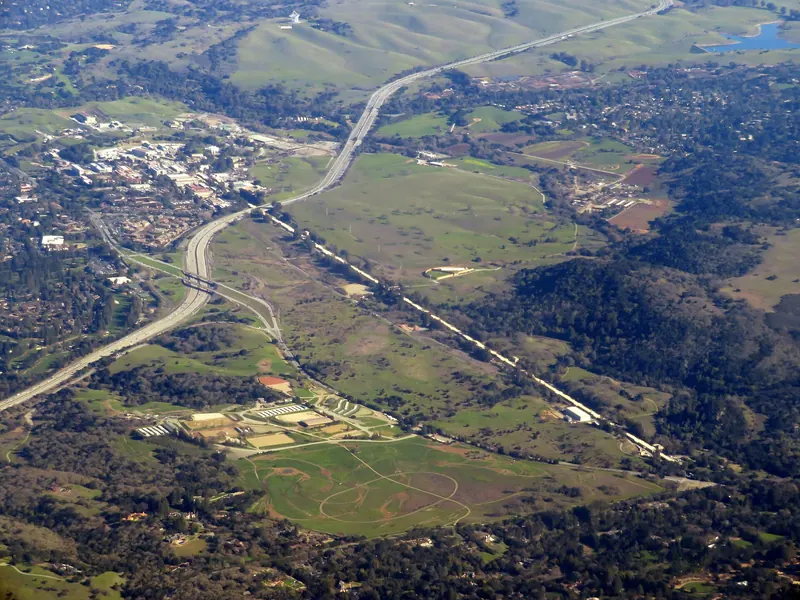
The main camp ran roughly from Valparaiso Avenue to San Francisquito Creek and from El Camino Real west to Alameda de las Pulgas. Division headquarters stood in what is now downtown Menlo Park, close to Santa Cruz Avenue. The base hospital sat on Willow Road. Up in the hills, an artillery range stretched between Los Trancos and Madera creeks. Practice trenches cut across the land where SLAC National Accelerator Laboratory now stands.

Who trained there
The camp was first meant for the 41st Division, a National Guard unit drawn from Washington, Oregon, Idaho and Wyoming. The Army moved that division to Camp Greene in North Carolina instead. Camp Fremont became home to a new Regular Army division.
- September 27, 1917: About 1,500 men of the 8th Infantry Regiment arrived from the Philippines. They formed the core of the new 8th Division.
- January 1918: The division's units were all in place. Draftees kept arriving through 1918.
- May to September 1918: An officers' training school ran at the camp.
- August 1918: About 5,000 men left for Vladivostok under Maj. Gen. William S. Graves for the Siberian intervention. Some stayed in Russia until 1920.
- November 1918: The armistice came before most of the division reached France.
Other units shared the grounds, including the 319th Engineers, the 12th Infantry and the remount depot that bought, trained and shipped horses and mules. Philip Johnston, who later helped organize the Navajo code talkers of World War II, trained here. So did John K. Cannon, a future Air Force general.
The 1918 flu at the camp
The influenza pandemic reached the camp in late September 1918. The Almanac, drawing on Wilcox's research, dates the first case to September 28. A quarantine followed. The Almanac says it ended on October 18 when some units were ordered to move out. Letters from a camp worker, held by the Menlo Park Historical Association, give a later end date of November 9. The same letters mention about 40,000 troops, a higher figure than most accounts give. Sick men traveled east in rail cars with the windows open and many fell ill on the way.
Counts of the sick vary. KQED reported 2,418 respiratory patients admitted to the base hospital over six weeks. The Almanac's summary gives about 8,000 men treated. Both sources agree on the deaths: 147 soldiers died of pneumonia and related illness. Our page on the 1918 flu pandemic follows the outbreak in Palo Alto and at Stanford.
Life next door to an army
A camp of 28,000 young men changed daily life in two small towns. Palo Alto had a few thousand residents and a strict ban on alcohol. Menlo Park was not yet incorporated. Shops, cafes and service businesses opened to serve soldiers and some stayed open long after the war.
- Stanford. According to Wilcox, 4 percent of male students went straight into the camp within a single month and overall enrollment fell 28 percent between 1917 and 1918. The university tightened curfews for women students living near the troops. Wartime gaps also let Ruth Taylor become the first woman to edit the Stanford Daily. Our Stanford history page covers the campus side.
- Menlo Park. Army engineers of the 8th Division built the town's first paved streets and its first public water and gas lines. Federal money paid for a main sewer to Atherton that stayed in use until 2000.
- Palo Alto. Families came by train to visit sons and husbands. The Hostess House gave them a supervised place to meet. Our Menlo Park guide shows how the two towns sit side by side today.
Not everyone welcomed the camp. Wilcox found that some landowners opposed it and others did not fully grasp that artillery would be fired across their land. Arguments over drinking and dating ran through the whole stay.
The camp closes
With the war over, the Army had no use for the site. Salvage of the camp was ordered in December 1918. The Menlo Park Historical Association dates the formal closing to August 1919, with the 8th Division demobilized the next month. Buildings and lumber were sold at auction. Some accounts say the camp was finally abandoned in January 1920 and KQED reported that by April 1920 only a handful of landmarks remained.
The hospital had a longer life. On April 2, 1919, the Public Health Service reopened it as U.S. Public Health Service Hospital No. 24, a 570-bed tuberculosis sanatorium on about 90 acres. The Willow Road site later became a Veterans Administration hospital and it is still a VA campus today.
The Hostess House connection
The War Department asked the YWCA to build hostess houses at Army camps around the country, so soldiers could meet visiting mothers, wives and sweethearts in a respectable setting. Julia Morgan designed the one at Camp Fremont. It opened in May 1918 and served the camp until October that year.
After the war the YWCA handed the building to Palo Alto for a token $1. In May 1919 workers cut it into nine sections and horse teams pulled them on rollers across the creek to a site near the Palo Alto train station. The city dedicated it on November 11, 1919, as a community center and a memorial to those who died in the war. Its 1976 National Register nomination calls it the only intact building left from California's two World War I Army training camps. The full story is on our Hostess House page.
What you can still see
- The Hostess House, 27 University Avenue, Palo Alto. Now the MacArthur Park restaurant and California Historical Landmark No. 895. See our landmarks guide for its listings.
- Fremont Park, downtown Menlo Park. This small park on Santa Cruz Avenue was dedicated to the camp's memory in 1938. It holds a bronze plaque first set up at a 1923 reunion of the 8th Division and the 319th Engineers, plus signs from the Menlo Park Historical Association with a map of the camp.
- The VA campus on Willow Road. The site of the old base hospital. Wilcox has said a few original buildings still stand there, but the campus is a working medical center, not a museum.
- The foothills. SLAC's construction erased most of the trench field, where children still played into the 1940s. Old shells still surface. KQED reported 75mm rounds found near Foothills Park and Portola Valley in November 2010 and the Almanac reported another find at Stanford Research Park on November 30, 2015.
Good to know
- If you ever spot a rusted shell or casing on a trail, do not touch it. Note the spot and call 911.
- There is no visitor center for the camp. Fremont Park is the easiest place to read about it on site.
- Barbara Wilcox's World War I Army Training by San Francisco Bay: The Story of Camp Fremont (The History Press, 2016) is the best single book on the subject.
A short Camp Fremont walk
You can link the main sites in an easy afternoon. Start at the Palo Alto Caltrain station and walk two minutes to the Hostess House on the far side of the El Camino Real underpass. Cross San Francisquito Creek into Menlo Park along El Camino Real, a walk of about 20 minutes to Fremont Park on Santa Cruz Avenue. Picture the barracks rows that once filled these blocks. If you have a car or a bike, finish with the view from the Stanford foothills, where the trench lines and artillery ranges lay. For dates in context, see our Palo Alto timeline.
Frequently asked questions
Where was Camp Fremont?
Camp Fremont stood in what is now central Menlo Park, just across San Francisquito Creek from Palo Alto. The main camp was bounded roughly by Valparaiso Avenue, Alameda de las Pulgas, San Francisquito Creek and El Camino Real. Training ranges spread into the Stanford foothills and Portola Valley.
How many soldiers trained at Camp Fremont?
Most accounts put the peak at about 27,000 to 28,000 soldiers, mainly from the Army's 8th Division. The camp had about 1,125 buildings, nearly all temporary wooden structures.
Are any Camp Fremont buildings still standing?
The best survivor is the Hostess House, designed by Julia Morgan in 1918 and moved to 27 University Avenue in Palo Alto in 1919. Its National Register nomination calls it the only intact building left from California's World War I Army camps. The site of the camp hospital on Willow Road is now a Veterans Affairs campus.
Why was it called Camp Fremont?
The Army named it for John C. Frémont, the explorer, officer and early California political figure. A memorial park in downtown Menlo Park, Fremont Park, now carries the camp's name and a plaque from 1923.
Can you still find artillery shells from Camp Fremont?
Yes. Old shells still turn up now and then in the foothills where the Army trained. Local press reported finds in 2010 and in 2015. If you ever see one, leave it alone and call 911.