On this page
At the start of 1890 Palo Alto did not exist under that name. There was a stretch of former rancho land north of Leland Stanford's horse farm, a grid of surveyed streets called University Park and a railroad that did not yet stop there. By 1900 the census counted 1,658 people in an incorporated city with a newspaper, a school district, a women's club and a water system of its own.
This page follows that decade theme by theme. The founding itself, from Timothy Hopkins's 1887 purchase to the incorporation vote, has its own detailed page on the founding of Palo Alto. Here we summarize it and set it beside what was happening at the university, in neighboring Mayfield and in the Stanford family.
The setting in 1890
The ground was already laid. The Stanfords had signed the founding grant of their university in November 1885 after the death of their only son. Hopkins, a university trustee, bought land north of the railroad from the Seale family and platted University Park in 1887. Deeds written in 1889 said a lot would revert if liquor was ever sold on it.
The trains came first. Southern Pacific added a flag stop for the university in 1890, according to our railroad history. A small waiting room was enclosed there in 1893, with a retired boxcar pressed into service for baggage. Across San Francisquito Creek the hills were still farmland. To the south, Mayfield had its depot, its main street and roughly a dozen saloons.
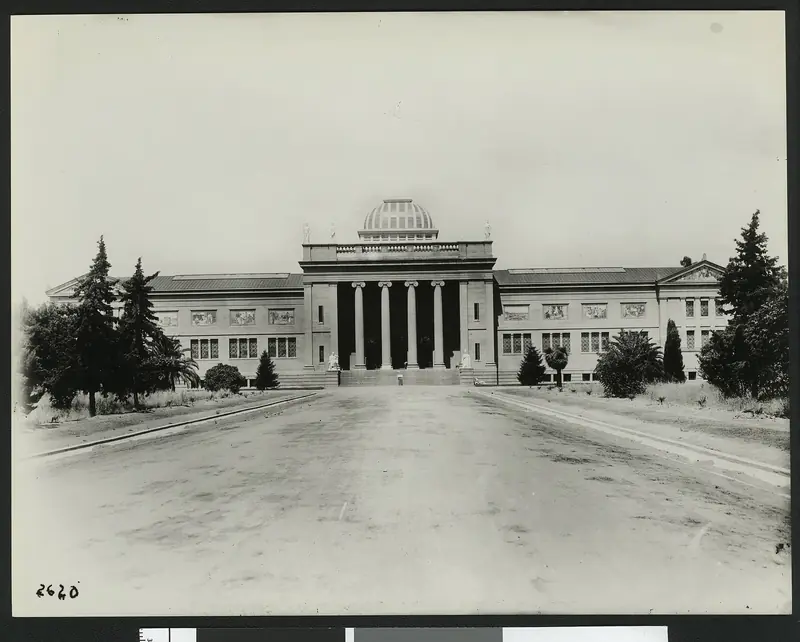
The campus itself was a work site. Frederick Law Olmsted's firm had drawn the plan, but Stanford's business manager fired Olmsted's job foreman in 1890 and the landscape architect stepped back. The Main Quad was rising in sandstone on the flat land Stanford had chosen.
The university opens
David Starr Jordan, a fish biologist who had been president of Indiana University, arrived in June 1891 to lead the new school. Classes began on October 1, 1891. Stanford sources count 555 students in the first class. A City of Palo Alto history gives 465, so the number depends on who is counting and when. Among the pioneers was a 17-year-old from Oregon named Herbert Hoover, who graduated in 1895. Ernest Houston Johnson entered with the same class and became Stanford's first African American graduate, also in 1895.
Student life arrived quickly. The student paper that became the Stanford Daily began in 1892 as The Daily Palo Alto and served town and campus alike. The first Big Game against the University of California was played in 1892. Timothy Hopkins paid for a seaside laboratory in Pacific Grove that opened the same year.

Our page on David Starr Jordan covers his long presidency and the later reckoning with his views on eugenics.
A town takes shape
University Park filled in as the university opened. On March 1, 1892, J. F. Parkinson hauled the first load of lumber to his new yard, according to a 1922 county biography. By January 1, 1893, the yard had done $70,000 in business. The town took the name Palo Alto in 1892, after Alexander Gordon agreed to rename his own Palo Alto tract to the south as College Terrace.
The institutions of a real town followed in a rush:
- January 5, 1893: The first issue of the Palo Alto Times. A rival weekly, the Palo Alto Live Oak, started in 1896 and merged with the Times in June 1900.
- March 20, 1893: The founding date the school district gives for itself. The first school opened that September with two teachers and 70 pupils in a temporary two-room schoolhouse.
- June 20, 1894: Twenty-four women met at the town's old Presbyterian Church and founded the Woman's Club of Palo Alto.
- 1896 and 1898: A library reading room opened, followed by a lending library.
Anna Zschokke, a widow who had moved to town, pushed for that first schoolhouse and later paid for a three-room high school building on Forest Avenue near Cowper Street, around 1897. She also wrote a pioneer history of the town in 1896. Her story is on our Anna Zschokke page and the district's longer arc is in our school district history.
Professors began buying lots south of University Avenue because they could only lease land on campus. The Wing house on Lincoln Avenue went up in 1893 and the Sanford house on Kingsley Avenue in 1894. That cluster became Professorville.
Incorporation in 1894
By 1894 the town wanted its own government. Male residents voted 98 to 21 for incorporation on April 9, 1894. They also elected a five-member Board of Trustees. The results were filed with the state on April 16, the date this site uses. The state approved the new city on April 21. The city seal adds yet another date, April 23. Our founding page explains all four, so we will not repeat the detail here.
The new city kept the dry rule. Beyond the deed clauses, an 1894 town rule restricted liquor, a step our page on Palo Alto's alcohol ban places in a story that ran until 1971.
The Stanford estate crisis
The young university nearly died in its third year. Leland Stanford died on June 21, 1893, during the national Panic of 1893. His estate went into probate. In 1894 the federal government filed a claim of about $15 million against it over the Central Pacific's debts to the United States.
Jane Stanford kept the school open. She drew a court-approved allowance from the estate, cut costs and paid faculty as best she could. The government's case ended at the U.S. Supreme Court. In United States v. Stanford, 161 U.S. 412, decided on March 2, 1896, the court ruled for the estate. Even then the money took years to free up. In 1897 she took her jewels to London to sell for the university and came home with most of them when the offers disappointed her. In 1899 she gave the university more than $10 million in stocks, bonds and property.
The same year she amended the founding grant so that women students would never exceed 500 at one time. Our pages on Jane Stanford and the Stanford family cover these years in full.
City services
The new city moved quickly to own its basic services. It installed a water system in 1896 and a sewer system in 1898. In the 1890s the town bought electricity from a Redwood City company at 20 cents a kilowatt-hour. Stanford engineering professors Charles Marx and Charles B. Wing argued the city could produce it for half that. The municipal electric system began on January 16, 1900, with the rate set at 10 cents. Our city utilities history follows the story to today's carbon neutral power.
The stock farm and Mayfield
Leland Stanford's horse breeding operation did not survive him for long. After his death the university needed money and horses were sold at auction. The Palo Alto Stock Farm closed in 1903. Its Red Barn still stands on campus.
Mayfield, a couple of miles south, carried on as the area's wet town. It had refused Stanford's 1886 demand to close its saloons and the new dry town to the north grew partly at its expense. Mayfield would incorporate in 1903 and ban saloons soon after. Our Mayfield page tells that story.
1890s timeline
| Year | Event |
|---|---|
| 1890 | A railroad flag stop serves the future university. Olmsted's role at Stanford ends. |
| 1891 | Jordan arrives in June. Stanford opens on October 1. |
| 1892 | University Park becomes Palo Alto. Parkinson's lumber yard opens. The student daily starts. |
| 1893 | The Palo Alto Times begins. The school district forms. Leland Stanford dies in June. |
| 1894 | Incorporation vote on April 9. The Woman's Club forms in June. The federal claim on the estate is filed. |
| 1896 | The Supreme Court rules for the estate on March 2. The city water system goes in. |
| 1898 | The sewer system opens. Lou Henry earns Stanford's first geology degree awarded to a woman. |
| 1899 | Jane Stanford sets the 500 limit on women and transfers more than $10 million to the university. |
What you can still see
A surprising amount of the decade survives. The street grid of University Park is downtown's grid. Professorville's oldest shingled houses date to the 1890s. The Main Quad, the Red Barn and the Stanford Mausoleum, where Leland Stanford was laid to rest in 1893, are all on campus. For exact dates across the whole period, see our Palo Alto timeline. The next chapter, with the 1906 earthquake and a world war camp next door, continues on our page about the 1900s and 1910s.
Frequently asked questions
When did Stanford University open?
Stanford opened to students on October 1, 1891. Stanford sources count 555 students in the first class, while a City of Palo Alto history gives 465. David Starr Jordan, who had arrived that June, was the first president.
When was University Park renamed Palo Alto?
In 1892. Timothy Hopkins had laid out the townsite in 1887 as University Park. Alexander Gordon's tract to the south had used the Palo Alto name first and agreed to become College Terrace so the new town could take it.
Why did Stanford almost close in the 1890s?
Leland Stanford died in June 1893 during a national financial panic. His estate went into probate and in 1894 the federal government claimed about $15 million over Central Pacific railroad debts. Jane Stanford kept the school running on a court-approved allowance until the U.S. Supreme Court ruled for the estate on March 2, 1896.
How many people lived in Palo Alto in 1900?
The 1900 census counted 1,658 residents. Ten years later the city had 4,486. Mayfield, the older town to the south, was still a separate community and did not join Palo Alto until 1925.
What city services did Palo Alto start in the 1890s?
The city installed its own water system in 1896 and a sewer system in 1898. Its municipal electric system followed on January 16, 1900. Palo Alto still owns and runs these utilities today.