On this page
Most visitors to California Avenue see a pleasant car-free street with cafes, a train station and a Sunday farmers market. Few know they are standing on the main street of a different town. Mayfield was here first. It had a post office, a newspaper, a brewery and a railroad depot while the land that became downtown Palo Alto was still pasture.
Mayfield's story is one of the great what-ifs of Peninsula history. Leland Stanford offered to make it the gateway to his new university. Mayfield said no, mostly because of its saloons. This page follows the town from its start in the 1850s to its absorption into Palo Alto in 1925. For the town that won, see our page on the founding of Palo Alto.
A roadhouse, a farm and a name
Mayfield began with travelers. El Camino Real was the main road between San Francisco and San Jose and stagecoaches needed places to stop. According to the City of Palo Alto, James Otterson built a roadhouse here in 1853. It was known as Uncle Jim's Cabin, near today's corner of El Camino Real and California Avenue. By 1855 it had become a mail stop with Otterson as postmaster and he is credited with proposing the name Mayfield.
The name echoes a neighboring property. On April 10, 1853, Elisha Oscar Crosby bought 250 acres of the old Robles rancho for $2,000 and called it Mayfield Farm. On September 23, 1856, the property passed to Sarah Armstrong Wallis to settle a debt Crosby owed her. Wallis became a leading suffragist. In 1870 she was president of the Mayfield women's suffrage association and of California's first statewide suffrage organization. Her farm is now the Barron Park neighborhood, named after Edward Barron, who bought it in 1878.
The state honors her as California Historical Landmark No. 969, "Sarah Wallis Mayfield Farm." The plaque was dedicated on October 11, 1986, on La Selva Drive in Barron Park.
The railroad town
The San Francisco and San Jose Railroad reached Mayfield in October 1863. Service through to San Jose began in January 1864. A storekeeper donated land on the main street for the station, which settled where the town's center would be. The first station building went up in 1869.
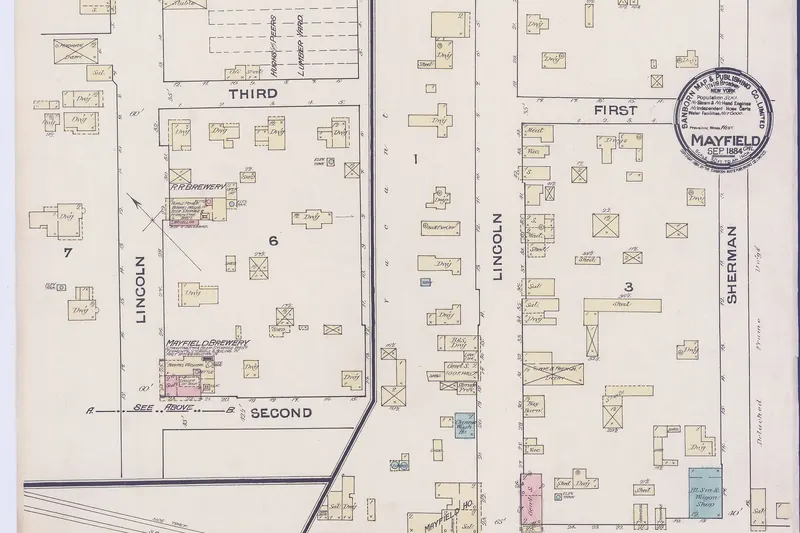
The rail line turned a crossroads into a real town. By the 1880s Mayfield had stores, hotels and a blacksmith. The Mayfield Brewery opened in 1868 at what is now the corner of California Avenue and Birch Street. The Mayfield Enterprise newspaper was publishing by 1869, in both English and Spanish, a reminder that Californio families still lived in the area.
It also had saloons, lots of them. Most local accounts, including the Palo Alto History Museum and KQED's reporting with Palo Alto Historical Association historian Steve Staiger, put the number at 13 in the 1880s. KQED adds two breweries. For a small farm town, that was a lot of drinking.

Leland Stanford's dry demand
In 1876 Leland Stanford began buying land next door for his Palo Alto Stock Farm. After his son died in 1884, he and Jane Stanford decided to build a university on the farm. A university needed a town for its faculty, staff and students. Mayfield was the obvious candidate. It sat right at the edge of the farm and already had a depot.
In 1886, according to the Palo Alto History Museum, Stanford met Mayfield residents at the corner of what is now California Avenue and El Camino Real, then Lincoln and Main. He described plans for a university with its main entrance near Stanford Avenue and Hanover Street. He had one condition. The town had to ban alcohol.
Mayfield refused. Its economy leaned on the saloons and many residents saw no reason to give them up for a school that did not exist yet. So Stanford looked north. His friend and trustee Timothy Hopkins bought land beside the railroad and laid out University Park in 1887, with deeds that banned the sale of liquor. That town took the name Palo Alto and became the university's gateway instead.
Good to know
- The 1886 meeting is recorded in local histories but no transcript survives. Treat details of the conversation as tradition.
- The liquor clause in Palo Alto deeds outlived Mayfield. A judge ruled it unenforceable in 1970 and downtown saw its first legal public drink in May 1971.
Losing ground to the dry town
The choice cost Mayfield. Construction workers who had lived there while the university was built moved to the new town, which was quieter and better for families. Mayfield gained a rough reputation. In 1904, the Palo Alto History Museum reports, grocer Frank Backus told the town's trustees that rowdy outsiders were causing trouble. He noted that Mayfield rents of $5 to $6 a month could not compete with Palo Alto's $20 to $25, a sign of which town people wanted to live in.
Mayfield incorporated as a town in 1903. The county supervisors approved the step in May and residents voted 102 to 26 in favor that July. Arthur Bridgman Clark, an architect who also designed early houses in Professorville, became the first mayor.
The new town finally banned saloons. The Palo Alto History Museum says voters approved the ban in 1904. Wikipedia's Palo Alto history says the ban took effect in January 1905. KQED cites a San Francisco Examiner item of January 2, 1905, lamenting that Mayfield could no longer serve Stanford drinkers. Some owners ignored the law at first. Ten days in jail persuaded them otherwise. In 1909 a state law banned liquor sales within a mile and a half of the campus, which settled the matter for the whole area.
Relations between the towns stayed prickly. In 1905 Mayfield accused Palo Alto of "unsisterly conduct" for allegedly blocking a road toward the university.
The cannery years
Without saloons Mayfield needed other work. Orchards still covered much of the Santa Clara Valley and fruit needed processing. In 1918 Thomas Foon Chew started a cannery in Mayfield. It packed fruit and vegetables from the valley's farms and at its peak was the largest employer in the area. It closed in 1949, by which time the old town of Mayfield had long since become part of Palo Alto, though the cannery's own area was not annexed until 1954.
Annexation in 1925
From 1918 on, some Mayfield residents pushed to join Palo Alto. They pointed to money problems, poor roads and weak services. Palo Alto ran its own utilities and had more to offer. A first annexation vote failed in 1924.
The second try succeeded in 1925. Wikipedia, citing local records, reports that Palo Alto voters approved annexing Mayfield on July 2, 1925, by 1,094 to 441. The Palo Alto History Museum gives a closer count of 357 to 288 for the 1925 vote. Sources differ, so check the original records if the numbers matter for your work. Either way, the towns were officially consolidated on July 6, 1925.
The merger required new street names, since the towns had duplicates. Several changes still shape the map:
- Lincoln Avenue, Mayfield's main street, became California Avenue.
- Washington Street in College Terrace became Cornell Street.
- College Terrace's Palo Alto Avenue became College Avenue.
The neighborhood of College Terrace, tied to Mayfield, joined Palo Alto in the same annexation. Mayfield's train station kept the old name until 1941, when it became the California Avenue station.
California Avenue today
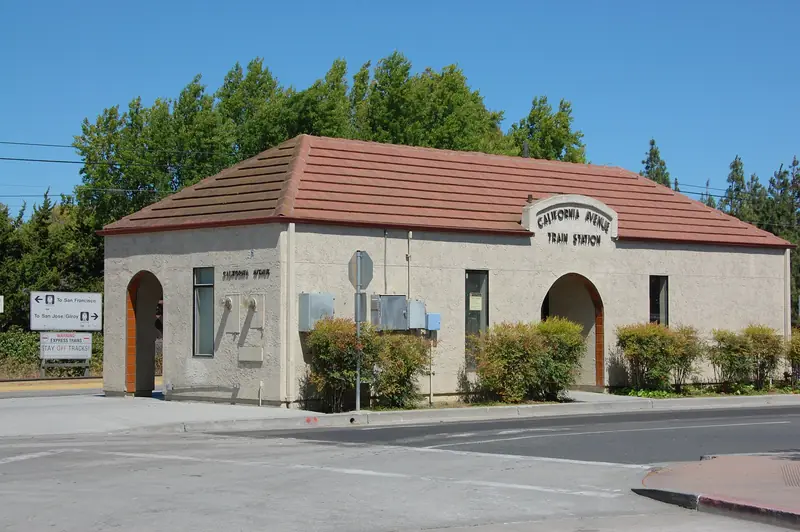
Mayfield's main street is now Palo Alto's second downtown. The blocks between El Camino Real and Birch Street are closed to cars, with restaurant seating in the roadway. The year-round Sunday farmers market fills the street every week. Caltrain stops at the California Avenue station, the descendant of Mayfield's 1869 depot. Our California Avenue guide covers places to eat and things to do.

A short Mayfield walk takes about an hour:
- Start at the California Avenue Caltrain station, the old Mayfield depot site.
- Walk west on California Avenue, Mayfield's former Lincoln Avenue.
- Pause at Birch Street, where the Mayfield Brewery opened in 1868.
- Continue to El Camino Real, near the site of Uncle Jim's Cabin and Stanford's 1886 meeting.
- Cross El Camino into College Terrace and see Mayfield Park beside the 1936 library on Wellesley Street.
- If you have a bike, ride south to La Selva Drive in Barron Park for the Sarah Wallis landmark plaque.
For the full chronology of both towns, see our Palo Alto timeline. If you would rather have a guide, local Peninsula history tours sometimes include California Avenue.
Frequently asked questions
Where was Mayfield, California?
Mayfield was centered where California Avenue meets El Camino Real in today's Palo Alto. Its main street, then called Lincoln Avenue, ran from the highway to the railroad station. The area is now the California Avenue business district and the neighborhoods around it.
Why didn't Stanford University build its town in Mayfield?
In 1886 Leland Stanford asked Mayfield to close its saloons in exchange for becoming the university's gateway town. Mayfield, which had about 13 saloons, refused. Stanford backed Timothy Hopkins's new dry townsite to the north instead, which became Palo Alto.
When did Mayfield become part of Palo Alto?
Palo Alto voters approved annexing Mayfield on July 2, 1925. The two towns were officially consolidated on July 6, 1925. Mayfield's main street was renamed California Avenue because Palo Alto already had a Lincoln Avenue.
Is anything left of Mayfield today?
Yes, in pieces. California Avenue follows Mayfield's main street and its Caltrain station sits where Mayfield's depot stood. Mayfield's street grid, a few older buildings and the California Historical Landmark plaque for Sarah Wallis's Mayfield Farm in Barron Park all survive.