On this page
Picture University Avenue around 1915. A trolley wire hangs over the middle of the street. A small electric car rolls from the Southern Pacific depot toward the creek, while another heads up toward the campus. Every hour a bigger interurban car leaves the depot bound for Los Altos and San Jose. Within twenty years almost all of it was gone, paved over for the automobile.
This page reconstructs Palo Alto's streetcar era with dates from railway records and the state's regulators. Some dates differ between sources. We note where. For the main railroad line, see our railroad history.
Before the streetcars
From the start Stanford needed a link between its campus and the train. In the late 1880s, according to Stanford Transportation, the university ran a horse-drawn vehicle that carried 12 passengers between the campus and the station across El Camino Real. Students and visitors also walked or rode bicycles down the long, straight line of Palm Drive and University Avenue.
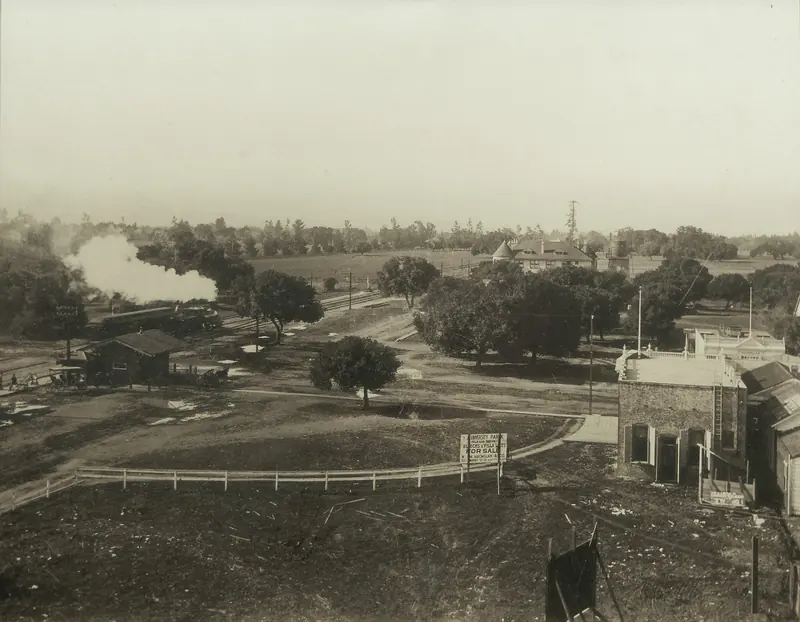

The town lines, 1906
Palo Alto's first streetcars ran on November 15, 1906, under the name Santa Clara Interurban Railroad Company. Despite the name, these were local lines. The Peninsular Railway, a Southern Pacific company, took them over on June 30, 1909. Two routes did most of the work:
- University Avenue to Ravenswood: Ran east from the Southern Pacific depot, at first only as far as Pope Street. The tracks were later extended across San Francisquito Creek toward Ravenswood, the area that became East Palo Alto. After disputes over who would maintain the bridge, service was cut back to the creek.
- Waverley Street to Stanford: Started at Embarcadero Road and Waverley Street, ran along Waverley to University Avenue and continued to the campus. It was later extended south from Embarcadero to Oregon Avenue, through what are now Professorville and Old Palo Alto.
Destination signs preserved in San Jose read "N. Palo Alto to Stanford" and "Mayfield to Stanford," which suggests cars also linked Mayfield with the campus.
The Stanford line, 1909 to 1929
Service to the university began in 1909. Stanford Transportation says electric streetcars replaced the old horse-drawn link that year. On campus the cars ran on track the university owned and leased to the railway. One account traces the route along Galvez Street past the stadium to Lasuen Street, then west to end at the Oval at the head of Palm Drive. Our page on the Oval and Palm Drive describes the spot today.
For students, the car was the cheap way into town. For the town, it brought Stanford money to downtown merchants. The line lasted 20 years. Its last day was October 21, 1929.
The interurban to Los Altos and San Jose
The bigger ambition was regional. Southern Pacific incorporated the Peninsular Railroad on December 21, 1905, hoping to run electric cars from San Jose up the Peninsula to San Francisco. That plan stalled at once. The Colorado River flood of 1905, which created the Salton Sea, forced Southern Pacific to rush its spare rails to the Imperial Valley. Only the lines around San Jose, Palo Alto and Los Gatos were built. Electric cars never ran between Palo Alto and San Mateo. A second attempt in the 1910s died for lack of steel during World War I.
The company reorganized as the Peninsular Railway in 1909, combining several smaller lines. Locals called it the Pin. Its Palo Alto service ran like this:
| Line | Dates | Route | Frequency |
|---|---|---|---|
| San Jose to Los Altos to Palo Alto | March 5, 1910, to September 30, 1934 | Stevens Creek Road, the Mayfield Cutoff and El Camino Real | Every 60 minutes |
| Palo Alto to Los Altos to Los Gatos | 1910 to October 1, 1934 | El Camino Real, the Mayfield Cutoff, Saratoga and Los Gatos roads | Every 60 minutes |
A stub service ran on the Mayfield Cutoff in 1909 while the line was still being built. In Los Altos the electric cars ran beside the Southern Pacific steam tracks, roughly along today's Foothill Expressway. They stopped at the station that helped create the town. Our guides to Los Altos and downtown Los Altos cover the town today.
At its height the system was large. By 1931 the Peninsular Railway ran 34 cars on 91.1 miles of track across Santa Clara County, reaching Cupertino, Saratoga, Campbell, Los Gatos and Alum Rock Park.
The 1929 decision
Paved roads and cheap cars ate into ridership through the 1920s. Local service inside Palo Alto ended on September 27, 1925. The decisive blow came in 1929, when the street itself was needed for cars.
On September 17, 1929, the state Railroad Commission ruled on the Peninsular Railway's request to abandon its Palo Alto tracks. The decision lays out why:
- The state Division of Highways planned to widen El Camino Real and asked the railway to remove its tracks or rebuild them in the center of the new pavement.
- Palo Alto planned to pave University Avenue between the highway and the railroad and wanted the tracks in the middle of the street removed.
- The Stanford line was "essentially a street car line," partly on campus track leased from the university. Stanford offered no objection to ending it.
The commission let the railway abandon about two miles of track between Mayfield Junction and the University Avenue depot, along with the Stanford line. Interurban cars would meet Southern Pacific trains at the Mayfield station instead, today's California Avenue. No one protested at the hearing. The highway widening is part of our El Camino Real history.
This explains a mismatch in published dates. Some sources say interurban cars stopped at the Palo Alto depot from 1910 to 1934. The commission's 1929 order and the railway's own route history show they were cut back to Mayfield in 1929 and ran from there until 1934.
The end of the line
The Great Depression finished the Pin. Its Palo Alto interurban runs ended on September 30 and October 1, 1934. Buses replaced all the lines by the late 1930s. Southern Pacific steam trains kept using the Mayfield Cutoff through Los Altos until early 1964, when the route was pulled up for Foothill Expressway.
The Stanford link survived in other forms. A private bus line took over the run to campus. The City of Palo Alto agreed to subsidize it in 1963. In December 1975 the university launched a trial with two leased trolley-style buses, the start of today's free Marguerite shuttle. Local bus service in the city is now run mainly by VTA, covered in our guide to VTA buses and shuttles.
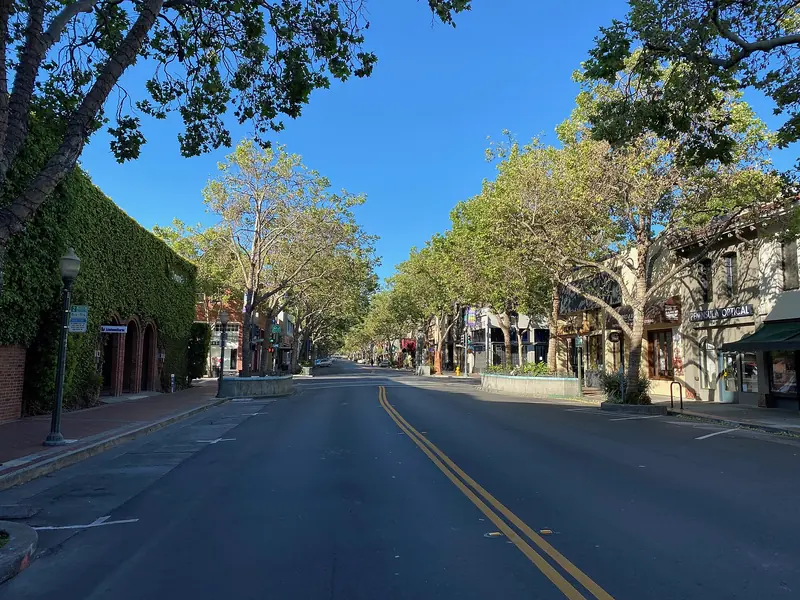

Traces you can still find
- Car No. 52: A Peninsular Railway car with a clerestory roof is preserved and restored at the Western Railway Museum in Solano County, where it carries visitors.
- Destination signs: Signs from the "N. Palo Alto to Stanford" and "Mayfield to Stanford" runs are kept at the trolley barn in History Park, San Jose.
- California Avenue station: After 1929 the interurban cars met Southern Pacific trains at the Mayfield depot, today's California Avenue Caltrain stop.
- Foothill Expressway: The curve of the road through Los Altos follows the old rail corridor shared by steam and electric trains.
Good to know
- Sources disagree on whether the Stanford streetcars started in 1906 or 1909. The town lines began in 1906. Service to campus is dated 1909.
- Peninsular Railway cars and Southern Pacific trains were run by the same parent company but were separate services.
Frequently asked questions
Did Palo Alto have streetcars?
Yes. Local electric streetcars began in Palo Alto on November 15, 1906. Lines ran along University Avenue, on Waverley Street and out to the Stanford campus. Local town service ended in 1925 and the Stanford line in 1929.
Was there a train from Palo Alto to Los Altos?
Yes, two kinds. Southern Pacific steam trains used the Mayfield Cutoff through Los Altos from about 1908 until early 1964. The Peninsular Railway also ran hourly electric interurban cars from Palo Alto through Los Altos to San Jose and Los Gatos from 1910 to 1934.
Why did the Palo Alto streetcars stop?
Cars and paved roads drew riders away. In 1929 the state planned to widen El Camino Real and Palo Alto planned to pave University Avenue. Both wanted the tracks gone. Regulators approved removing them that September. The Depression finished off the rest of the interurban system in 1934.
What was the Peninsular Railway?
It was an electric interurban railway owned by Southern Pacific, known locally as the Pin. Formed in 1909 from several smaller lines, it linked San Jose with Palo Alto, Los Altos, Cupertino, Saratoga, Los Gatos and Campbell. By 1931 it ran 34 cars on about 91 miles of track.
Can you still see a Peninsular Railway car?
Yes. Car No. 52 is preserved and restored at the Western Railway Museum in Solano County, where it carries visitors. Destination signs from the Palo Alto lines are kept at History Park in San Jose.