On this page
When Palo Alto residents pay their utility bill, the money goes to City Hall. The city owns and runs its water, wastewater, electric and natural gas systems and a fiber optic network. The Northern California Power Agency says City of Palo Alto Utilities, known as CPAU, runs more utilities than any other California municipality. That setup is unusual today. In Palo Alto it is more than 125 years old.
This page traces how it happened, using the dates the city itself publishes, with notes where other sources differ. For practical information on starting service, rates and outage numbers, see our guide to City of Palo Alto Utilities.
Two professors and a price fight
Palo Alto incorporated in 1894 as a small college town with no public services. Electricity came from a private company. According to a 2000 exhibit at the Museum of American Heritage, the Peninsula Lighting Company of Redwood City began supplying the newly incorporated town in 1896 at 20 cents per kilowatt-hour.
Two Stanford engineering professors, Charles "Daddy" Marx and Charles B. Wing, thought that was too much. They led a campaign for public ownership and argued the town could produce its own power for half the price. The city credits them with the early push that gave Palo Alto its municipal utilities. Their timing fit the national mood. Around 1900 many American reformers saw city-owned water and power as a cure for monopoly pricing.
Water in 1896, sewers in 1898
Water came first. The city says its water supply system was installed in 1896, making Palo Alto one of the early American towns to own and run its own water utility. The early system drew on local wells. The wastewater collection system came online in 1898.
The most visible survivor of the early water system is the Tower Well at the corner of Alma Street and Hawthorne Avenue. Built in 1910, it is a 78-foot reinforced concrete cylinder that held a 155,000-gallon tank. It stored the town's supply and protected nearby buildings in case of fire. Its valve, made in the early 1900s, opened and closed on electrical signals as part of an early automatic control system.
Over time the city came to rely on water imported through San Francisco's regional system. A local history of the Tower Well says that by the late 1980s the city relied on Hetch Hetchy water and the tower had been abandoned. The council considered turning it into a house and a day care center, then chose to keep it as built. It now stands among native plants with benches and information panels.
The municipal electric system, 1900
The city-owned electric utility began operating on January 16, 1900. A town ordinance set the rate at 10 cents per kilowatt-hour, half what the private company had charged. The city ran its own power plant in those years.
That plant proved its worth on April 18, 1906. As the earthquake shook the town, engineer Robert McGlynn cut the plant's supply while its 60-foot tower swayed. Palo Alto escaped the fires that destroyed San Francisco and kept its water and electricity running. Our 1906 earthquake page tells that story.
Electricity soon became part of civic pride. From 1911 to 1925 a lighted arch spanned University Avenue. By the 1920s a web of city-owned conduits, water mains, sewers and storm drains ran beneath the downtown street, as a diorama in the Museum of American Heritage exhibit showed.
Natural gas, 1917
Gas came well after water and power. The city lists its natural gas distribution system as operating since 1917, so it is a mistake to group gas with the turn-of-the-century utilities, as some short histories do. Today CPAU buys gas on the wholesale market and delivers it through city-owned mains.
The same year the Army began building Camp Fremont across the creek. Its engineers gave Menlo Park its first public water and gas lines, a reminder of how far ahead Palo Alto's own systems were.

The treatment plant by the bay
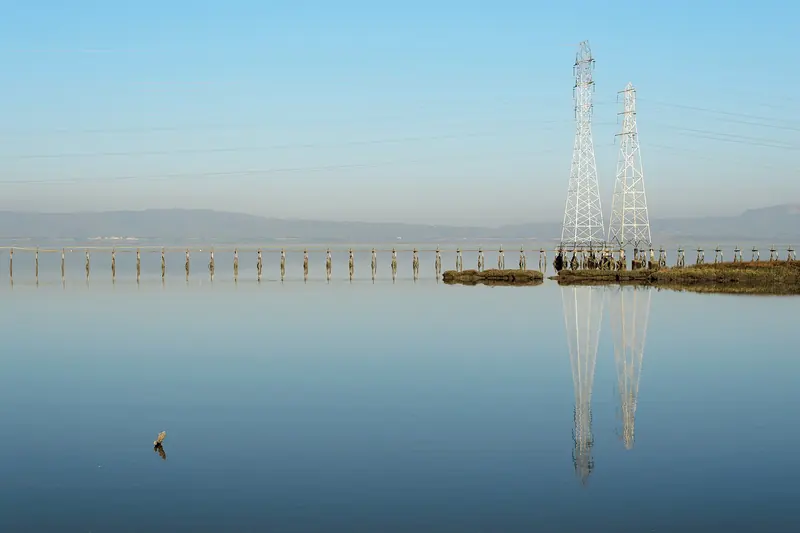
Palo Alto treats its sewage at a plant at the end of Embarcadero Way on the edge of the bay. Aerial photos show it there by 1956. Today the Regional Water Quality Control Plant treats more than 17 million gallons a day from Palo Alto and neighboring communities. Most of the cleaned water flows out through the Baylands to San Francisco Bay. Some is treated further and sent through separate purple pipes as recycled water. The plant sits beside the Baylands Nature Preserve.
Dark fiber and Palo Alto Fiber
In the 1990s the city added a new kind of utility. CPAU says it built its dark fiber loop in 1996. A 1999 trade report described it as a 29-mile ring around the city, built in 1997 and completed in 1998, linked to the Palo Alto Internet Exchange. The city leases strands of this unlit fiber to businesses. By early 2026 about 200 commercial customers brought in roughly $3 million a year, according to local reporting.
Homes took longer.
- April 5, 1999: The City Council votes 7 to 1 for a five-year fiber-to-the-home trial in the Community Center neighborhood, one of the first in an existing U.S. neighborhood.
- 2000s and 2010s: Several citywide fiber plans are studied but not built.
- December 2025: Construction begins in a Greer Park pilot area, tied to an electric grid upgrade so crews can dig once.
- 2026: The city opens Palo Alto Fiber to homes in the pilot area, sized for up to 1,000 homes, with any citywide expansion depending on how the pilot performs.
The carbon neutral era
Owning the utility lets the city choose where its power comes from. Palo Alto buys electricity and gas on the wholesale market and is a member of the Northern California Power Agency. In 2013 it began supplying 100 percent carbon neutral electricity, matched on an annual basis from hydroelectric, solar, wind and landfill gas sources. On July 1, 2017, it added carbon neutral natural gas through offsets.
- March 19, 2018: The council approves a Utilities Strategic Plan.
- October 2022: The council adopts a goal of carbon neutrality by 2030, building on its target of cutting emissions 80 percent from 1990 levels by 2030.
- Today: CPAU pays rebates for heat pumps and other electric appliances to move homes off gas. It also runs public EV chargers, covered in our EV charging guide.
The utilities by the numbers
These figures come from the city's Utilities at a Glance page for fiscal year 2025.
| Utility | Started | Key figures, FY2025 |
|---|---|---|
| Water | 1896 | 16,626 residential customers, 231 miles of main, 8 wells, 7 reservoirs |
| Wastewater | 1898 | 216 miles of sewer, treated at the regional plant |
| Electric | 1900 | 26,428 residential and 3,566 commercial customers, 9 substations, 184 MW peak load |
| Natural gas | 1917 | Carbon neutral through offsets since 2017 |
| Fiber | 1996 to 1998 | Dark fiber for business, Palo Alto Fiber pilot for homes |
The electric utility also maintains 7,033 streetlights and 109 traffic signals. Check the city's Utilities at a Glance page for updated numbers and the About CPAU page for the official history.
Seeing utility history
The Tower Well at Alma Street and Hawthorne Avenue is the easiest stop, with panels that explain the early water system. The Museum of American Heritage, which hosted the utility's centennial exhibit "Energizing the Community" from June 16 to October 15, 2000, focuses on everyday technology of the past. The utility won the Arbor Day Foundation's Tree Line USA recognition in 2019 for its care of trees near power lines. For the trees that line the city's streets, see our urban forest guide.
Frequently asked questions
When did Palo Alto start its own utilities?
The city's water system was installed in 1896, two years after incorporation. The sewer system followed in 1898, the municipal electric system began on January 16, 1900 and natural gas service was added in 1917, according to City of Palo Alto Utilities.
Why does Palo Alto own its electric utility?
In the 1890s the town bought power from the Peninsula Lighting Company of Redwood City at 20 cents per kilowatt-hour. Stanford professors Charles Marx and Charles B. Wing argued the town could do it for half the price. The city's own system started in 1900 and an ordinance set the rate at 10 cents.
Where does Palo Alto's water come from?
Most of it is Sierra Nevada snowmelt that travels about 200 miles from the Tuolumne River watershed near Yosemite, almost entirely by gravity, through the regional San Francisco system. The city also keeps wells and reservoirs. Its historic Tower Well at Alma and Hawthorne dates to 1910.
Is Palo Alto's electricity carbon neutral?
The city says its electric supply has been 100 percent carbon neutral since 2013, matched on an annual basis using hydroelectric, solar, wind and landfill gas power. It added carbon neutral natural gas, using offsets, on July 1, 2017.
Does Palo Alto offer city fiber internet?
The city has leased dark fiber to businesses since the late 1990s. It is now rolling out a residential service called Palo Alto Fiber, starting with a pilot area in the Greer Park neighborhood sized for up to 1,000 homes. Check the city's fiber page for your address.