On this page
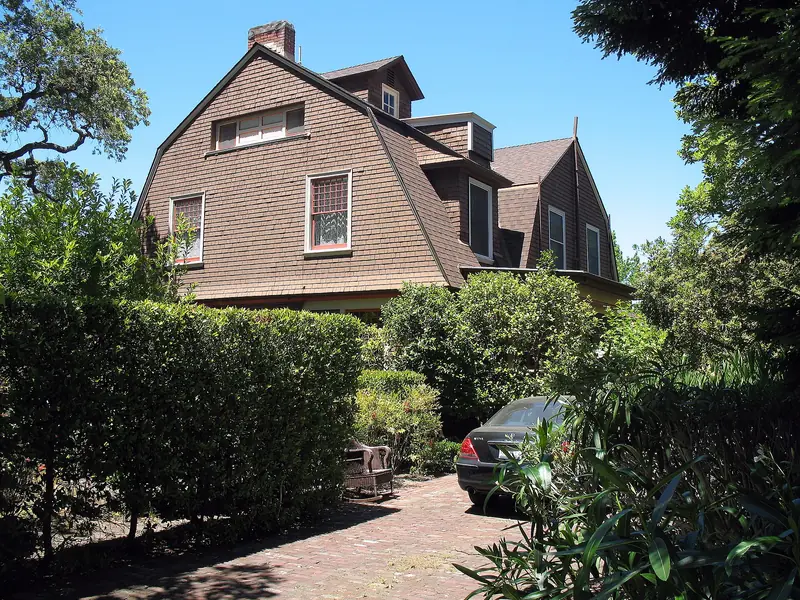
Professorville is the most photographed residential neighborhood in Palo Alto and one of the easiest to enjoy. Its streets are flat and shady. Its houses are close to the sidewalk. Almost every block has something to read in the shingles and rooflines. It is also where a small wooden garage became the symbol of Silicon Valley.
This guide explains how the neighborhood came to be, where the historic district begins and ends, what to look for in the architecture and which houses to stop at. It finishes with a walking route you can do in about an hour.

Why the professors settled here
Stanford University opened in 1891 on the Stanfords' former stock farm. Leland and Jane Stanford let faculty build houses on campus, but only on leased land. Professors who wanted to own their homes had to look elsewhere. The nearest option was the new townsite of University Park, which Timothy Hopkins had laid out in 1887 just across the tracks. Its deeds banned the making or selling of alcohol, which suited a university town.
The blocks a short walk south of University Avenue filled up first. Land was subdivided for home sites from about 1889. Lots came in all sizes, including full and half blocks. Several owners later sold off the edges of their large parcels, which is why some grand old houses now sit on modest lots and why you will see flag lots tucked behind street-facing homes.
Professors were not the only residents. Tradespeople who served the university, students and their families lived here as well. By the 1920s most of the district was built out, usually with a detached garage at the back of each lot. After the 1930s the bigger lots were split and vacant parcels filled in after World War II. By midcentury many of the large houses had become student rentals. Interest in preservation grew in the 1970s.
The historic district and its boundaries
The Professorville Historic District was added to the National Register of Historic Places in 1980 under reference number 80000861. The National Park Service describes it as roughly bounded by Embarcadero Road, Addison Avenue, Emerson Street and Cowper Street. Its historic heart is Kingsley, Lincoln and Addison avenues, crossed by Ramona, Bryant and Waverley streets. The nomination counted 105 contributing houses built between the 1890s and 1929.
The City of Palo Alto also protects the area through its own historic inventory. In 1993 the locally designated district was expanded east to Embarcadero Road. It covers about 65 acres and nearly 200 residential properties. The city publishes design guidelines for Professorville that owners follow when they remodel or rebuild.
Residents and real estate maps often stretch the name a little further. You will hear Professorville used for the blocks between Addison Avenue and Embarcadero Road from Emerson Street to Webster Street.
Shingles, gambrels and porches
The signature Professorville house is clad in brown wood shingles and topped with a gambrel roof, the barn-like roof with two slopes on each side. Many have deep porches and small-paned windows. The look grew out of the First Bay Tradition, a Bay Area style that favored natural materials. It also borrowed freely from Colonial Revival and Craftsman design.
The variety is wider than it first appears. The city's guidelines list these styles from the early period, roughly the 1890s through the 1930s:
- First Bay Tradition and Shingle style
- Colonial Revival, including stately Dutch Colonials that dominate three blocks of Kingsley Avenue
- Queen Anne
- Craftsman bungalows
- Spanish Colonial and Mission Revival
- Tudor Revival
- Prairie School
Later infill added ranch houses, a few modern homes and newer designs that echo the old ones. Bernard Maybeck designed here. So did Arthur Bridgman Clark, a Stanford art professor. Later came his son Birge Clark, who became Palo Alto's most prolific architect.
Notable houses
All of these are private homes. Enjoy them from the sidewalk.
- Frank Angell House, 1005 Bryant Street. Built for Frank Angell, who founded Stanford's psychology department. The National Park Service calls it a classic example of the district's style.
- Sunbonnet House, 1061 Bryant Street. Bernard Maybeck designed it for Emma Kellogg, a deaf activist. The cantilevered porch roof looks like an old-fashioned sunbonnet. It replaced an earlier Maybeck house for Kellogg that burned.
- Fernando Sanford House, 450 Kingsley Avenue. A three-story frame house with 14 rooms, a Queen Anne corner tower and a Palladian window. Frank McMurray of Chicago, a former student, designed it for Sanford, the head of Stanford's physics department. Sanford made an accidental X-ray observation in 1893, two years before Wilhelm Röntgen announced his discovery.
- 433 Melville Avenue. Designed by Professor Arthur B. Clark for Charles Henry Gilbert, the founding chair of Stanford's zoology department.
- The Wing house on Lincoln Avenue. Built in 1893 to Arthur B. Clark's design for civil engineering professor Charles Benjamin Wing, who designed the original Stanford Stadium and served on the city council, including as mayor.
- The Abbott house on Lincoln Avenue. A 1901 Colonial Revival home built for Nathan Abbott, the first dean of Stanford Law School. The psychologist William James was staying upstairs during the 1906 earthquake.
- Wilson and Kelly studio, 944 Bryant Street. A cottage from around 1905 where Maude Wilson and Alice Kelly ran the Bungalow Photographic Studio from 1906.
- 433 Kingsley Avenue. Home from 1935 to 1949 of Michael and Sarah Stein, Gertrude Stein's brother and sister-in-law and early collectors of Henri Matisse.
- Sherwood Court. Ten cottages designed by Birge Clark and built in 1940 behind the houses near Waverley Street and Kingsley Avenue. It is sometimes called Kingsley Court.
The HP Garage at 367 Addison
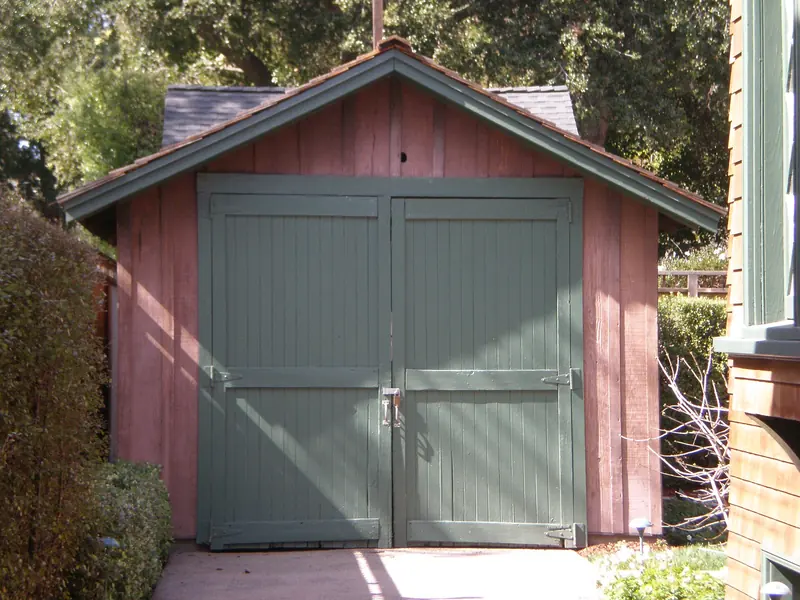

The house at 367 Addison Avenue was built in 1905. Its first occupant was Dr. John Spencer, who became Palo Alto's first mayor in 1909. The house was later split into apartments. In 1938 David and Lucile Packard rented the ground floor and Bill Hewlett moved into a shed on the property. On January 1, 1939, Hewlett and Packard formalized their partnership and used the small garage out back as their workshop. Their first product was an audio oscillator.
The garage became a city landmark in 1985 and California Historical Landmark No. 976 in 1987. It was dedicated as the Birthplace of Silicon Valley in 1989. HP bought the property in 2000 and finished restoring it in 2005. It was added to the National Register in 2007. The site is not open for tours, but you can see the garage and plaque from the sidewalk and driveway. Our HP Garage visitor guide has more detail and Silicon Valley history picks up the story from there.
A one-hour walking route
This loop covers the highlights at an easy pace. Start from downtown, about a ten minute walk north, or park on a side street and respect the residential permit signs.
- Begin at the HP Garage, 367 Addison Avenue, between Waverley and Bryant streets.
- Walk to Bryant Street and turn south. Stop at the cottage at 944 Bryant, the former photo studio.
- Continue south on Bryant past the Frank Angell House at 1005 Bryant and on to the Sunbonnet House at 1061 Bryant near Lincoln Avenue.
- Detour along Lincoln Avenue to see the early faculty homes, including the Wing and Abbott houses.
- Turn onto Kingsley Avenue. Look for the Dutch Colonials, the Sanford house at 450 Kingsley with its corner tower and the Stein house at 433 Kingsley.
- Near Waverley Street, look for the entrance to Sherwood Court, but stay outside since it is private.
- Head south to 433 Melville Avenue, the Gilbert house.
- Finish at Embarcadero Road. Gamble Garden is just across Embarcadero at Waverley Street if you want to keep going into Old Palo Alto.
Add one more stop on the way back to downtown. The state landmark plaque at Channing Avenue and Emerson Street marks the Federal Telegraph Company lab where Lee de Forest developed the vacuum tube amplifier between 1911 and 1913. Our history of Palo Alto tells that story.
Palo Alto Stanford Heritage, the local preservation group, has offered docent-led tours in spring and publishes self-guided walks on its website. If you prefer someone else to do the talking, try a self-guided audio tour or browse Silicon Valley tours that include the garage.
Living in Professorville today
Professorville is a quiet residential neighborhood with a short walk to University Avenue, the Caltrain station and the downtown library and parks. Bryant Street is a popular bike route, so you will share the road with commuters. The trade-off for the history is regulation. Exterior changes go through the city's historic review process and new construction must fit the design guidelines. Most houses are large single-family homes, with a few apartments and cottages mixed in. For prices and the wider market see our Palo Alto real estate guide. To compare it with nearby areas, start at our neighborhoods overview or walk up to downtown.
Good to know
- Every house on this page is a private residence. Photos from the sidewalk are fine. Do not knock or wander onto lots.
- Late afternoon light is best for photos of the shingles.
- Residential permit rules apply on many blocks near downtown. Check signs before leaving a car for long.
Frequently asked questions
Why is it called Professorville?
Many of Stanford University's first professors built homes there in the 1890s and early 1900s. Stanford only leased its campus land, so faculty who wanted to own their houses bought lots in the new town just south of University Avenue. The nickname stuck.
Where exactly is Professorville?
It lies a few blocks southeast of downtown Palo Alto. The National Park Service describes the historic district as roughly bounded by Embarcadero Road, Addison Avenue, Emerson Street and Cowper Street. Its historic core is Kingsley, Lincoln and Addison avenues.
Can you go inside the HP Garage?
No. The garage at 367 Addison Avenue is on private property owned by HP and is not open for tours. You can see it and the state landmark plaque from the sidewalk.
Is there a guided tour of Professorville?
Palo Alto Stanford Heritage has run docent-led neighborhood tours and publishes self-guided walks. The route on this page covers the main houses in about an hour on your own.
Are Professorville houses open to the public?
No. Almost every building is a private home. Enjoy them from the sidewalk, keep voices down and do not walk onto driveways or porches.