On this page
Palo Alto is a college town that spent most of its history without a legal bar downtown. From the first lot sales in the 1880s until 1971, the sale of hard liquor along University Avenue was banned by one rule or another. Students drove to roadhouses across the county line. Professors had bottles shipped in crates, by one local story labeled as books. The town's second downtown, California Avenue, was born in a rival town that had too many saloons.
This page untangles where the ban came from, how people got around it and how it finally ended. The early townsite story is on our founding of Palo Alto page. The saloon town next door is on our Mayfield page.
Why a wine baron wanted a dry town
The irony is hard to miss. Leland Stanford owned the Vina ranch in Tehama County, whose vineyard was then called the largest in the world. KQED reports that the family even ran a winery on campus for a time. He was no temperance crusader.
He was a politician, though. Steve Staiger of the Palo Alto Historical Association has explained that Stanford saw a sober setting as a selling point for parents in an era when the temperance movement was strong. Mayfield, the farm town at the edge of his land, had about 13 saloons and two breweries. In 1886 Stanford asked it to close them in exchange for becoming the university's gateway. Mayfield refused. Our page on the Stanford family covers the man behind the decision.
Four layers of rules
A common belief is that the ban sat in Stanford's founding grant. It did not. The grant was signed November 11, 1885. Its text, reprinted in the university's 1908 trustees' manual, says nothing about alcohol. The dry rules came from four other places:
- The deeds. At Stanford's request, Timothy Hopkins wrote a clause into University Park deeds that banned making or selling intoxicating liquor on the lot. If an owner broke it, the property could revert to Hopkins. Local histories date the clause to 1889.
- The town. Stanford Magazine reports that Palo Alto's founding documents of 1894 outlawed "any tippling-house, dramshop, cellar, saloon, bar, bar-room" or other place where liquor was sold. Some accounts blur this with the deed clause, so treat the exact wording and date with care.
- The state. In 1909 state Sen. Marshall Black, a Palo Alto businessman, won passage of a law banning liquor sales within a mile and a half of a university. In practice it was aimed at Stanford. It later appeared in the Penal Code as section 172a.
- The university. Stanford allowed students to drink for its first 17 years. After what David Starr Jordan called "a wave of beer drinking" in 1907, a student affairs committee banned alcohol on campus in 1908. More than 300 students marched in protest. On October 30, 1908, the trustees asked the faculty to ban liquor in fraternity houses and other student lodgings.
National Prohibition then covered everyone from 1920 until its repeal at the end of 1933. When it ended, Palo Alto's local rules simply stayed in place.
Loopholes and lawsuits
The ban was never airtight. Accounts differ on the details, but several cracks appear in the record:
- Low-alcohol beer: Weak beer was allowed under state rules. A 1948 Stanford Daily editorial noted that 3.2 percent beer was legal on campus under state code. A later history puts the downtown limit at 2.5 percent.
- Bottle clubs: Two private clubs downtown served members from bottles they brought themselves.
- The 1934 pharmacy case: The state granted a liquor license to the California Avenue Pharmacy. Stanford's trustees challenged it. On November 2, 1934, the California Supreme Court held that the distance should be measured in a straight line from the campus limits and that the license was void. It still denied Stanford's petition because the university had used the wrong legal procedure.
- South Palo Alto: In 1953 a store in south Palo Alto, outside the restricted area, received permission to sell hard liquor.
Whiskey Gulch
The best known escape lay just over San Francisquito Creek. Attorney and state Assemblyman Frank Crist, a Stanford graduate, attacked the deed restrictions in the 1930s. In 1933 he won the right to run a liquor business at the far end of University Avenue near the Bayshore Highway, outside Palo Alto's limits. Others followed. Generations of students knew the strip of bars and liquor stores as Whiskey Gulch.
The area later became part of East Palo Alto. The liquor stores gave way to office buildings and a hotel. The site is now University Circle, home of the Four Seasons. Students also drove to roadhouses on the Peninsula. The Dutch Goose in Menlo Park, opened in 1966, became a favorite. If you plan a visit today, call ahead, since its old website domain is now parked.
The ban weakens in the 1960s
By the 1960s the rules looked dated. Cars made them easy to dodge. In February 1966 an anonymous group of Stanford parents complained that students could drink just 120 feet from the dorms at a barbecue spot outside the campus line. That April the trustees went the other way and allowed students over 21 to drink in campus residences. A dean told parents the university would no longer police state drinking laws. The wider mood of the decade is on our page about Palo Alto in the 1960s.
The 1970 ruling and the first legal drink
The end came through the courts. Barry Amato, who ran the Shutter restaurant in the Hotel President building at 482 University Avenue, sued over the old Hopkins restrictions. His lawyer was Frank Crist, the same man who had opened Whiskey Gulch. In 1970 Judge Peter Anello of Santa Clara County ruled the restrictions invalid and unenforceable.
The celebration followed in May 1971. Sources disagree on the details:
| Detail | What sources say |
|---|---|
| Date | May 21, 1971 (Mountain View Voice) or May 22, 1971 (other local histories) |
| Place | The Shutter at 482 University Avenue (Mountain View Voice) or Henry's in the same hotel building (Stanford Magazine) |
| The drink | A martini handed to Frank Crist. Local historians say it was water, because the liquor had not arrived yet. |
| Full end of the ban | 1971 in most accounts. A history by Gullard and Lund, cited by the Almanac, gives 1972. |
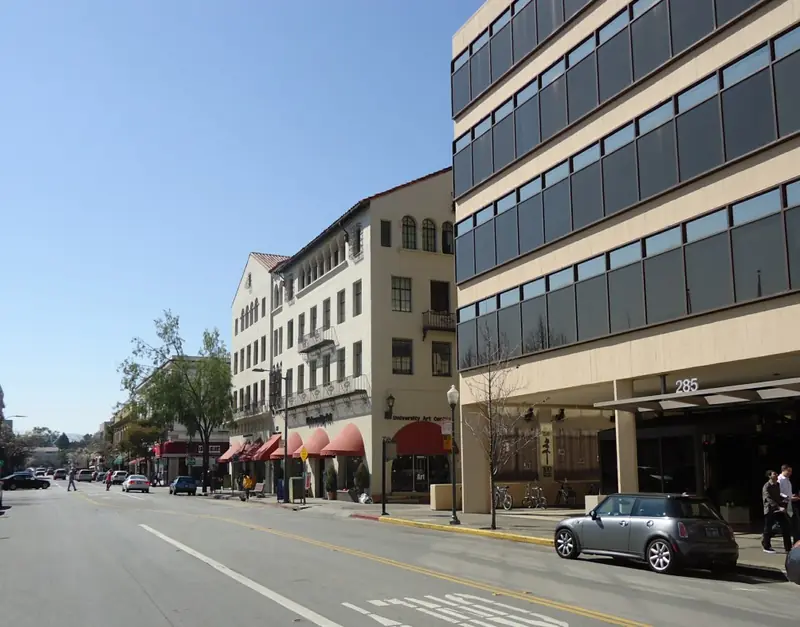
Henry's became a student favorite and lasted until 1995. The Hotel President building is now a hotel again.

The dry legacy today
Today downtown and California Avenue are full of bars, wine bars and restaurants with full liquor licenses. Our guide to bars, wine and beer covers them. A few traces of the old rules remain. Palo Alto still has no brewery inside city limits. The town's two downtowns still reflect the split between a dry university town and its wet neighbor.
A dry town walk
You can trace the story in about an hour on foot. Start at the Palo Alto Caltrain station and walk up University Avenue through the old Hopkins Tract, where every lot once carried the liquor clause. Stop outside 482 and 488 University, the Hotel President building, where the first legal drink was poured in 1971. Continue northeast along University toward the creek. Across the bridge, University Circle marks the site of Whiskey Gulch, the bars and liquor stores that thrived for decades just outside the line.
For the other half of the story, take Caltrain one stop south to California Avenue. This was Mayfield's main street, the town of 13 saloons that turned Stanford down in 1886 and then banned its own saloons in 1904 and 1905. Today its restaurants serve wine and cocktails on a car-free street, a short walk from where Leland Stanford made his offer.
Sources for this page
- Stanford Magazine, "Our Town", on the deeds, the 1894 rule, the 1909 law and Whiskey Gulch.
- KQED, 2019, on Mayfield and the Stanfords' motives.
- The Stanford Daily, 2016, on campus rules from 1908 to 1966.
- Mountain View Voice, "Peninsula history", on the 1971 toast and the lawsuit.
- Board of Trustees v. State Board of Equalization (1934), the California Avenue Pharmacy case.
Frequently asked questions
Was Palo Alto a dry town?
Yes, for most of its first 80 years. Deeds in the original townsite banned selling liquor, a 1909 state law barred liquor sales within a mile and a half of Stanford and national Prohibition added another layer from 1920 to 1933. Downtown's first legal cocktail was served in May 1971.
Did the Stanford founding grant ban alcohol?
No. The 1885 founding grant says nothing about liquor. The restrictions came from Timothy Hopkins's deeds, a state law passed in 1909 and the university's own student rules, which banned drinking on campus from 1908 until the trustees relaxed them in 1966.
Why was Leland Stanford against saloons if he made wine?
He was not a teetotaler. He owned what was then called the world's largest vineyard. Local historians say he wanted a sober town beside the campus because it would reassure the parents of prospective students during the temperance era.
What was Whiskey Gulch?
Whiskey Gulch was a cluster of bars and liquor stores at the far end of University Avenue across San Francisquito Creek, in what is now East Palo Alto. Frank Crist won the right to open a liquor business there in 1933, outside Palo Alto's restrictions. The site is now University Circle and the Four Seasons hotel.
When did the alcohol ban end in Palo Alto?
A Santa Clara County judge ruled the old deed restrictions unenforceable in 1970 in a case brought by restaurant operator Barry Amato. Downtown celebrated its first legal public drink in May 1971. Sources give May 21 or May 22. One book cited by the Almanac puts the full end in 1972.