On this page
Few cities are as attached to their trees as Palo Alto. The name itself comes from El Palo Alto, the tall redwood beside San Francisquito Creek. The first residents in the 1890s planted the town's early canopy on bare farmland and carried water to keep the saplings alive. Today the older neighborhoods sit under arching street trees, the foothills are dotted with native oaks and the city counts its trees with the care other towns give to budgets.
This guide explains what the urban forest is, how the city plans for it, which trees the law protects, what the latest oak count found and where to see the most notable trees. If you own property here, the rules section matters most.
What the urban forest includes
The city defines the urban forest broadly. It includes street trees, park trees, forested parkland and trees on private property. Together they shade streets, soak up stormwater, filter the air, store carbon and raise property values.
The Urban Forestry Section of Public Works runs the public side. The city says the section maintains nearly 66,000 trees. City staff, in-house crews and contractors plant, prune and remove public trees and run a street tree pruning program. Inspection and pruning requests go to Public Works at 650-496-5953 or [email protected]. The city's urban forest page has the details.
Palo Alto's program has collected outside recognition. The city has held Tree City USA status since the late 1980s. In August 2016 it became the 15th city in the United States and Canada accredited by the Society of Municipal Arborists. City Utilities has also been named a Tree Line USA utility for its care around power lines. Our guide to city utilities explains the city-owned power system.
The Urban Forest Master Plan
Work on the city's Urban Forest Master Plan began in December 2010. The City Council adopted the first edition in 2015 and a second edition in February 2019, with a revised set of goals, policies and programs and a new implementation plan. The plan looks ahead about ten years.
It tackles a few big issues:
- Uneven canopy. Tree cover is much thicker in some neighborhoods than others. Planting programs in south Palo Alto aim to narrow the gap.
- Coordination. Many departments touch trees, from utilities to planning to parks.
- Regulation. How the city protects trees during construction and on private land.
- Practice. How trees are planted, watered, pruned and replaced.
When it adopted the second edition, the council asked staff to follow up on topics the plan did not cover well, including native species and ecology, development rules and work with environmental groups. The full plan and its supporting reports are on the master plan page.
Protected and heritage trees
Palo Alto's tree rules live in Title 8 of the municipal code. An update that took effect on May 1, 2024 widened the protections. The city's protected trees page sorts them into three groups.
| Category | What is protected |
|---|---|
| Public trees | Every tree in a street right of way, park or city facility, at any size |
| Native species | Coast live oak, blue oak, California black oak, valley oak, big leaf maple and California incense cedar at 11.5 inches DBH or more |
| Coast redwood | 18 inches DBH or more |
| Other mature trees | Any tree at 15 inches DBH or more, except invasive and high water use species such as willows, alders, cottonwoods and dawn redwoods |
| Heritage trees | Individual trees of any size or species designated by the City Council for historical significance |
DBH means diameter at breast height, measured on the trunk about four and a half feet above the ground. Property owners can nominate a tree with distinctive character for heritage status.
What owners need to do
- Before removing a protected tree, get a permit. For a home with no development project, apply to the Urban Forestry Section for a Tree Removal Permit through the online permit portal or by emailing an application and an arborist report to [email protected]. Commercial and multi-unit properties go through planning review instead.
- Before maintenance on a protected tree, notify the public and Urban Forestry at least seven days in advance. Small jobs such as removing a dead or broken branch and work on trees under five years old are exempt.
- Before working near a street tree, get a permit from Urban Forestry for any work on or within its drip line.
Allowed reasons for removal include a tree that is dead, hazardous or a nuisance, or one that crowds a nearby protected tree or damages a home's foundation. Check the tree ordinance page before you call a tree service.
The Great Oak Count
Native oaks are the original trees of the valley floor. Before the town was built, they dotted the grassland between the bay and the hills. To see how they are faring, the city and the nonprofit Canopy ran the Great Oak Count from 2017 to 2025. More than 350 volunteers walked nearly 280 routes across 24 neighborhoods and mapped and measured more than 11,000 native oaks. The results were released in February 2026.
- Native oaks grew by more than 2,000 since the 2001 Oakwell survey, a rise of 22 percent.
- Valley oaks rose 39 percent and black oaks rose 400 percent. Blue oaks rose more than 3,000 percent from a very small base.
- Oaks planted as street trees jumped from 341 to more than 1,700.
- Seven neighborhoods lost oaks: Barron Park, Professorville, Old Palo Alto, Crescent Park, Charleston Meadows, Downtown and the Palo Alto High School area. Professorville lost more than 35 percent.
The city noted that canopy cover in those neighborhoods fell by 7 to 11 percent between 2020 and 2022 and that losing mature oaks may be one reason. A companion survey of 840 young trees found 77 percent in good or excellent condition and a mortality rate of 5 percent.
Canopy and the South Palo Alto Tree Initiative
Canopy is a Palo Alto nonprofit created in 1996 to grow and care for the urban forest. It works closely with the city on planting, young tree care and education. Since 2016, Canopy and the city have planted more than 1,500 trees through the South Palo Alto Tree Initiative, mostly drought tolerant or native species, to even out the canopy gap between the north and south of town. See our guide to south Palo Alto for the neighborhoods involved.
Canopy relies on volunteers for planting days, watering reminders and surveys. Our volunteering guide lists other ways to help.
Notable trees to see
El Palo Alto
The city's namesake is a coast redwood more than 1,000 years old, standing about 110 feet tall beside the Caltrain tracks and San Francisquito Creek. The Portolá expedition camped near it in November 1769. It once had a twin trunk, photographed by Carleton Watkins in 1870, that fell sometime in the late 1870s or 1880s by most accounts. See our full guide to El Palo Alto.
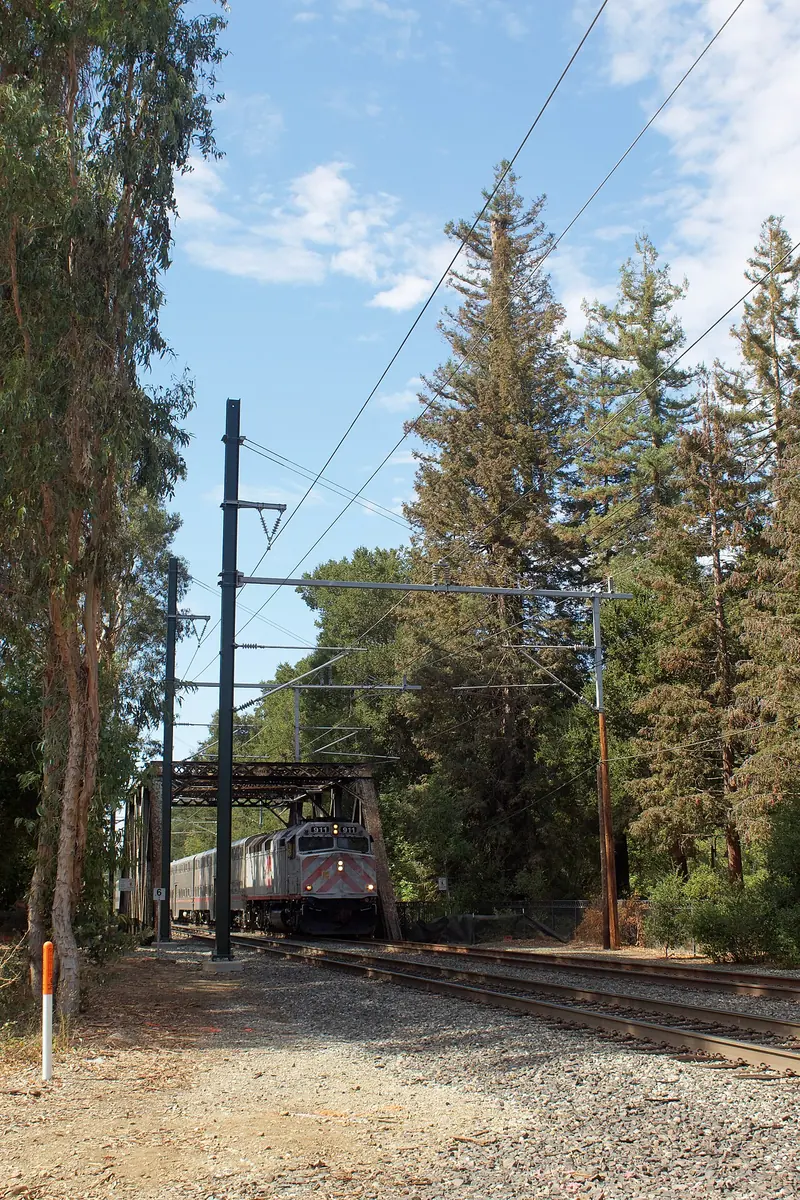

Street trees of the old neighborhoods
Walk the streets of Professorville, Crescent Park and Old Palo Alto to see the canopy the early residents planted. On many blocks large, mature street trees meet over the roadway. These are also among the neighborhoods where the Great Oak Count found native oaks declining, so the old canopy needs replanting to last.
Rinconada Park's redwoods
Rinconada Park has a grove of redwoods and big shade trees that make it one of the coolest spots in town on a hot day.
Stanford
Palm Drive's rows of palms frame the approach to the Main Quad and the campus is full of oaks and specimen trees. The Arizona Cactus Garden shows a very different side of the university's plant collection. Our self-guided campus walk passes many of them.
Good to know
- All street trees are city property. Do not prune them yourself. Call Urban Forestry.
- Notice rules for protected tree maintenance took effect May 1, 2024.
- Questions about permits go to [email protected].
- For the history of how the town was planted, see our founding of Palo Alto page.
Frequently asked questions
Which trees are protected in Palo Alto?
All public trees, including street and park trees, are protected. On private land the city protects coast live, blue, black and valley oaks plus big leaf maple and incense cedar of 11.5 inches in diameter or more, coast redwoods of 18 inches or more and most other mature trees of 15 inches or more. Council-designated heritage trees are protected at any size.
Do I need a permit to cut down a tree in Palo Alto?
You need a permit to remove a protected tree. For homes without a development project, apply to the Urban Forestry Section for a Tree Removal Permit with an arborist report. Since May 1, 2024 owners must also give at least seven days of public notice before most maintenance on protected trees.
Who maintains street trees in Palo Alto?
The city's Urban Forestry Section in Public Works plants, prunes and maintains public trees. You need a city permit before doing any work on or within the drip line of a street tree. Call 650-496-5953 or email [email protected] for inspections and pruning requests.
What is a heritage tree in Palo Alto?
A heritage tree is an individual tree of any size or species that the City Council designates for its historical significance or distinctive character. Property owners can nominate trees. Once designated, the tree is protected under the city's tree ordinance.
How many oaks are in Palo Alto?
The Great Oak Count, finished in 2025, mapped and measured more than 11,000 native oaks. That was over 2,000 more than the 2001 survey, a 22 percent increase, though several older neighborhoods lost oaks.