On this page
Palo Alto entered the 1990s still patching up after the Loma Prieta earthquake. Its population was flat at 55,900, its school district had just hit bottom and downtown was living under a 1986 cap on new offices. By 1999 the city was one of the hottest office markets in the country. Startups that would become household names were renting rooms above University Avenue shops. In between, the creek on the city's north edge produced the worst flood on record.
This overview runs theme by theme. It picks up from our page on Palo Alto in the 1980s and leads into our full account of the dot-com era, which covers the boom and bust in detail.
Rebuilding after the quake
The early 1990s were years of repair, especially at Stanford. The Loma Prieta earthquake of October 1989 had damaged 242 campus buildings. Memorial Church was rededicated on November 1, 1992. Ground was broken on October 26, 1995, to restore the old Stanford Museum and add a 42,000 square foot wing. It reopened in 1999 as the Iris and B. Gerald Cantor Center for Visual Arts. Our Loma Prieta page follows the long rebuild.
The founders of HP were giving on a large scale. Lucile Packard Children's Hospital opened in June 1991, helped by a $40 million Packard gift from 1986. In 1994 Bill Hewlett and Dave Packard gave a combined $77 million toward the Science and Engineering Quad. Packard died at Stanford on March 26, 1996, at 83. Our Hewlett and Packard page covers their later years.
From biotech to the web
The decade's first startups were not yet internet companies. IDEO formed downtown in 1991 when David Kelley's design firm merged with two others. Incyte Pharmaceuticals was founded in Palo Alto in April 1991 and Affymetrix spun off from Affymax in 1993. The law firm Wilson Sonsini moved into its 650 Page Mill Road headquarters when the building opened in 1994.
The web changed everything quickly. In December 1991 SLAC, on Stanford land, put the first web server outside Europe online. In 1994 two Stanford graduate students began the directory that became Yahoo. In 1996 Digital Equipment Corporation began operating the Palo Alto Internet Exchange, an early meeting point where networks swapped traffic. The pace picked up at the end of the decade:
- February 10, 1998: VMware was founded in Palo Alto, growing out of Stanford research.
- December 1998: Confinity was founded by a group including Peter Thiel and Max Levchin.
- February 1999: Google moved into 165 University Avenue with eight employees. It outgrew the space within months and left for Mountain View later that year.
- March 1999: X.com incorporated in Palo Alto. It later merged with Confinity to form PayPal.
- November 18, 1999: Agilent Technologies, spun off from HP, sold stock to the public. Its headquarters was at 395 Page Mill Road.
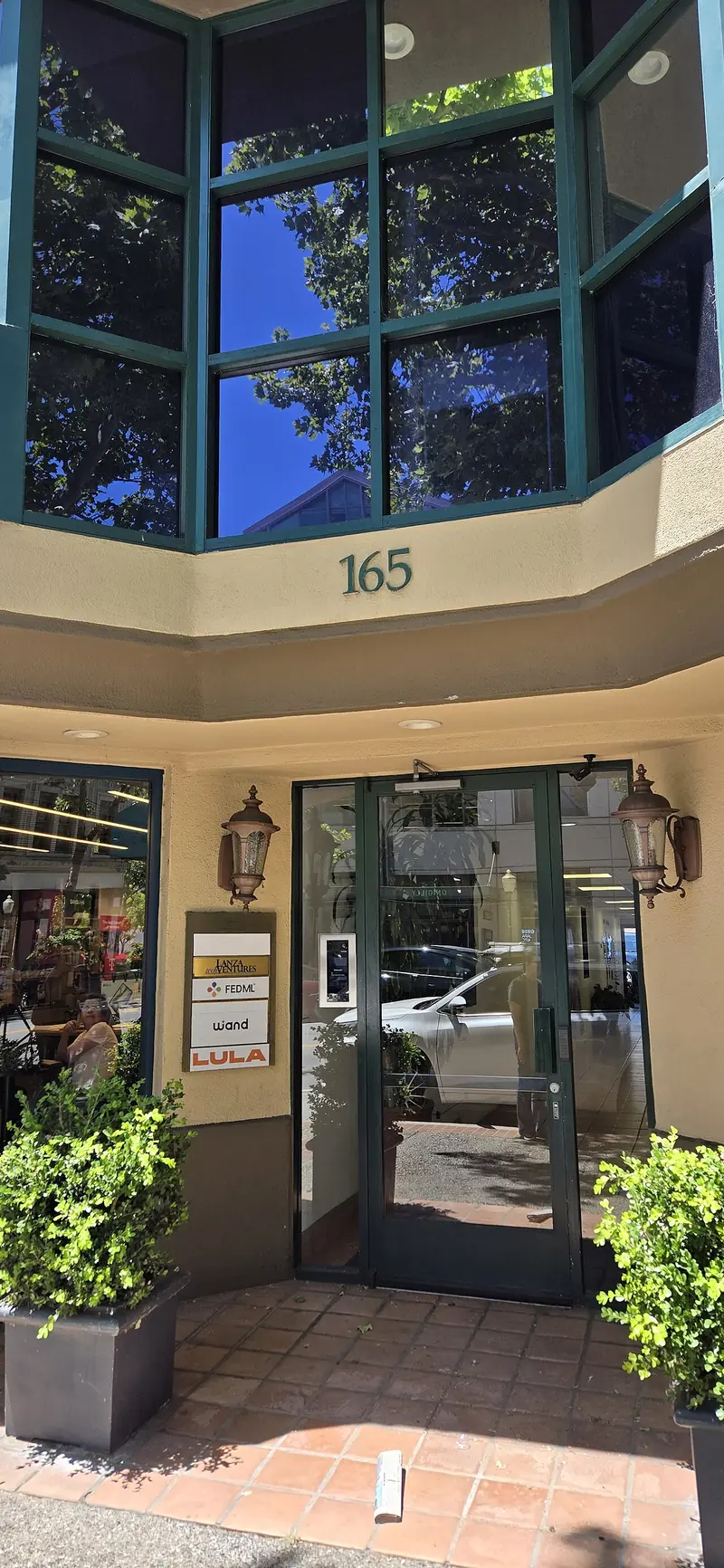

The rush showed in rents. By the early 2000 peak, downtown offices were renting for as much as $11 or $12 a square foot per month, a local broker reported. The 1986 downtown cap meant few new buildings, so companies squeezed into whatever space they could find.
The city at 100
Palo Alto marked its centennial in 1994. During the celebrations the original University Park townsite, the Hopkins Tract, was proclaimed a local heritage district. The downtown train depot joined the National Register of Historic Places on April 18, 1996.
Preservation became a live issue. In 1996, after new owners bulldozed 34 houses built before 1940, the City Council adopted an emergency moratorium on demolishing pre-1940 homes, the Palo Alto Weekly reported. An interim preservation order followed in 1998 and the Historic Resources Board wrote to 3,300 residents to say their homes might be added to the inventory. Our historic districts page explains the protections that exist today. Palo Alto Neighborhoods, an umbrella group for neighborhood associations, was founded in 1998.
The city's utility also looked ahead. City of Palo Alto Utilities says it built its dark fiber loop in 1996. A 1999 trade report described a 29-mile ring around the city, built in 1997 and completed in 1998 and linked to the internet exchange. Our city utilities history covers it.
News and rails
The old Peninsula Times Tribune, heir to the Palo Alto Times of 1893, closed on March 12, 1993. The Palo Alto Weekly began posting all its content online as Palo Alto Online in January 1994. It is often described as one of the first community news sites on the web. The free Palo Alto Daily News launched on December 7, 1995, with a press run of 3,000 copies. Our newspapers page follows each paper.
The trains changed hands. In 1991 the Peninsula Corridor Joint Powers Board, formed by San Francisco, San Mateo and Santa Clara counties, bought the right of way from Southern Pacific for $202 million. It took over operations in 1992, ending about 120 years of Southern Pacific service. See our railroad history.
Schools grow again
Palo Alto's school district had shrunk for two decades. Enrollment bottomed out at 7,452 in 1989. In the 1990s new families arrived with the tech boom and the numbers climbed. The district reopened Jordan Middle School in 1991. Barron Park Elementary opened in September 1998 as the district's twelfth elementary school. Terman Middle School would follow in 2001. Voters also approved a school bond in 1995, which Ballotpedia mentions as expiring when the district asked for a new one in 2008. Our school district history covers these years.
The 1998 flood
The winter of 1997 to 1998 brought one of the strongest El Niño patterns of the century. On the night of February 2 to 3, 1998, swollen San Francisquito Creek met a high tide. Around 1 a.m. water backed up behind the undersized Pope-Chaucer Street bridge and spilled over the banks. Because the creek runs on a raised fan of its own sediment, the water flowed away from the channel into Crescent Park, the Duveneck/St. Francis area and parts of Menlo Park and East Palo Alto.
About 1,700 properties were damaged. Damage was first estimated at $28 million and later revised to $40 million. About 500 residents evacuated and no deaths were reported. The peak flow of about 7,200 cubic feet per second remains the flood of record. Officials also confirmed that city crews had sandbagged the city manager's house, an episode the papers called sandbag-gate. On May 14, 1999, five agencies formed the San Francisquito Creek Joint Powers Authority to manage the creek. Our pages on the 1998 flood and San Francisquito Creek cover the night and the long fix.
1990s timeline
| Year | Event |
|---|---|
| 1991 | Jordan Middle School reopens. IDEO formed. Children's hospital opens. Rail line bought from Southern Pacific. |
| 1992 | Memorial Church rededicated November 1. Public agency takes over the trains. |
| 1993 | Peninsula Times Tribune closes March 12. |
| 1994 | City centennial. Palo Alto Online launches. Hewlett and Packard give $77 million. |
| 1996 | Internet exchange opens. Demolition moratorium. Dave Packard dies. |
| 1998 | Flood on February 2 to 3. VMware and Confinity founded. Barron Park Elementary opens. |
| 1999 | Google at 165 University. Creek authority formed. Agilent goes public. Cantor Center reopens. |
The census of 2000 counted 58,598 residents, up modestly from 55,900. The bubble that had filled downtown was about to burst, a story picked up on our page about Palo Alto in the 2000s.
Frequently asked questions
Which internet companies started in Palo Alto in the 1990s?
VMware was founded in Palo Alto in February 1998. Confinity, one half of what became PayPal, was founded there in December 1998 and X.com, the other half, in March 1999. Google worked out of 165 University Avenue for a few months in 1999 before moving to Mountain View.
What happened in the 1998 Palo Alto flood?
On the night of February 2 to 3, 1998, San Francisquito Creek topped its banks at high tide around 1 a.m. About 1,700 properties in Palo Alto, Menlo Park and East Palo Alto were damaged. Damage was first put at $28 million and later revised to $40 million. No deaths were reported.
Did Palo Alto schools grow in the 1990s?
Yes. Enrollment had bottomed out at 7,452 in 1989. As it climbed again, the district reopened Jordan Middle School in 1991 and opened Barron Park Elementary in September 1998 as its twelfth elementary school. Terman Middle School reopened in 2001.
When did Palo Alto turn 100?
The city marked its centennial in 1994, a hundred years after the April 1894 incorporation. During the celebrations the original University Park townsite was proclaimed a local heritage district.
What was the Palo Alto Internet Exchange?
It was an early internet exchange point where networks connected to trade traffic. It began operating in Palo Alto in 1996, owned and operated by Digital Equipment Corporation. The city's own dark fiber ring of the late 1990s linked to it.