On this page
Most visitors know Bill Hewlett and David Packard as two names on a garage plaque. In Palo Alto they are more than that. Their company filled Stanford Research Park, their management style became a model for Silicon Valley and their money paid for a children's hospital, a restored movie palace and a large share of Stanford's science buildings. This page follows the two men from their childhoods to their deaths and points out where their influence still shows around town.
The garage itself has its own page. Read our guide to the HP Garage at 367 Addison Avenue for the house, the 200A oscillator and how to see it. The company's later history, from the research park to the 2015 split, is on our Hewlett-Packard profile.
Two boys from opposite directions
William Redington Hewlett was born on May 20, 1913, in Ann Arbor, Michigan. His father, Albion Walter Hewlett, taught medicine at the University of Michigan. In 1916 the family moved to San Francisco when his father took a post at Stanford's medical school, which was then in the city. Bill attended Lowell High School, where he commanded the school's Junior ROTC battalion in 1929 and 1930. His father died of a brain tumor while Bill was still young. Biographers note that Stanford admitted him partly as a courtesy to his late father, since his grades were uneven. Later accounts say he had dyslexia.
David Packard was born on September 7, 1912, in Pueblo, Colorado. His father, Sperry Sidney Packard, was a lawyer. At Centennial High School he built radios and played several sports. He was tall and athletic. At Stanford he lettered in football and basketball and joined Phi Beta Kappa.
Stanford and Frederick Terman
The two met at Stanford, where both studied engineering and both earned bachelor's degrees in 1934. The decisive figure was their professor, Frederick Terman, who worried that his best graduates kept leaving California for jobs in the East. Terman pushed the pair to build something near campus instead.
Their paths split for a few years first. Hewlett went to MIT and earned a master's degree in electrical engineering in 1936. Packard took a job with General Electric in Schenectady, New York. In 1938 Packard came back to Stanford. Terman is often credited with helping bring him back. He finished a master's degree in electrical engineering and married Lucile Salter, whom he had met as a student. Hewlett returned as well and completed an engineer's degree at Stanford in 1939. His graduate work on a new kind of audio oscillator became the company's first product.
The 1939 partnership at 367 Addison
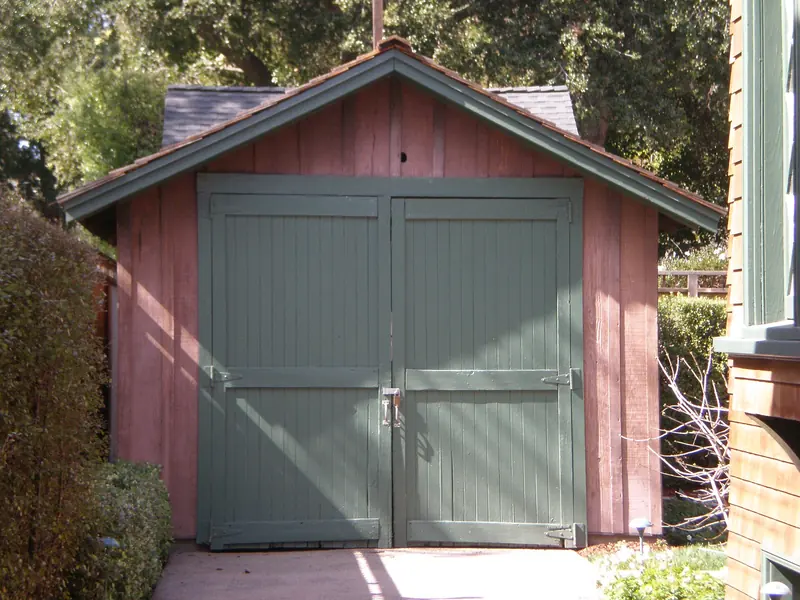
Hewlett and Packard began discussing a company in August 1937. In 1938 the newly married Packards rented the ground floor of a house at 367 Addison Avenue, just south of downtown. Hewlett slept in a shed out back. The detached one-car garage became the workshop. On January 1, 1939, the two formalized their partnership with $538 in cash and equipment. A coin toss put Hewlett's name first.
Their first big order came from Walt Disney Studios, which bought eight oscillators for work on Fantasia. By 1940 they had outgrown the garage and moved to rented space at 481 Page Mill Road. Later that year Hewlett married Flora Lamson. The garage is now California Historical Landmark No. 976 and the house and garage were listed on the National Register in 2007.

War, incorporation and the research park
World War II split the partners again. Hewlett served as an Army Signal Corps officer and later led the electronics section of a new development division on the War Department's special staff. After the war he joined a team that inspected Japanese industry. Packard stayed in Palo Alto and ran the company, which grew on military orders for test equipment.
The partnership became a corporation on August 18, 1947, with Packard as president. In 1956 HP leased land in the new Stanford Industrial Park and in 1957 it sold stock to the public for the first time. The company moved its headquarters to 1501 Page Mill Road in 1960, where HP Inc. still has its head office. Our page on Stanford Research Park covers how that move helped define the park.
| Role | Bill Hewlett | David Packard |
|---|---|---|
| President of HP | 1964 to 1977 | 1947 to 1964 |
| Chief executive | 1968 to 1978 | 1964 to 1968 |
| Chairman | Vice chairman to 1987 | 1964 to 1968 and 1972 to 1993 |
| Outside service | President of the Institute of Radio Engineers, 1954 | U.S. Deputy Secretary of Defense, 1969 to 1971 |
Packard's time in Washington under President Nixon ran from January 24, 1969, to December 1971. He then returned to HP as chairman. Hewlett ran the company day to day through most of the 1970s and handed the chief executive job to John Young in 1978.
The HP Way
The founders became as famous for how they ran the company as for what it made. The approach came to be called the HP Way. HP first wrote it down in 1957 as six corporate objectives after a meeting of senior managers in Sonoma. A seventh objective was added in 1966. The company published a booklet titled The HP Way in July 1977.
- Management by objectives. Employees got clear goals and wide freedom in how to reach them.
- Management by walking around. Packard's phrase for managers who left their offices to talk with people on the floor.
- Open doors and shared rewards. HP set up profit sharing and stock purchase plans for employees, unusual for a large company in that era.
- Growth paid for by profits. The founders avoided long-term debt and reinvested earnings.
- Citizenship. The company was expected to contribute to the communities where it worked.
The best-known test came in 1970, when orders fell. Instead of laying people off, HP put everyone, executives included, on a "nine-day fortnight" with a 10 percent cut in hours and pay for about six months. Packard explained the philosophy in his 1995 book The HP Way: How Bill Hewlett and I Built Our Company. Hewlett called the HP Way Packard's greatest legacy. An HP archivist later said company papers suggest the idea started with Hewlett. Both claims can be true of a partnership this close.
Observers usually date the end of the HP Way to the early 2000s, when chief executive Carly Fiorina merged HP with Compaq. Walter Hewlett, Bill's son, led an unsuccessful fight against the merger in 2002.
Families and private lives
Bill and Flora Hewlett had five children. Flora died in 1977. In 1978 he married Rosemary Kopmeier Bradford. He was a keen outdoorsman, amateur botanist and photographer of wildflowers. Some of his plant collections went to the California Academy of Sciences.
David and Lucile Packard had four children: David, Nancy, Susan and Julie. Lucile Packard was deeply involved in the family's giving and died in 1987 at 72. The Packards kept ranch land and a home in Los Altos Hills. Their son David Woodley Packard later founded the Packard Humanities Institute and led the restoration of the Stanford Theatre on University Avenue.
Philanthropy
From the 1960s on, both men gave away much of what HP made them. The David and Lucile Packard Foundation dates to 1964. The William and Flora Hewlett Foundation followed in 1966. Both remain among the largest private foundations in the country and both are based in Los Altos and Menlo Park, a short drive from where the company started.
- Monterey Bay Aquarium. Prompted by daughters Nancy and Julie, the Packards created the aquarium's foundation in 1978 and gave about $55 million to build it. It opened in 1984 with Julie Packard as executive director. David Packard gave $13 million in 1987 to start the Monterey Bay Aquarium Research Institute.
- Lucile Packard Children's Hospital. In 1986 the Packards gave $40 million toward a children's hospital at Stanford. It opened in June 1991 and carries Lucile's name.
- The Stanford Theatre. In 1987 the Packard Foundation bought the 1925 movie palace downtown. It reopened in 1989 after a careful restoration. Our page on downtown theaters tells that story.
- The Science and Engineering Quad. In 1994 Hewlett and Packard gave a combined $77 million to Stanford. The David Packard Electrical Engineering Building and the William R. Hewlett Teaching Center stand side by side there.
- The 2001 Hewlett gift. In May 2001 the Hewlett Foundation pledged $400 million to Stanford, then reported as the largest gift ever to a university. A third went to the School of Humanities and Sciences and $100 million to undergraduate education.
Deaths and legacy
David Packard died at Stanford on March 26, 1996, at 83. He left the bulk of his estate, roughly $4 billion, to the Packard Foundation, including valuable land in Los Altos Hills. Bill Hewlett died of heart failure in Palo Alto on January 12, 2001, at 87. He was interred at Los Gatos Memorial Park in San Jose. Honors included the National Medal of Science for Hewlett in 1983 and the Presidential Medal of Freedom for Packard in 1988.
Their names are all over the region today. Look for them on Stanford's engineering buildings, the children's hospital and the aquarium. In Palo Alto the clearest traces are the garage on Addison Avenue, the HP campus on Page Mill Road and the restored theater on University Avenue. For the broader story of the companies that followed them, read our Silicon Valley history. You can also see the garage on a Silicon Valley tour.
Frequently asked questions
How did Bill Hewlett and David Packard meet?
They met as engineering students at Stanford in the early 1930s, where both took classes from Frederick Terman. Both earned bachelor's degrees in 1934. They began talking seriously about a company in August 1937 and formalized their partnership on January 1, 1939.
Why is the company called Hewlett-Packard and not Packard-Hewlett?
They flipped a coin. Packard won the toss and the name came out as Hewlett-Packard, a story Packard repeated in his 1995 book The HP Way.
What was the HP Way?
It was the founders' management philosophy. It stressed trust in employees, management by objectives, informal management by walking around and an obligation to the community. HP first wrote it down as six objectives in 1957 and added a seventh in 1966.
What did Hewlett and Packard give to Stanford?
A great deal. The Packards gave $40 million toward Lucile Packard Children's Hospital, which opened in 1991. The two founders gave $77 million together in 1994 toward the Science and Engineering Quad. In 2001 the Hewlett Foundation pledged $400 million, then called the largest gift ever to a university.
When did Hewlett and Packard die?
David Packard died at Stanford on March 26, 1996, at 83. Bill Hewlett died in Palo Alto on January 12, 2001, at 87. Both had stepped back from running HP years earlier.