On this page
At 5:04 p.m. on Tuesday, October 17, 1989, much of the Bay Area was settling in to watch Game 3 of the World Series between the Giants and the A's. Then the ground moved. The Loma Prieta earthquake ruptured a section of the San Andreas fault system deep under the Santa Cruz Mountains. It killed 63 people across the region, collapsed a double-deck freeway in Oakland and dropped a section of the Bay Bridge.
Palo Alto was spared the worst. Stanford was not. The university's older stone buildings took the hardest hit in the area and some stayed closed for a decade. This page covers what happened in town and on campus, how Stanford paid for the repairs and what you can see today. For the first great quake, read our page on the 1906 earthquake at Stanford and Palo Alto.
Fifteen seconds on a World Series evening
The quake's epicenter lay in the Forest of Nisene Marks State Park, about 10 miles northeast of Santa Cruz and roughly 35 miles from downtown Palo Alto. It measured magnitude 6.9. The heaviest shaking near the epicenter lasted about 15 seconds. Farther away, the length and strength of shaking depended heavily on soil. Rock sites shook briefly. Soft fill near the bay shook longer and harder.
The timing almost certainly saved lives. Because both World Series teams were local, many commuters had left work early or stayed late to watch the game. Freeways that would normally have been jammed at rush hour were unusually quiet. Game 3 was postponed for 10 days.
The heaviest losses were elsewhere: 42 deaths in the collapse of the Cypress Street Viaduct in West Oakland, fires and collapses in San Francisco's Marina District and wrecked downtown blocks in Santa Cruz and Watsonville. Palo Alto residents mostly dealt with broken dishes, toppled bookcases, cracked chimneys and a long, anxious night of aftershocks.
What happened in Palo Alto
We found few detailed public accounts of damage in the city itself, which fits the general picture of a town that came through far better than its neighbor. Most Palo Alto homes are wood-frame houses, which flex in an earthquake instead of cracking. The city's weak point was older unreinforced brick, the same kind of construction that had failed downtown in 1906.
One documented local loss sits on El Camino Real. Dinah's Garden Hotel says the 1989 earthquake ruined the old Dinah's Shack, the roadside restaurant that had stood on its site since 1926. Our Dinah's Garden Hotel page tells the rest of that story.
The quake also hardened local attitudes about preparation. Palo Alto's municipal code includes a seismic hazards program for older buildings. The city's current advice for households is on our earthquake safety page.
Stanford: 242 damaged buildings
Stanford's campus sits on the alluvial plain a few miles east of the San Andreas fault. Much of the original Quad and its neighbors were built of sandstone over unreinforced masonry. According to Stanford's Quake '06 Centennial Alliance, the 15-second shock damaged 242 university buildings and 20 of them had to close.
The damage would have been worse without earlier work. Stanford had already retrofitted some older buildings in the 1980s. The History Corner, the Old Pavilion (now the Ford Center) and Roble Hall all came through with little damage. Roble had reopened just three weeks before the quake. Stanford's risk manager reported that no building already up to modern code was damaged. No deaths or injuries were reported on campus.
The old Main Library
The single largest damage claim on campus was Green Library West, the 1919 Main Library built after the 1906 quake wrecked its predecessor. Thousands of volumes crashed to the floor. Decorative columns shifted and cracks up to 30 feet long opened in the walls. The university archivist recalled seeing daylight through cracks in the corners of her office. The 700,000 books in its stacks fared better than they might have, thanks to a $5.5 million project in 1988 that braced the seven stories of shelving. The building was emptied and closed. Our Green Library page covers the building as it stands now.
Memorial Church
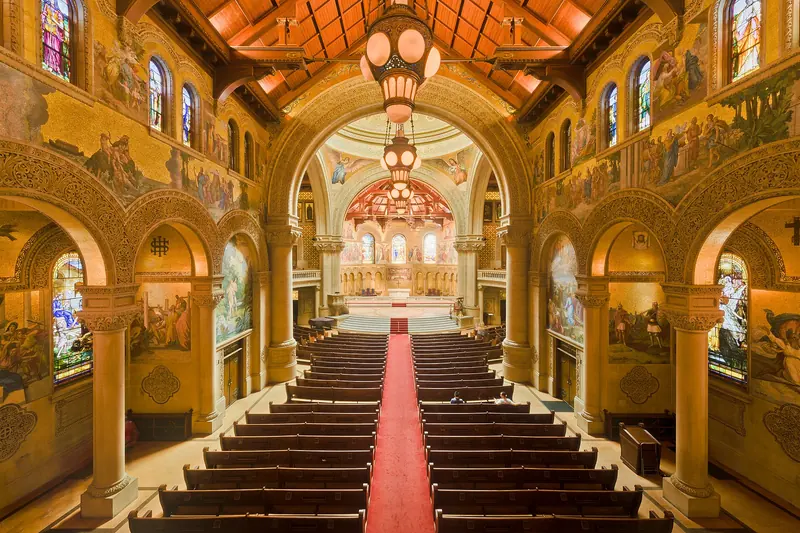
Memorial Church had been rebuilt after 1906 with better ties between its crossing and walls, which helped it survive. Even so, the four great mosaic angels below the dome were badly damaged. An eight-foot section of one angel's wing fell about 70 feet to the floor. Stones from the east arch landed on balcony pews and the organ loft railing collapsed inward. Pieces of the fallen mosaics were stolen and later returned anonymously. The central shaft of the Celtic cross on the facade was destroyed.

The Stanford Museum and the Quad
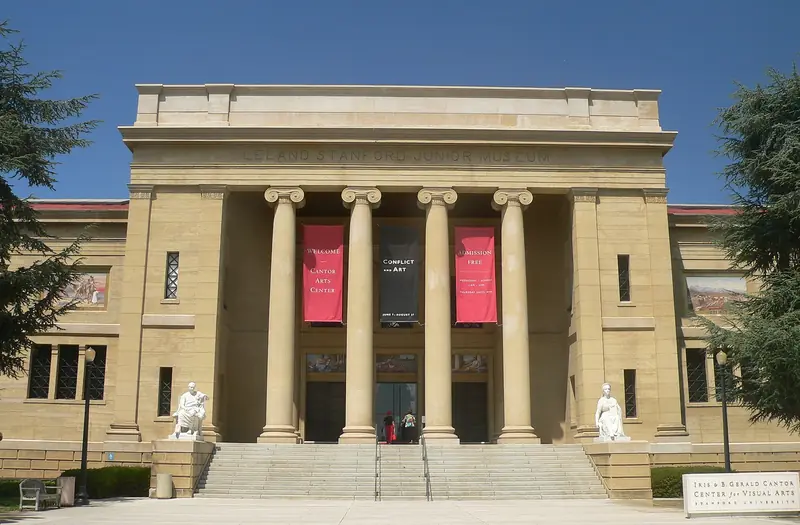
The museum, already a survivor of 1906, was damaged badly enough to close for good in its old form. Along with the Geology and Language corners of the Quad, it ranked just behind the library among Stanford's largest federal damage claims. Around the Main Quad, workers propped the arcades with big plywood braces. Studio art students painted them in bright colors until the arches were retrofitted.
Self-insured: how Stanford paid
Stanford faced the quake without earthquake insurance. Its insurer had cancelled the policy in June 1985. After a search turned up only very high premiums, the state insurance commissioner found that adequate coverage was not available at a reasonable price. Stanford chose to self-insure and had set aside only $7 million for emergency repairs.
| Item | Figure |
|---|---|
| Total repair bill | About $160 million, about 7 percent of the replacement value of all campus assets |
| FEMA's assessment of eligible damage | $67 million |
| Paid by FEMA | $50.3 million |
| State disaster assistance | $5 million |
| Green Library West repair and retrofit | $21 million |
| Total eventually spent with upgrades | About $300 million |
The FEMA talks were long. Stanford officials described damage estimates for single buildings shrinking from $1 million to as little as $10,000 as engineers argued over what counted as quake damage. The agency's position shifted under director James Lee Witt in the Clinton years, when FEMA agreed to pay toward seismic upgrades. Some buildings did not qualify at all. Memorial Church was not academic, so it got nothing. The Old Chemistry Building had been empty before the quake. Alumni gifts, including a 1994 Stanford Restoration Fund campaign, covered much of the gap. These figures come from Stanford's Quake '06 research and a 2013 Stanford Daily history.
Rebuilding, building by building
- Memorial Church, 1992. A $10 million drive, with many gifts from undergraduates, paid for the work. Crews found the crossing's arches hollow and filled the voids with more than 470 tonnes of concrete and steel. They rebuilt the roof with 30,000 new clay tiles and anchored the angels with steel and resin. Part of the west transept became a small chapel decorated with original mosaic pieces saved from 1906. The church was rededicated on November 1, 1992.
- The museum, 1999. Stanford hired Thomas K. Seligman in 1991 to lead the rebuilding. Polshek and Partners won the design competition, with Richard Olcott as principal designer. Ground was broken on October 26, 1995. The museum reopened in 1999 as the Iris and B. Gerald Cantor Center for Visual Arts, at a cost of $36.8 million. Visit it through our Cantor Arts Center guide.
- The Bing Wing, 1999. After a decade-long effort, Green Library West reopened as the Bing Wing, restored and seismically upgraded.
- The Quad. Arcades and corners were retrofitted over the 1990s. Our Main Quad page describes the buildings today.

What the quake changed
Loma Prieta pushed Stanford to treat seismic safety as an ongoing program rather than a repair job. Some older buildings were judged too costly to fix. In 2013, for example, Stanford said Meyer Library, a study hall from 1966, would be torn down rather than upgraded because a retrofit cost too much.
The quake also left an artistic trace. Andy Goldsworthy's Stone River near the Cantor Center is built from about 6,500 sandstone blocks salvaged from campus buildings damaged in 1906 and 1989. It is a stop on our sculpture walk.
Where to see 1989 today
- Memorial Church. Look up at the angels below the dome, then find the small chapel in the west transept.
- The Bing Wing of Green Library. Its restored reading rooms and exhibitions open off Lasuen Mall.
- The Cantor Arts Center. The old museum front and the 1999 wing sit side by side. Admission is free.
- Stone River. The salvaged sandstone wall lies between the Cantor and the Anderson Collection.
Good to know
- Memorial Church was closed to visitors for maintenance from June 15 to October 31, 2026. Check Stanford's site before you go.
- The Cantor Arts Center is free and closed Tuesday and Wednesday.
- For household preparation in Palo Alto, see our emergency preparedness guide.
A guided Stanford and Silicon Valley tour will cover the Quad and the church, though most of these sites are easy to see on your own.
Frequently asked questions
How strong was the Loma Prieta earthquake?
It measured magnitude 6.9 and struck at 5:04 p.m. on October 17, 1989. The epicenter was in the Forest of Nisene Marks State Park in the Santa Cruz Mountains, roughly 35 miles from Palo Alto. The strongest shaking lasted about 15 seconds.
Was anyone hurt at Stanford in 1989?
No deaths or injuries were reported on campus, according to a Stanford Daily history. Across the region the quake killed 63 people, most of them in the collapse of the Cypress Street Viaduct in Oakland.
How much damage did the 1989 earthquake do to Stanford?
Stanford studies count 242 damaged buildings, 20 of which were closed. The repair bill came to about $160 million. FEMA assessed eligible damage at $67 million and paid $50.3 million of it. With seismic upgrades, Stanford ultimately spent about $300 million.
When did Memorial Church reopen after the 1989 earthquake?
The church stayed closed while crews repaired its mosaics and braced its crossing. It was rededicated on November 1, 1992. A $10 million fundraising drive paid for the work.
Why was the Stanford Museum closed for ten years?
The 1989 quake badly damaged the old museum building. Stanford rebuilt and expanded it with a new wing designed by Polshek and Partners. Ground was broken in October 1995 and the museum reopened in 1999 as the Iris and B. Gerald Cantor Center for Visual Arts.