On this page
For a few years at the end of the 1990s, downtown Palo Alto was the center of a gold rush. Venture money poured into anything with a web address. Startups crammed into second floor offices above University Avenue shops. Office rents passed anything the city had seen. Then the market broke. By the end of 2002 a quarter of Palo Alto's office space sat empty and many of the companies that had paid record rents were gone.
This page tells that story with the numbers that are documented. It focuses on Palo Alto itself. For a walk past the addresses, see our page on University Avenue's tech history. For the decade that set the stage, see Palo Alto in the 1970s.
The setting in the late 1990s
Palo Alto entered the boom with deep roots in technology. Hewlett-Packard had grown from the garage on Addison Avenue into a giant on Page Mill Road. Stanford Research Park was full. Xerox PARC was still on Coyote Hill Road. Sun Microsystems had its headquarters on San Antonio Road. Sand Hill Road, just across the city line, held the venture firms that would fund the boom.
What changed in the mid 1990s was the web. Stanford graduate students had started Yahoo on campus in 1994. Netscape's browser made the internet usable for ordinary people. Investors decided that the next great companies would be online. The quickest place to start one was a few blocks from Stanford, near a train station and a short drive from the investors. Downtown Palo Alto fit all three.
Companies of the boom
Dozens of small startups came and went without leaving a record. These are the Palo Alto companies of the period whose dates are well documented:
| Company | Palo Alto link | Key date |
|---|---|---|
| VMware | Founded in Palo Alto from a Stanford research project | February 10, 1998 |
| Confinity | Founded in Palo Alto, built the PayPal service | December 1998 |
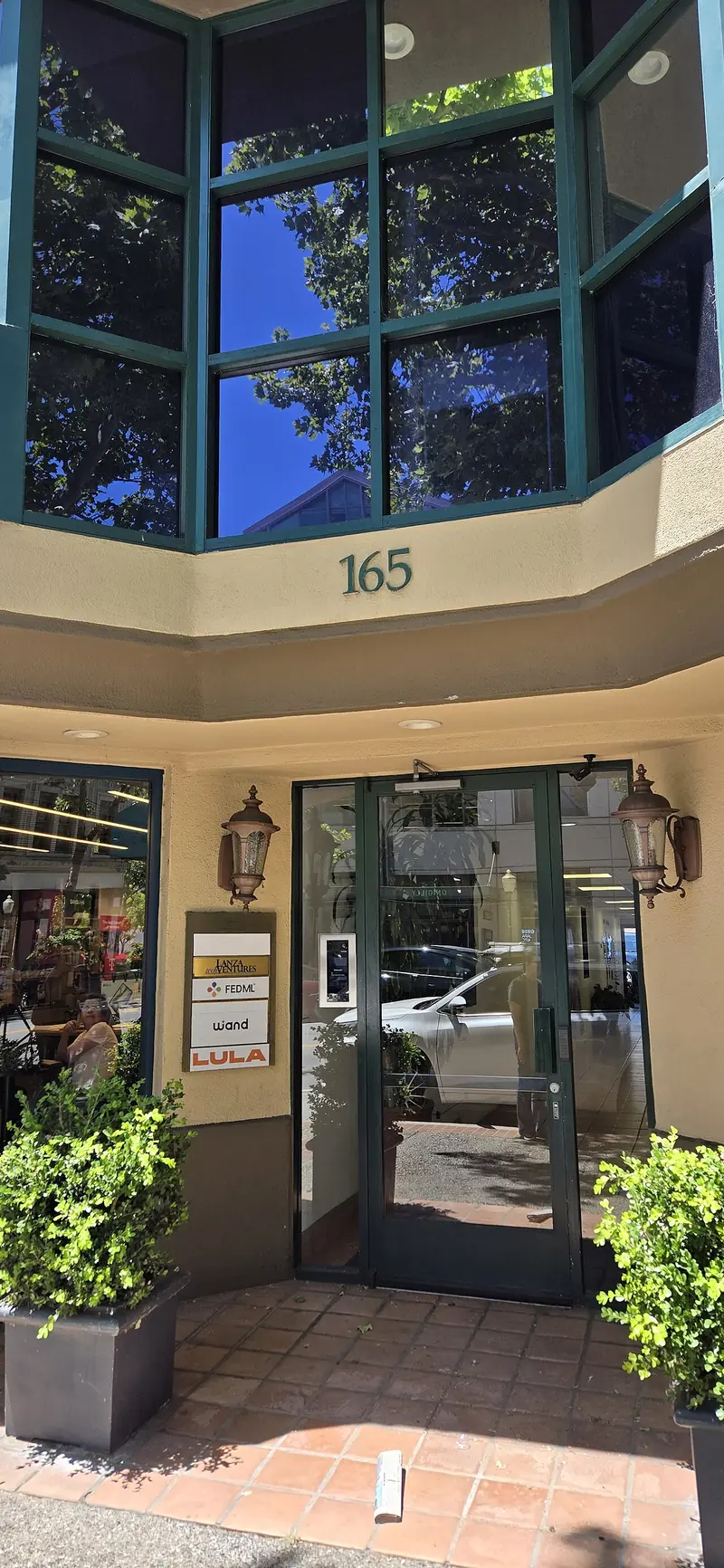
| Office at 165 University Avenue with eight employees | February 1999 | |
| X.com | Online bank founded in Palo Alto by Elon Musk and partners | March 1999 |
| TIBCO | Palo Alto software company, initial public offering | July 14, 1999 |
| Agilent | HP spinoff with headquarters at 395 Page Mill Road | 1999 to 2006 |
Google is the best known. It had grown out of a Stanford research project and a rented garage in Menlo Park. It moved into 165 University Avenue in February 1999, outgrew the space within months and left for Mountain View later that year. Our Google page has the details. VMware grew into a large campus in Stanford Research Park. See our VMware page.
PayPal: two Palo Alto startups become one
The PayPal story is the most Palo Alto of the era. Confinity was founded in December 1998 by a group that included Peter Thiel and Max Levchin. It started with a way to beam money between PalmPilots and then moved to payments by email. X.com was incorporated in March 1999 by Elon Musk with Harris Fricker, Christopher Payne and Ed Ho. It was run from a house at first and then from a Palo Alto office.
The two rivals merged on March 30, 2000, weeks after the stock market peak. The combined company kept the X.com name for a time and became PayPal, Inc. in February 2001. That year its headquarters was at 1840 Embarcadero Road near the Baylands. eBay announced it would buy PayPal on July 8, 2002, at the bottom of the market. Many of its early employees later started or funded other companies. Our PayPal page covers the full story.
University Avenue at the peak
Downtown Palo Alto had a small office market. Most buildings were two to four stories, with shops on the ground floor and offices above. There was little room to build more. When demand spiked, prices had nowhere to go but up.
Metro Silicon Valley reported in January 2003 that downtown Palo Alto offices had rented for as much as $11 or $12 a square foot per month at the early 2000 peak. That works out to well over $100 a square foot per year. Brokers described the city as almost fully built out. Small companies competed for sublets. Older tenants with long leases found their space suddenly valuable.

The lucky building
One address became famous. Saeed Amidi's family business owned 165 University Avenue and rented space to young companies. Logitech had worked there earlier. Google and Confinity both used it. Danger, the phone maker Microsoft bought in 2008, came later. Locals started calling it the lucky building. It has no plaque and is not open to visitors.
The bust, 2000 to 2002
The turn came fast. The Nasdaq Composite peaked at 5,048.62 on March 10, 2000. Within days tech stocks began to slide. They kept falling through 2001. By October 2002 the tech heavy indexes had lost close to 80 percent of their peak value.
In Palo Alto the effects showed up in empty offices. According to the broker Cornish and Carey, as reported by Metro, the city's office vacancy rate rose from 12 percent in early 2001 to 25 percent at the end of 2002. Downtown rents fell to about $3 to $4 a square foot per month by early 2003. Roxy Rapp, a downtown property owner, told the paper that across the Peninsula even at $2 there was no one to rent the space.
The bust looked different from the outside. University Avenue still had restaurants and shoppers. The changes were upstairs, in the dark second floor windows and the sublet signs. Startups folded or moved to cheaper space. Larger companies cut staff.
Good to know
- Exact numbers for Palo Alto startups that failed in the bust were never published. Treat any precise count with caution.
- Rent and vacancy figures here come from one broker as reported by Metro Silicon Valley. Other brokers used different boundaries.
- Most addresses on this page are private offices. Look from the sidewalk.
What the bust left behind
The crash cleared the ground for the next wave. Lower rents brought new companies downtown within a few years:
- Palantir was founded in Palo Alto in 2003 and grew across many offices on Hamilton Avenue.
- Facebook arrived in the summer of 2004 and leased its first office at 471 Emerson Street in January 2005. See our Facebook page.
- PayPal's alumni stayed in the area and started or funded new companies.
The boom also left a political legacy. Residents had watched offices take over downtown space and push up costs. In 2015 the city set an annual cap on new office space downtown, on California Avenue and along El Camino Real and moved to protect ground floor retail. The University Avenue tech page covers those rules.
Seeing the era today
A short walk covers the downtown sites. Start at the Palo Alto Caltrain station and walk up University Avenue. Stop at 165 University, then continue past Emerson Street to see where the next wave settled. Our downtown guide covers the street and our famous tech addresses tour adds the older sites. For the investors who funded the boom, read about Sand Hill Road.
Frequently asked questions
Which dot-com companies were in Palo Alto?
Google worked out of 165 University Avenue in 1999. Confinity and X.com, which merged to form PayPal, were both founded in Palo Alto. VMware was founded in Palo Alto in 1998 and TIBCO went public in 1999. Sun Microsystems and Agilent also had headquarters in the city in those years.
How expensive was office space in Palo Alto during the dot-com boom?
Metro Silicon Valley reported in 2003 that downtown Palo Alto offices had rented for as much as $11 or $12 a square foot per month during the early 2000 peak. By early 2003 rents had fallen to about $3 to $4, according to the broker Cornish and Carey.
When did the dot-com bubble burst?
The Nasdaq Composite peaked at 5,048.62 on March 10, 2000. Tech stocks fell through 2001 and bottomed in October 2002, down close to 80 percent from the peak. In Palo Alto office vacancy rose from about 12 percent in early 2001 to 25 percent at the end of 2002, according to Cornish and Carey.
What is the lucky building in Palo Alto?
It is 165 University Avenue, an office building above shops where Logitech, Google, Confinity and later Danger all worked. Locals call it the lucky building. It is a private office building with no plaque.