On this page
A historic district protects the look of a whole area rather than one building at a time. In Palo Alto that means three very different places: a neighborhood of shingled faculty houses from the 1890s, a single downtown block of 1920s stucco and tile and a pair of 1950s Eichler tracts with glass walls and flat roofs. Together they show nearly every phase of the city's growth.
This page lists each district with its listing date, boundaries as published and the features that earned the designation. For individual landmarks and plaques see our historic landmarks guide. For how the city's Historic Inventory categories work, see our historic homes guide. Dates and reference numbers come from National Park Service records as summarized by Wikipedia, the NPS Professorville page and the City of Palo Alto.
Two kinds of district
Palo Alto's districts sit on two different lists with different effects:
- National Register historic districts are listed by the National Park Service. For private homeowners the federal listing is mostly honorary. It brings eligibility for some grants and for tax credits on income-producing buildings and places the district on the California Register automatically.
- Local historic districts are created by the city. Buildings inside them are part of the city's Historic Inventory, first adopted in 1979. Exterior changes go through review by the Historic Resources Board under the Secretary of the Interior's Standards.
Professorville and Ramona Street are on both lists. Greenmeadow and Green Gables are National Register districts only.
| District | National Register | Ref. no. | Local district | Era |
|---|---|---|---|---|
| Professorville | Oct. 3, 1980 | 80000861 | Yes, expanded 1993 | 1890s to 1920s |
| Ramona Street Architectural District | Mar. 27, 1986 | 86000592 | Yes | 1920s and 1930s |
| Greenmeadow | July 28, 2005 | 04000862 | No | 1954 and 1955 |
| Green Gables | July 28, 2005 | 04000863 | No | 1950 |
Professorville (1980)
Professorville was Palo Alto's first historic district and remains its best known. Stanford's early faculty could build on campus only on leased land, so many bought lots in the new town south of University Avenue from the 1890s on. The National Park Service describes the district as roughly bounded by Embarcadero Road, Addison Avenue, Emerson Street and Cowper Street. The federal listing covers 34.4 acres.
The NPS singles out the brown shingle houses with gambrel roofs, a row of stately Dutch Colonials on Kingsley Avenue and styles that run from Colonial Revival to Craftsman. Notable houses it names include the Frank Angell House at 1005 Bryant Street, Bernard Maybeck's Sunbonnet House at 1061 Bryant Street and the Queen Anne house at 450 Kingsley Avenue, built for physics professor Fernando Sanford to a design by his former student Frank McMurray. The Varian brothers lived at 1044 Bryant Street before founding their company.
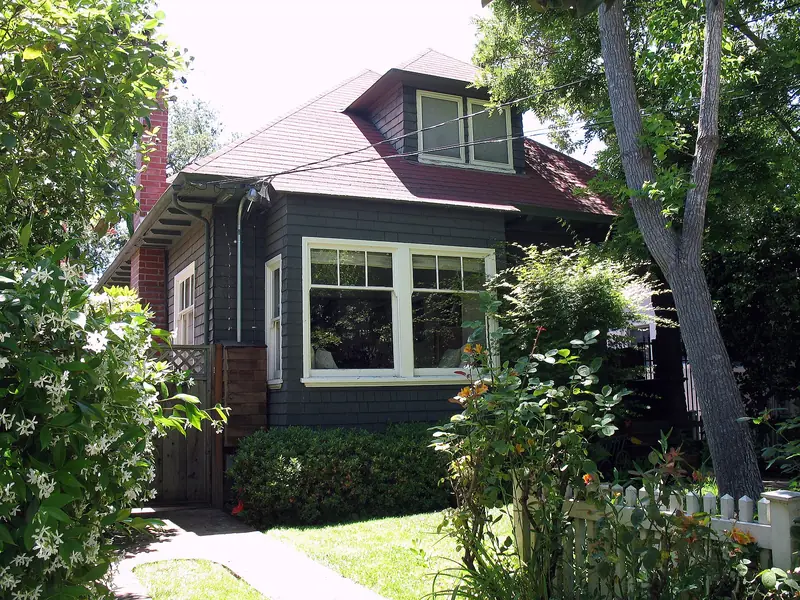

The city's local Professorville district is larger. It was expanded in 1993 and covers about 65 acres. Published counts of its houses range from 105 contributing houses to nearly 200 properties, depending on what is counted. The city publishes design guidelines for the district. See our Professorville guide or follow the Professorville walking tour.
Ramona Street Architectural District (1986)
This district is a single block with outsized influence. It covers 518 to 581 Ramona Street and 255 to 267 Hamilton Avenue, between University and Hamilton avenues. Wikipedia's infobox gives the listing date as March 27, 1986, while its text says the district was designated in 1985. The two dates may reflect separate local and federal steps.
Pedro de Lemos, the craftsman, artist and Stanford museum curator, set the direction. His Gotham Shop at 520 Ramona Street was the first building to go up, in 1925. He also built the Spanish Colonial Revival office building at 533 to 539 Ramona in 1938, with its recessed arched entrance and inner patio. Birge Clark designed the 1928 Medico-Dental Building (some sources say 1927) at Hamilton and Ramona. The Cardinal Hotel across the street, designed by William H. Weeks and opened in 1924, is a contributing building. Our Birge Clark page and our guide to Spanish Colonial Revival architecture cover the style in depth.
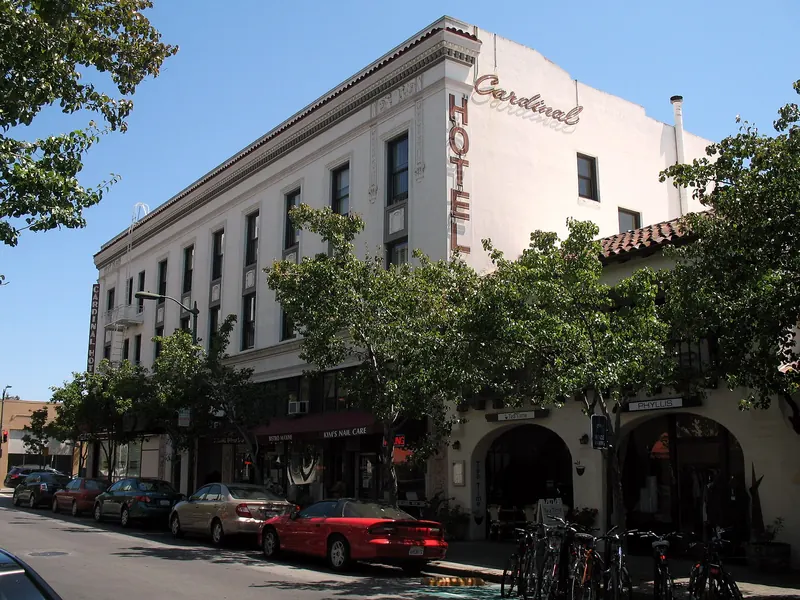

The block's use has changed recently. On March 10, 2025, the City Council voted to keep Ramona Street between University and Hamilton permanently car-free, so the district now reads as a pedestrian plaza.
Greenmeadow (2005)
Greenmeadow is the best preserved Eichler neighborhood in Palo Alto. Joseph Eichler built it in 1954 and 1955 to designs by A. Quincy Jones and Frederick Emmons. The district includes 243 single-story homes along with a community center and pool that residents bought from the builder and still run. The first family moved into a model home on October 31, 1954, while the rest of the tract was still under construction, according to the community association. Residents have held a Fourth of July parade every year since 1955. Our Greenmeadow page covers the neighborhood today.
Green Gables (2005)
Green Gables, listed on the same day as Greenmeadow, is an earlier Eichler tract in north Palo Alto. It was built in 1950 with houses designed by the San Francisco firm Anshen and Allen and the district counts 63 Eichler homes. The listing names Channing Avenue, Ivy Lane, Greer Road and Wildwood Lane. Residents organized both Eichler nominations through a group called Eichler Historic Quest. The tract sits in the area our Duveneck/St. Francis page covers.
Visiting the districts
All four districts are easy to see from public sidewalks. Professorville and Ramona Street are a ten minute walk apart and both are close to the Palo Alto Caltrain station, so a morning on foot covers them with time for coffee downtown. Greenmeadow is in south Palo Alto between Alma Street, East Charleston Road, Middlefield Road and San Antonio Road. Green Gables is in north Palo Alto toward Highway 101, so a bike makes it practical to add the Eichler districts on the same day. Every house in these districts is a private home. Stay on the sidewalk, skip drones and photograph architecture rather than people or windows.
Other district-style protections
- The Hopkins Tract. During the city's centennial in 1994, the original University Park townsite was proclaimed a local heritage district. We found no sign that the proclamation added design review beyond what the inventory already required.
- Eichler overlays. Single-story overlay zoning covers parts of eleven Eichler tracts and bars second stories there. The city adopted advisory Eichler design guidelines on April 2, 2018. Our Eichler homes history explains how the overlays came about.
The preservation fights
Historic districts in Palo Alto have not always been calm. In 1996, after new owners bulldozed 34 houses built before 1940, the City Council adopted an emergency moratorium on demolishing pre-1940 homes, the Palo Alto Weekly reported. An interim preservation order followed in 1998 and the Historic Resources Board wrote to 3,300 residents to say their homes might be added to the inventory. The resulting fight led to Measure G in 2000, a preservation ordinance that voters defeated with 52 percent voting no. The episode still shapes how cautiously the city expands its lists. A 2023 survey of about 155 buildings was the most recent effort. Our historic homes guide tracks what is known about its outcome.
Prefer a recorded guide while you walk? Browse self-guided audio tours for the wider region and pair one with a district walk here.
Frequently asked questions
How many historic districts does Palo Alto have?
Palo Alto has four historic districts on the National Register of Historic Places: Professorville, the Ramona Street Architectural District, Greenmeadow and Green Gables. Professorville and Ramona Street are also local historic districts under the city's own preservation rules.
When was Professorville listed as a historic district?
The Professorville Historic District joined the National Register on October 3, 1980, covering 34.4 acres of houses built for Stanford's early faculty. The city's local Professorville district, expanded in 1993, is larger, at about 65 acres.
Are Eichler neighborhoods in Palo Alto historic districts?
Two are. Greenmeadow has 243 Eichler homes from 1954 and 1955. Green Gables is an Eichler tract built in 1950. Both were listed on the National Register on July 28, 2005. Several other Eichler tracts have single-story overlay zoning and the city adopted advisory Eichler design guidelines in 2018.
Can I remodel a house in a Palo Alto historic district?
Usually yes, but exterior changes to buildings in the local districts or on the city's historic inventory go through historic review. National Register status alone is mostly honorary for private homeowners. Check with the city's planning staff before you design anything.
What is the Ramona Street Architectural District?
It is the 500 block of Ramona Street between University and Hamilton avenues plus a few Hamilton Avenue buildings, mostly Spanish Colonial Revival work from the 1920s and 1930s. It joined the National Register on March 27, 1986. The block has been permanently closed to cars since a 2025 council vote.