On this page
Apple's official story starts in a garage in Los Altos and ends with a ring-shaped headquarters in Cupertino. Neither town is Palo Alto. Yet many of the turning points in Steve Jobs's life happened in or next to this city. He got his first taste of the electronics industry at Hewlett-Packard here. He saw the future of computing at a Palo Alto lab. He started his second company in Stanford Research Park, raised his family in Old Palo Alto and gave one of the most watched commencement speeches ever at Stanford Stadium.
This page sticks to public facts drawn from Stanford Report, the Steve Jobs Archive, the Associated Press and our own company pages. It leaves out private family details. Jobs died in 2011. His family still values its privacy and so should visitors.
A Peninsula childhood
Jobs was born in San Francisco on February 24, 1955. He was adopted by Paul and Clara Jobs, a working-class couple without college degrees. He told that story himself in his Stanford speech. He grew up in Mountain View and Los Altos and attended Homestead High School in Cupertino.
Palo Alto was the big electronics town just up the road. In Jobs's own telling, repeated in Walter Isaacson's 2011 biography, he joined the Hewlett-Packard Explorers Club as a teenager, meeting at HP's Palo Alto headquarters. He also liked to tell how, at about 12, he called Bill Hewlett at home to ask for spare parts. Hewlett gave him the parts and a summer job at HP. Our page on Bill Hewlett and David Packard covers the company that made that kind of call possible.
Apple and its Palo Alto neighbors
After a short time at Reed College in Portland, Oregon, Jobs came home. In 1976 he and Steve Wozniak founded Apple. They assembled early Apple I computers at the Jobs family home in Los Altos, a story our Los Altos guide tells. Wozniak was then working at HP.
The money and advice that turned Apple into a company came from the Peninsula. Mike Markkula, a former Intel and Fairchild manager, joined as an investor and executive. Sequoia Capital invested in 1978, about two years after the founding, as our Sequoia page notes.
The 1979 visit to Xerox PARC
The most famous Palo Alto moment in Apple's early history came in December 1979. Jobs and a team from Apple received demonstrations of technology at Xerox's Palo Alto Research Center, in exchange for Xerox being able to buy Apple stock. They saw a graphical interface with windows and icons, controlled by a mouse. Much of that work traced back to ideas from Douglas Engelbart's lab at SRI, a story told on our page about Douglas Engelbart.
Jobs came away convinced that this was how personal computers should work. Apple's Lisa and Macintosh followed. Whether Apple "stole" the idea is still argued. Our Xerox PARC page lays out what was shown and what Apple built.
NeXT in Stanford Research Park
In 1985 Jobs was forced out of Apple. In his Stanford speech he called it the thing that "freed me to enter one of the most creative periods in my life." He founded NeXT, a computer company aimed at universities and businesses. Its early offices were in Stanford Research Park on Palo Alto's south side, the same office park that had grown up around HP and Varian. He also bought the computer graphics group that became Pixar.
NeXT's machines never sold widely. Its software did matter. When Apple bought NeXT in 1997, the deal brought Jobs back to Apple and gave Apple the foundation for its later operating systems.
Family life in Old Palo Alto
In 1989 Jobs spoke at the Stanford Graduate School of Business. There he met Laurene Powell, then an MBA student, a meeting that has been widely reported. They married in 1991. The couple made their home in Old Palo Alto, one of the city's oldest neighborhoods of tree-lined streets and large lots, where they raised their children.
The house remains a private family home.
Please respect the family's privacy
- We do not publish the address. It is a private residence, not a landmark or museum.
- Do not stop, photograph or gather outside the house. It is a quiet residential street and the neighbors deserve the same respect.
- For public places tied to Apple history, use our tech history tour instead.
The 2005 Stanford commencement speech
Stanford president John Hennessy invited Jobs to give the commencement address about six months before the ceremony, according to the Steve Jobs Archive. Jobs worked on it for months, emailing himself ideas and outlines. In the final weeks he wrote it himself, working closely with Laurene. He passed on suggestions from Apple's public relations team.
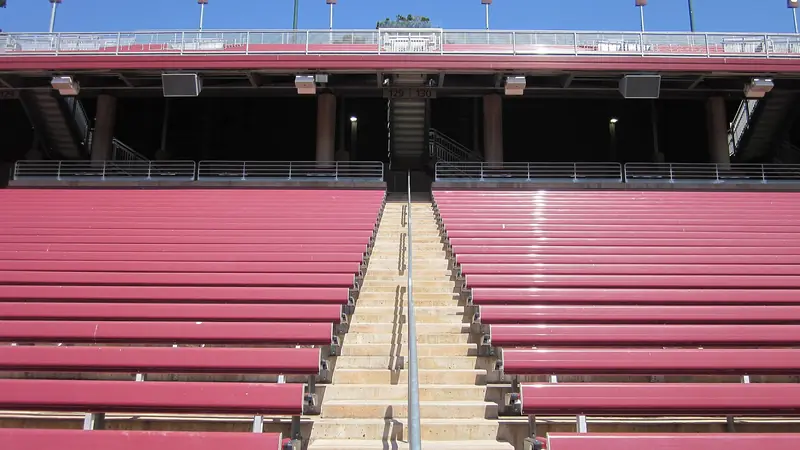
He gave the speech on Sunday, June 12, 2005, at Stanford's 114th commencement in Stanford Stadium. Stanford Report estimated the crowd at 23,000. He wore jeans and sandals under his black robe. He read his text and spoke for about 15 minutes.

He told three stories:
- Connecting the dots. His adoption, dropping out of Reed and the calligraphy class that later shaped the Macintosh's typefaces. "You can only connect them looking backward, so you have to trust that the dots will somehow connect in your future."
- Love and loss. Being fired from Apple in 1985, then founding NeXT and Pixar and meeting his wife.
- Death. His cancer diagnosis about a year earlier. "Your time is limited, so don't waste it living someone else's life."
He closed with a line he credited to the farewell issue of the Whole Earth Catalog, the counterculture publication Stewart Brand produced in Menlo Park: "Stay Hungry. Stay Foolish." Stanford has posted the video and text ever since. It is among the most viewed commencement speeches online. Our guide to Stanford commencement weekend covers the ceremony as visitors experience it today.
Death and memorial
Jobs stepped down as Apple's chief executive in August 2011. He died at his home in Palo Alto on October 5, 2011, at 56. Apple announced his death that evening and people left flowers, notes and apples at Apple stores around the world, including the store in downtown Palo Alto, as widely reported at the time.
On October 16, 2011, a private, invitation-only memorial service was held at Stanford's Memorial Church, the Associated Press reported, under heavy security. Apple held a separate celebration of his life for employees at its Cupertino campus a few days later.
Steve Jobs's Palo Alto today
There is no Steve Jobs museum in Palo Alto and the city has not tried to make one. The traces are spread around:
- The Apple store at 340 University Avenue, a glass-fronted building that opened downtown in 2012. Our electronics shopping guide covers it.
- Xerox PARC on Coyote Hill Road, now part of SRI. It is a working lab and is not open for tours.
- Stanford Research Park, where NeXT began.
- Stanford Stadium and Memorial Church, both on campus and both public places when open.
Treat these as public places. Leave the family home and other private places out of any visit.
Frequently asked questions
Did Steve Jobs live in Palo Alto?
Yes. He lived with his family in the Old Palo Alto neighborhood for about two decades and died at home in Palo Alto on October 5, 2011. The house is a private family home. Please do not visit it or treat it as a tourist stop.
When did Steve Jobs give his Stanford commencement speech?
On Sunday, June 12, 2005, at Stanford's 114th commencement in Stanford Stadium. Stanford Report estimated the crowd at 23,000. He told three stories from his life and ended with the words "Stay Hungry. Stay Foolish."
Did Steve Jobs go to Stanford?
No. He briefly attended Reed College in Portland, Oregon, then dropped out. His Stanford ties came later, through the 2005 commencement speech, friends on the faculty and his wife, Laurene Powell Jobs, who earned her MBA at the Stanford Graduate School of Business.
What did Steve Jobs see at Xerox PARC?
In December 1979 Jobs and a team from Apple received demonstrations of PARC technology in Palo Alto, including a graphical interface controlled by a mouse. In exchange, Xerox could buy Apple stock. The ideas shaped Apple's Lisa and Macintosh computers.
Where was Steve Jobs's memorial service?
A private, invitation-only memorial was held at Stanford Memorial Church on October 16, 2011, according to the Associated Press. Apple held a separate celebration for employees in Cupertino a few days later.