On this page
Silicon Valley has no single monument. Its story sits on ordinary streets in Palo Alto and Mountain View: a plaque set flat in a sidewalk, a wooden garage behind a house, a plain office building above a shop, a research campus on a hill. Most of these sites are private and you will see them from outside. One stop, the Computer History Museum, puts the actual machines in front of you. This plan links all of them into one day.
The morning is a walk through downtown Palo Alto, using our famous tech addresses guide as the backbone. The afternoon heads south by car, bike or rideshare to Stanford Research Park, the semiconductor sites and the museum, ending at Google's public visitor center. It runs roughly in historical order too, from radio tubes in 1911 to the search engine era.
The route at a glance
| Time | Stop | What you can see |
|---|---|---|
| 8:30 a.m. | Federal Telegraph plaque, Channing Avenue and Emerson Street | Sidewalk plaque only |
| 9 a.m. | HP Garage, 367 Addison Avenue | Garage and plaque from the sidewalk |
| 10 a.m. | 165 University Avenue and 471 Emerson Street | Building exteriors and a small marker |
| 11:30 a.m. | Xerox PARC, Coyote Hill Road | Building from the road |
| 12:30 p.m. | Fairchild site and the Shockley monument | Outdoor markers and sculptures |
| 1:30 p.m. | Lunch, then the Computer History Museum | Full museum, ticketed |
| 4:30 p.m. | Google Visitor Experience | Store, cafe and plaza, free |
The Computer History Museum is open Wednesday to Sunday from 10 a.m. to 5 p.m., according to its hours page. It closes on Thanksgiving, Christmas Eve, Christmas Day and New Year's Day. On a weekend you can also flip the day: start at the museum when it opens at 10 a.m. and walk the downtown stops in the late afternoon light.
Morning: the downtown walk
Federal Telegraph and Lee de Forest
Start where the electronics story starts. At the southeast corner of Channing Avenue and Emerson Street, a plaque in the pavement marks California Historical Landmark No. 836. The Federal Telegraph Company began here in 1909 as Poulsen Wireless and was renamed soon after. Between 1911 and 1913 Lee de Forest and his assistants made the first vacuum tube amplifier and oscillator on this site. The buildings are long gone and the plaque is easy to walk past, so look down. Our Federal Telegraph history tells the full story.
The HP Garage
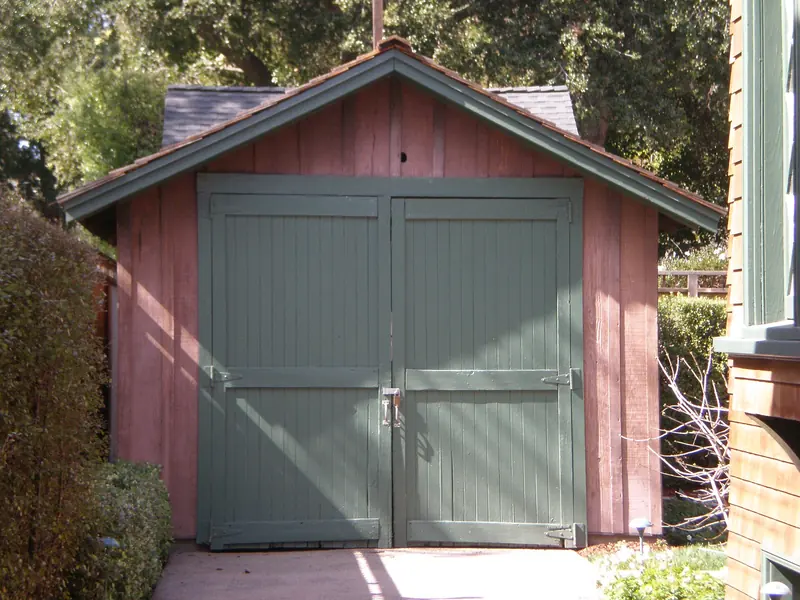
Walk about ten minutes south into Professorville to 367 Addison Avenue. Bill Hewlett and Dave Packard formalized their partnership on January 1, 1939 in the small wooden garage behind the house. Their first product was the HP 200A audio oscillator. The site is California Historical Landmark No. 976, dedicated as the Birthplace of Silicon Valley in 1989. It joined the National Register in 2007. HP owns the property and it is not open to the public. Stay on the sidewalk, do not open the gate and keep groups small. See our HP Garage page for photo tips.

165 University Avenue and 471 Emerson Street
Head north back to University Avenue. Number 165 is a modest office building above street-level shops. Logitech, Google, PayPal's predecessor Confinity and Danger all worked here early on. Google's office opened in February 1999 with only a handful of staff. Locals call it the lucky building. There is no plaque, so look for the number on the door.
A short walk away, 471 Emerson Street was Facebook's first office. A small marker records that the company leased it as The Face Book from January 2005 to July 2006. Other downtown addresses are often linked to Facebook's early years, but this is the one with documentation. Our guide to University Avenue's tech history covers the rest of the street.
Good to know
- Every downtown stop is free, unstaffed and viewable at any hour.
- Public restrooms are scarce. Use a cafe or the Downtown Library on Forest Avenue.
- The walk from the Caltrain station through all four stops and back is about 2 miles.
Late morning: Stanford Research Park and PARC
Pick up your car, bike or ride and head southwest to Page Mill Road. Stanford Research Park opened in 1951 as the Stanford Industrial Park and now covers about 700 acres. HP left the garage for 481 Page Mill Road in 1940 and moved its headquarters into the park at 1501 Page Mill Road in 1960. HP Inc. is still based there. Drive past slowly. The campuses are private and most lobbies are badge-only.
Climb Coyote Hill Road to number 3333, the Palo Alto Research Center. Xerox opened PARC on July 1, 1970. Its researchers built the Alto personal computer, Ethernet, the laser printer and much of the windows and mouse interface people use today. Xerox donated PARC to SRI International in 2023. The building sits low against the hillside and you can see it from the road, but do not drive into the lots. Our Xerox PARC profile explains what happened there and why Xerox let others profit from it.
Midday: where silicon came in
Fairchild Semiconductor, 844 East Charleston Road
Drive southeast to East Charleston Road near the Mountain View line. In 1957 eight scientists who left Shockley's lab founded Fairchild Semiconductor here. Robert Noyce's integrated circuit patent was filed on July 30, 1959 and the site is California Historical Landmark No. 1000. Today it is a commercial building with a state marker out front. Stop, read and move on.
The Shockley monument, 391 San Antonio Road
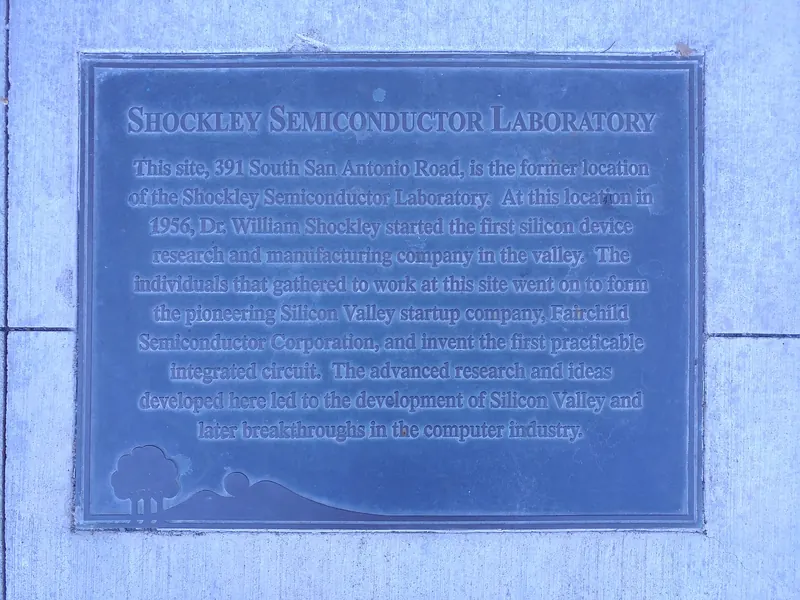
About five minutes away, just over the city line in Mountain View, stands the site of Shockley Semiconductor Laboratory. William Shockley grew up in Palo Alto and set up his lab here in 1956. The original building is gone. In its place is an outdoor monument with an IEEE Milestone plaque, an information panel and sculptures of early semiconductor devices, open at any hour. Our page on Shockley, Fairchild and the semiconductor boom covers the walkout that started it all.

Afternoon: the Computer History Museum
Have lunch near San Antonio Road or on Castro Street, then continue to 1401 North Shoreline Boulevard. The Computer History Museum is the one place on this tour where you go inside. Its main exhibit, Revolution: The First 2000 Years of Computing, fills 19 galleries with about 1,100 objects, from calculating devices to early personal computers. A restored IBM 1401 and a PDP-1 run in live demonstrations on set days. Check demo times before you go and build your visit around them.
Plan on 2 to 3 hours. Tickets are sold on the museum's own website and prices are listed there, so book ahead on busy days. Look for the Xerox Alto and early HP instruments, which tie back to the morning stops.
Late afternoon: Google's visitor center
Finish about a mile away at the Google Visitor Experience in the Gradient Canopy building, 2000 North Shoreline Boulevard. It opened on October 12, 2023 and is free. Google's visit page lists the store as open Monday to Saturday from 9 a.m. to 7 p.m. and Sunday from 10 a.m. to 6 p.m. The cafe closes an hour earlier. There are no guided tours. Google publishes a self-guided tour for your phone instead and the rest of the campus is working office space. Parking is free at Shoreline Lot C, except on concert days, when the Alta Garage is the backup.
Getting around and booking
The morning needs nothing but walking shoes. For the afternoon you have four choices:
- Car. The simplest option. The southern stops are spread out but parking is easy at each. If you flew in, you can compare rental cars for a single day.
- Bike. The route is flat apart from Coyote Hill Road. Palo Alto has no bike share, so rent from a shop or bring a bike on Caltrain.
- Rideshare or Waymo. Good for hopping between stops, though costs add up over five legs.
- Caltrain plus a ride. Skip PARC, take the train to Mountain View and continue to the museum by bus or rideshare.
If you would rather have a guide and a driver, several Silicon Valley tours leave from San Francisco and pass the big campuses in Mountain View and Cupertino. Most spend less time in Palo Alto than this route, so compare the stops before you book.
Tips for the day
- Respect the neighbors. Addison Avenue and the streets around it are homes. No drones, no lawns and no blocking driveways.
- Skip the celebrity houses. Famous founders lived in Palo Alto, but private homes are not stops on this tour.
- Add Stanford if you have time. Frederick Terman's engineering school is where many of these founders trained. A walk through the Science and Engineering Quad fits before the downtown loop.
- Stay downtown. You can start the walk straight from breakfast. Compare hotels near University Avenue early if your dates fall on a Stanford event weekend.
Frequently asked questions
Can you tour the HP Garage?
No. The garage at 367 Addison Avenue is private property owned by HP and has no public tours. You can see the garage and the state landmark plaque from the sidewalk. Keep voices low because it is a residential street.
Is Xerox PARC open to visitors?
No. PARC at 3333 Coyote Hill Road is a working research campus, now part of SRI International. You can see the long, low building from the road but cannot enter the grounds or lobby.
How long does a Silicon Valley tech history tour take?
Plan a full day. The downtown walk takes about 2 hours, the drive past PARC and the semiconductor sites takes about an hour with stops and the Computer History Museum deserves 2 to 3 hours. Google's visitor center adds 30 to 60 minutes.
Which day is best for this tour?
Wednesday to Friday. The Computer History Museum is closed Monday and Tuesday. Weekday traffic between Palo Alto and Mountain View is lighter in the middle of the day than at rush hour.
Can I do the tour without a car?
Partly. The downtown stops are all walkable from the Palo Alto Caltrain station. For PARC, the Shockley site and the museum, use a bike, a rideshare or a Waymo, or take Caltrain to Mountain View and continue by bus or rideshare.