On this page
Nearly every computer on earth owes something to a man most people have never heard of. Douglas Engelbart did not set out to invent a gadget. He wanted computers to make groups of people smarter, faster at solving hard problems. The mouse was one small tool in that larger plan. His team built it in a lab at the Stanford Research Institute in Menlo Park, a few minutes north of Palo Alto.
Our page on SRI International covers the institute itself and gives a short account of the 1968 demo. This page follows Engelbart: how he came to SRI, what his Augmentation Research Center built, what happened after and how Stanford came to keep his archive. Facts come from his Wikipedia biography, SRI and DARPA accounts and Stanford Libraries' catalog.
An essay on Leyte
Engelbart was born in Portland, Oregon, on January 30, 1925. During World War II he served two years in the Navy as a radio and radar technician in the Philippines. On the island of Leyte he read Vannevar Bush's 1945 essay "As We May Think," which imagined a desk-sized machine for storing and linking knowledge. The idea stayed with him.
He finished a degree in electrical engineering at Oregon State in 1948. He then came to the Peninsula to work at the NACA Ames laboratory in Mountain View, the forerunner of NASA Ames, doing wind tunnel maintenance. After marrying in May 1951 he left to study at the University of California, Berkeley, where he earned a master's in 1953 and a PhD in 1955.
Coming to SRI
In 1957 Engelbart joined the Stanford Research Institute, then still owned by Stanford and housed in Menlo Park. His early work there was on magnetic computer components. In his spare time he worked out his own agenda.
In 1962 he published a report titled "Augmenting Human Intellect: A Conceptual Framework." It argued that computers could extend human thinking the way tools extend human hands. Funding from ARPA, the Pentagon's research agency, followed, along with support from the Air Force. With it he founded the Augmentation Research Center, usually called ARC.
The Augmentation Research Center
ARC's main product was NLS, short for the oN-Line System. It let users write, edit and link documents on a screen, jump between them and work on the same material together. To make that practical the team built new input devices:
- The mouse. In 1964 engineer Bill English built the first one from Engelbart's design, a wooden box with two wheels at right angles underneath. The team nicknamed it the mouse because the cord looked like a tail.
- The chord keyset. A five-key pad for the other hand, so users could type commands without leaving the mouse.
- A standard keyboard for longer text.
Engelbart filed for a patent in 1967. U.S. Patent 3,541,541, titled "X-Y position indicator for a display system," was granted in 1970. SRI held the rights and Engelbart did not earn royalties from the mice that later sold by the billion.
December 9, 1968
On December 9, 1968, Engelbart sat on a stage at the Fall Joint Computer Conference in San Francisco and showed NLS to an audience of computer professionals. His screen was projected 22 feet high. His terminal was linked by telephone lines to an SDS 940 computer at SRI in Menlo Park, about 30 miles south. Team members there joined live by video. The projector was on loan from NASA Ames.
For about 90 minutes he showed things most people in the room had never imagined: pointing with a mouse, clicking on links, editing text on screen, sharing a screen with a distant colleague and seeing a colleague's face in a window. The session later earned the nickname "the Mother of All Demos." Our SRI page gives DARPA's account of the setup.
ARPANET, PARC and the long road
Because ARC already worked on networked computing, SRI became the second node of the ARPANET in 1969. Elizabeth Feinler's Network Information Center at SRI kept the network's directory. Our page on research labs near Palo Alto places that work alongside SLAC and PARC.
Engelbart's ideas spread mostly through other people. Several members of his team moved to Xerox's new Palo Alto Research Center in the early 1970s. There the mouse met the graphical desktop. Steve Jobs saw that work in 1979, as our page on Steve Jobs and Palo Alto explains. Apple brought the mouse to a mass market with the Macintosh in 1984.
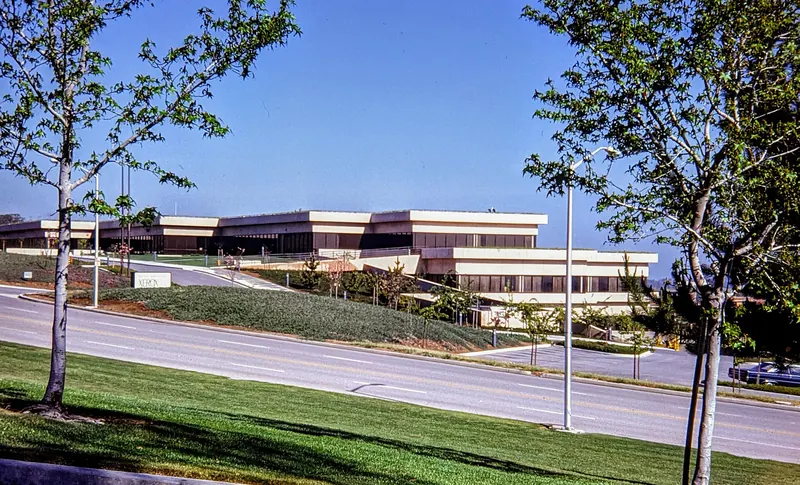

ARC itself faded. In 1970 SRI became independent from Stanford after student protests over military research. Funding for Engelbart's lab shrank. In the late 1970s, Wikipedia says 1976 in one passage, the lab and NLS were transferred to the timesharing company Tymshare, which renamed the system Augment. McDonnell Douglas bought Tymshare in 1984. Engelbart retired from that company in 1986.
Stanford keeps the record
Engelbart never taught at Stanford, but the university became the home of his legacy.
- Bootstrap seminars. In 1988 he and his daughter Christina founded the Bootstrap Institute, later the Doug Engelbart Institute. Its management seminars were held at Stanford from 1989 to 2000.
- The 1998 symposium. On December 9, 1998, the 30th anniversary of the demo, Stanford University Libraries and the Institute for the Future presented "Engelbart's Unfinished Revolution," a daylong public symposium. Wikipedia places it in Memorial Auditorium. Engelbart and members of his original team took part.
- The 2000 colloquium. In winter quarter 2000 the Stanford Center for Professional Development and the Engelbart institute ran a series called "An In-Depth Look at The Unfinished Revolution."
- The 40th anniversary. In 2008 a 40th anniversary event for the demo was held at Memorial Auditorium, according to Wikipedia.
- The papers. The Douglas Engelbart Papers and a separate collection of symposia records are held by Stanford's Department of Special Collections. Our Special Collections guide explains access. Video of the 1998 symposium is in the Stanford Digital Repository.
Honors and final years
Recognition came late but came in force. In 1997 Engelbart received the Turing Award and the $500,000 Lemelson-MIT Prize. In December 2000 President Bill Clinton presented him with the National Medal of Technology.
He lived for many years in Atherton, just north of Menlo Park. The Eichler Network, as cited on our Palo Verde neighborhood page, says he once lived in a Palo Verde Eichler in south Palo Alto. He died at home in Atherton on July 2, 2013, at 88. The Doug Engelbart Institute said he had lived with Alzheimer's disease since a 2007 diagnosis.
Where to see his work
- The Computer History Museum in Mountain View has exhibited early mice and material on the demo. Check its site for what is on view.
- SRI's campus at 333 Ravenswood Avenue, Menlo Park, is a working research site with no tours. You can see it only from the street.
- Full video of the 1968 demo is posted online by Stanford and others. It runs about 90 minutes and still rewards watching.
Frequently asked questions
Who invented the computer mouse?
Douglas Engelbart conceived it at SRI in Menlo Park and engineer Bill English built the first one in 1964. It was a wooden box with two wheels underneath. Engelbart filed for a patent in 1967 and received U.S. Patent 3,541,541 in 1970.
What was the Mother of All Demos?
It was Engelbart's live presentation of SRI's oN-Line System on December 9, 1968, at the Fall Joint Computer Conference in San Francisco. His screen was projected 22 feet high while his terminal linked to a computer at SRI about 30 miles away. He showed the mouse, linked text and shared editing.
Was Douglas Engelbart a Stanford professor?
No. He worked at SRI, then called Stanford Research Institute, which Stanford founded in 1946 and let go in 1970. Stanford did host events about his work, including a 1998 symposium. Stanford Libraries also holds his papers.
Where is SRI International?
SRI's headquarters is at 333 Ravenswood Avenue in Menlo Park, just north of Palo Alto. It is a working research campus with no public tours or exhibits.
When did Douglas Engelbart die?
He died at his home in Atherton on July 2, 2013, at 88. The Doug Engelbart Institute said he had lived with Alzheimer's disease since a 2007 diagnosis.