On this page
For most of the 20th century, a night out in Palo Alto meant University Avenue and a movie. The town built two grand theaters in the 1920s, two blocks apart. Smaller houses opened on Emerson Street, Hamilton Avenue and California Avenue over the next 50 years. Only two downtown screens survive today. One of them survives because a son of Hewlett-Packard's co-founder loved old movies.
This page tells the history. For showtimes and practical tips, see our guide to movie theaters in Palo Alto today.
Early screens on University Avenue
Movies reached Palo Alto early. The first Varsity Theatre opened on University Avenue across the street from the later building. Wikipedia dates it to 1911 and the theater history site RoadsideArchitecture.com to 1912. The Stanford Theatre that opened in 1925 was billed as the "New Stanford," which suggests an earlier house by that name, though we found few details about it.
The 1920s were the boom years. Palo Alto had just absorbed Mayfield in 1925 and downtown was filling with Spanish-style buildings. Theater chains were building ornate "movie palaces" across California.
The Stanford Theatre, 1925
The Stanford Theatre at 221 University Avenue opened on June 9, 1925, as the New Stanford, part of the Peninsula Theatre Company chain. The San Francisco firm Weeks and Day designed it in a neoclassical style with Persian and Moorish touches. Despite the name, it has never belonged to Stanford University.
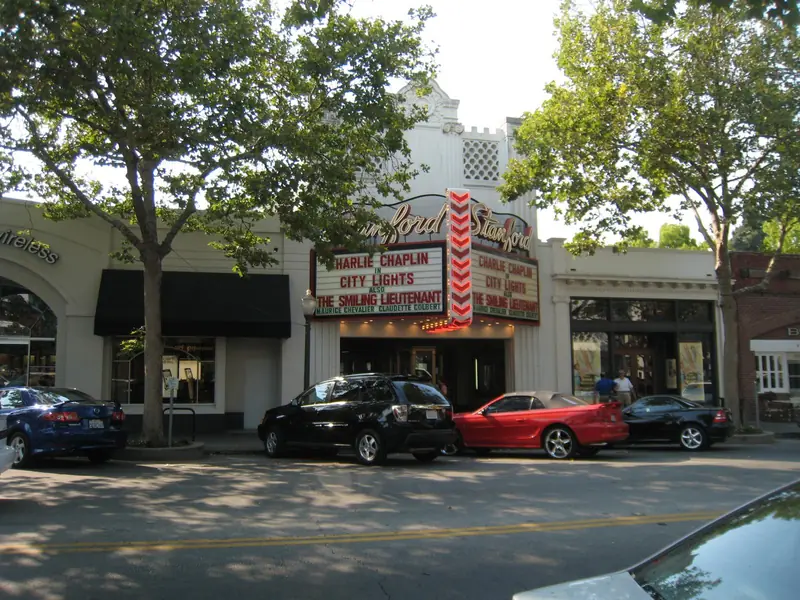

Like most single-screen palaces, it struggled after television arrived. The rescue came by accident. In 1987, after Fred Astaire died, David Woodley Packard rented the theater to show a run of Astaire films. His father, David Packard, saw the crowds and agreed to buy the building through the David and Lucile Packard Foundation. Our page on Bill Hewlett and David Packard covers the family.
The restoration
The restoration ran from 1987 to 1989 and aimed to bring back the 1925 interior in detail. The team studied original sketches to match the colors. Workers restored the ceiling paintings 50 feet above the seats, the hand-made stair tiles, seven chandeliers and even the snack bar and ticket booth. The theater reopened in 1989 with The Wizard of Oz. A Mighty Wurlitzer organ rises from the pit between shows. A 2017 refresh added new carpet and reupholstered seats.
The nonprofit Stanford Theatre Foundation runs it. Programs are themed seasons of classic films, mostly from the silent era to about 1970, usually as double features. Tickets are cheap and sold at the box office on the day of the show. Like other theaters it went dark during the pandemic. One theater history site dates its return to 2023. Our Stanford Theatre guide has current details.
The Varsity, 1927
Two blocks east, the new Varsity Theatre opened at 456 University Avenue on September 26, 1927, with the film Rose of the Golden West. The brothers James and Merritt Reid, best known for the Hotel del Coronado near San Diego, designed it. They mixed Mission Revival and Spanish Renaissance styles and added a neon marquee and a long, colonnaded courtyard off the sidewalk. The reported cost was $250,000 and the auditorium held about 975 seats. It was part of the Peninsula Theatres Corporation, a subsidiary of the West Coast Theatres chain that later merged into Fox. For years it was billed as the Fox Varsity. Birge Clark, often credited with downtown's Spanish buildings, did not design it.
The Varsity changed with the times. In the 1970s it became a revival house and a live music venue, with a restaurant in the courtyard. Landmark Theatres ran it from 1987 to 1994. It was one of the last three Bay Area theaters still showing The Rocky Horror Picture Show.
From theater to bookstore to coworking
The Varsity closed for financial reasons in 1994. Its owner, developer Charles "Chop" Keenan, won a zoning variance to add floor space to help pay for earthquake retrofitting and convert the building into a Borders bookstore. Locals protested. The San Francisco Chronicle compared the theater to the Louvre. The original plan to gut the interior was revised to meet federal rules for historic buildings and much of the interior and the facade survived.
Borders was liquidated in 2011. The building sat empty until 2015, when the architecture firm Gensler renovated it for a Blue Bottle cafe and HanaHaus, a public coworking space run by the software company SAP. The old auditorium and stage became the coworking room. The closure of both was announced in September 2024. We could not confirm a new tenant as of late October 2026. The courtyard and marquee are still worth a look from the sidewalk.
The Aquarius, 1969
The Aquarius at 430 Emerson Street opened on October 1, 1969, as a twin-screen theater, in the middle of Palo Alto's counterculture years. Landmark Theatres has run it since 1985, two years before it took over the Varsity. Both auditoriums were renovated in 2015 and recliners were added later, which cut the seat count sharply. It is the last downtown house for new independent and foreign films. See our page on Palo Alto in the 1960s for the era that produced it.
The Bijou, the Academy and other small houses
Smaller screens came and went around downtown. Cinema Treasures, a volunteer-run theater database, lists eleven theaters in Palo Alto over the years. A few with documented details:
- The Bijou, 640 Emerson Street. A single screen of about 300 seats. A Cinema Treasures contributor citing period ads says it opened on August 12, 1964, with Dr. Strangelove. The building later became a restaurant.
- The Academy Cinema, later the Festival Cinema, 475 Hamilton Avenue. A 114-seat revival house in a converted office building. It opened in October 1972 billed as "the Luxury Home of the Classics" and closed on April 18, 1985.
- The Palo Alto Automovie. A drive-in, long gone, that many older residents remember.
Cinema Treasures also lists the Paris and Copenhagen theaters, about which we found too little to report. It counts the Spangenberg Theatre at Gunn High School among Palo Alto's open screens. That is a school performing arts center rather than a commercial cinema.
The Fine Arts on California Avenue
California Avenue had its own theater for about 60 years. A 500-seat house called the California Avenue Theatre opened at 429 S. California Avenue on August 19, 1926, a year after Mayfield joined Palo Alto and its main street took the California Avenue name. It had an American Photo-player organ. Its later history, as Cinema Treasures records it:
| Year | Name and change |
|---|---|
| 1926 | Opens as the California Avenue Theatre. |
| 1936 | Renamed the Mayfield Theatre, after the old town. |
| 1950 to 1951 | Closes in April 1950 and reopens in May 1951 as the Cardinal, with a plain Moderne facade and marquee. |
| 1960 | Reopens in May as the Fine Arts, an art house under the same management as the Guild in Menlo Park, according to the Stanford Daily. |
| Late 1980s | Closes after a final run under the Renaissance Rialto chain. |
Cinema Treasures says the Fine Arts neon may still survive on the old marquee and that parts of the original facade remain behind the 1950s front. Our page on Mayfield covers the town the theater was briefly named for. Our California Avenue guide covers the street today.
Later losses
The last commercial screens to close in Palo Alto were outside downtown. The two-screen CinéArts at Palo Alto Square, at El Camino Real and Page Mill Road, closed in March 2020 at the start of the pandemic. Cinemark said in July 2021 that it would not reopen. Just over the Menlo Park line, the Guild Theatre showed films from 1926 until 2019 and has since reopened as a music venue.
Today the Stanford and the Aquarius carry on alone downtown. A walk along University Avenue still passes both 1920s palaces. Start at the Varsity's courtyard at 456, walk west to the Stanford Theatre at 221, then turn onto Emerson Street for the Aquarius. Our downtown architecture walking tour adds the Spanish-style buildings in between.
Frequently asked questions
What happened to the Varsity Theatre in Palo Alto?
The 1927 Varsity at 456 University Avenue closed as a movie theater in 1994. It became a Borders bookstore, which was liquidated in 2011. After a 2015 renovation it housed the HanaHaus coworking space and a Blue Bottle cafe, whose closure was announced in September 2024.
When did the Stanford Theatre open?
It opened on June 9, 1925, as the New Stanford. The David and Lucile Packard Foundation bought it in 1987 and restored it. It reopened in 1989 with The Wizard of Oz and still shows classic films.
How many movie theaters are left in downtown Palo Alto?
Two. The Stanford Theatre on University Avenue shows classics and the Landmark Aquarius on Emerson Street shows independent films. The CinéArts at Palo Alto Square, outside downtown, closed in 2020.
Was there a movie theater on California Avenue?
Yes. A 500-seat theater opened at 429 S. California Avenue in 1926. It was later called the Mayfield, the Cardinal and finally the Fine Arts, an art house that closed in the late 1980s.
Who designed the Varsity Theatre?
James and Merritt Reid, the San Francisco brothers known for the Hotel del Coronado. They gave it a mix of Mission Revival and Spanish Renaissance styles with a long colonnaded courtyard.