On this page
Downtown Palo Alto looks the way it does largely because of one decade. Between the mid-1920s and mid-1930s, local architect Birge Clark, artist Pedro de Lemos and a handful of others filled University Avenue and its side streets with white stucco, red tile and wrought iron. Much of it survives behind modern shop signs. This walk shows you where to look.
The route covers 14 stops in about 1.6 miles. Every building is a National Register property, a city Historic Inventory entry, a public building or a commercial block documented in Palo Alto Stanford Heritage's list of Clark's work. For the architect's life story, read our Birge Clark page before you go.
Before you go
Start at the Palo Alto Caltrain station so you can arrive by train. Our Palo Alto station guide covers the platforms and bike parking. Weekday mornings are the quietest time for photos. Weekend afternoons are busier but the Ramona Street courtyards and shops are open. Bring sunglasses: white stucco is bright at midday.
Most stops are commercial buildings with shops or offices inside. Look from the sidewalk unless a business is open to the public.
The route, stop by stop
- Palo Alto depot, 95 University Avenue. The 1941 Southern Pacific station is a Streamline Moderne building with curved corners and a horizontal profile. It joined the National Register on April 18, 1996. The city rates it Category 1.
- 125 University Avenue. Walk east under the trees. This 1925 Birge Clark building is one of his earliest downtown commissions and the city rates it Category 2.
- Fraternal Hall Building, 140 University Avenue at High Street. Listed on the National Register on February 15, 1990, under the addresses 140 University and 514 High. It is a reminder that downtown had lodge halls long before tech offices.
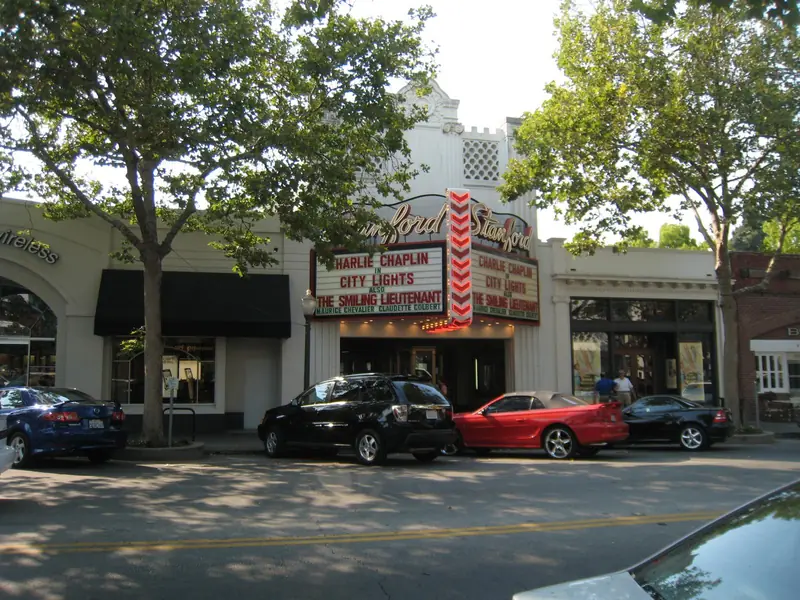
- Stanford Theatre, 221 University Avenue. Opened June 9, 1925, to a design by Weeks and Day, with Moorish and Persian ornament inside. The Packard family and foundation restored it from 1987 to 1989 and it still shows classic films. See our Stanford Theatre guide.
- Ramona Street Architectural District, 500 block. Turn right on Ramona. Pedro de Lemos built the Gotham Shop at 520 Ramona in 1925 around an old oak and designed 533 to 539 Ramona in 1938 with its arched entry and inner patio. Both are Category 1. Clark designed 532 to 538 (1926) and 541 to 545 (1927). The block has been car-free since 2020 and the City Council made that permanent on March 10, 2025.
- Cardinal Hotel and Medico-Dental Building, Hamilton Avenue at Ramona. The 1924 Cardinal Hotel at 235 Hamilton is by William H. Weeks and is part of the district. Clark's Medico-Dental Building at 261 to 267 Hamilton dates to the late 1920s. Our Cardinal Hotel page covers the hotel today.
- City Hall, 250 Hamilton Avenue. Look across Hamilton at the 1970 tower by Edward Durell Stone and Associates. It replaced the 1904 Carnegie library and shows how far taste moved in 40 years.
- U.S. Post Office, 380 Hamilton Avenue. Walk east two blocks. Clark's 1932 post office has an arcade of round arches and a tile roof in mixed shades. It joined the National Register on April 5, 1981. The city rates it Category 1. It now operates as Hamilton Station. Look for Greg Brown's mural Boy Fishing on the side wall.
- 323 University Avenue. Walk north on Bryant to University. This 1925 Clark building won a city preservation award in 2015 and is rated Category 2.
- The 400 block storefronts. Continue east. Clark designed 415 to 419 (1926), 423 to 437 (1927) and 436 to 452 (1927). Look above the shop windows for tile roofs, arched upper windows and iron balconies. Ground floors have changed many times. The upper floors tell the 1920s story.
- Varsity Theatre building, 456 University Avenue. Opened September 26, 1927, as a 975-seat movie palace by the brothers James and Merritt Reid. It is not a Clark building, though Clark's blocks flank it. Walk into the long colonnaded courtyard if the gate is open. The city rates it Category 1.
- Hotel President, 480 to 498 University Avenue. Clark's largest commercial job opened in 1929 with 125 rooms and a roof garden. It became apartments in 1968 and reopened as the Graduate by Hilton Palo Alto in January 2023.
- Old police and fire station, 450 Bryant Street. Head south to Bryant and Forest. Clark's 1927 building now houses the Avenidas senior center. Martin Webb's sculpture 148 Possibilities stands on the site.
- Roth Building, 300 Homer Avenue. Finish at Clark's 1932 Palo Alto Medical Clinic, listed on the National Register on June 21, 2010. Victor Arnautoff's 1932 frescoes line the covered entrance gallery. The building is planned as the Palo Alto History Museum, whose opening was postponed in January 2026.

The Varsity story
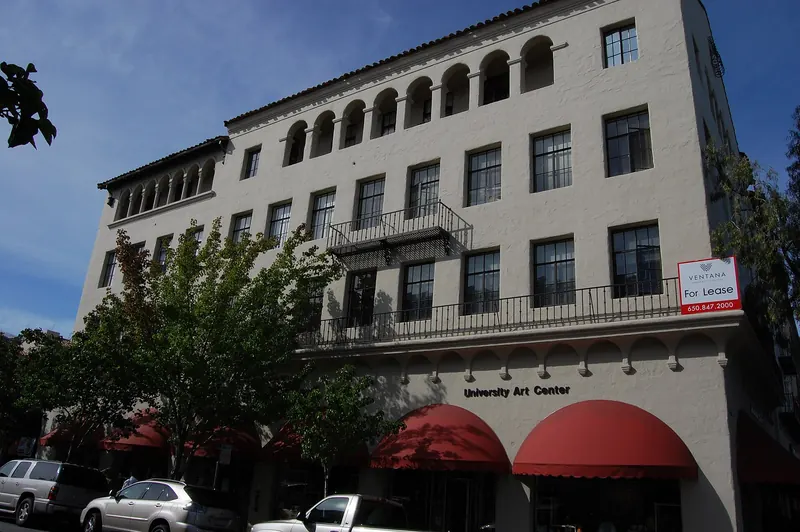
The Varsity is the building people most often credit to Clark by mistake. It was designed by Reid and Reid, the San Francisco firm also known for the Hotel del Coronado. It cost a reported $250,000. It mixed Mission Revival and Spanish Renaissance details around an open courtyard. An earlier Varsity Theatre had opened across the street in 1911.
The theater had many lives. It became a revival house and music venue in the 1970s. Landmark Theatres ran it from 1987 until it closed in 1994. A Borders bookstore moved in after a seismic retrofit that kept much of the interior and exterior. Borders closed in 2011. In 2015 a renovation by Gensler turned the old auditorium into HanaHaus, a coworking space run by SAP, with a Blue Bottle cafe. Both closed after an announcement in September 2024. Check current listings for what occupies the building now. Our movie theaters guide covers the town's lost cinemas.
Reading a 1920s storefront
Most of the buildings on this walk were built as shops with offices or apartments above. Clark called his style Early California. Once you know the pattern you can spot it on any block:
- Plain stucco walls with windows placed off-center rather than in rows.
- Red clay tile roofs at several heights, often hiding a flat roof behind.
- Arched openings for doors, passages and second-floor windows.
- Wrought iron balconies, grilles and lamps.
- Colored tile around doors and stair risers.
- Passages leading to courtyards behind the street wall.
Shop fronts have been replaced again and again, so look up. Palo Alto Stanford Heritage credits Clark with the "remarkable visual coherence" of the post-1920s city. Our architecture guide sets downtown alongside Professorville and the Eichler tracts.

Add-on stops
If you have more time, these documented buildings sit within two blocks of the route:
| Building | Address | Why stop |
|---|---|---|
| Baker Hotel | 435 to 439 Emerson St. | Clark, 1924 to 1925 |
| Commercial building | 611 to 619 Emerson St. | Clark, 1924 |
| Theodore Zschokke Cottages | 617 and 621 High St. | National Register, May 26, 2020 |
| Former auto dealership | 790 High St. at Homer | Clark, 1936, a turn toward Streamline Moderne |
| Pacific Art League | 668 Ramona St. | Clark design, construction date unconfirmed; the league's home since 1965, with a 2026 alley mural |
| Woman's Club of Palo Alto | 475 Homer Ave. | National Register, 2015 |
The murals are covered on our public art page. From the Roth Building it is two blocks to Channing Avenue and Emerson Street, the start of our Professorville walking tour.
Tips and etiquette
Good to know
- Shops and restaurants own the courtyards. Go in as a customer during business hours and do not block entrances for photos.
- Offices above the shops are private. Do not wander up stairways.
- Bikes are allowed on car-free Ramona Street, so keep an ear out.
- The Roth Building frescoes are visible from the walkway, but the building is not open yet.
For a recorded commentary instead of reading, browse Bay Area walking tours and add this loop afterward.
Why downtown looks Spanish
Palo Alto was founded in 1894 as a dry, wooden university town. Many early buildings burned or were replaced as the town grew. When Clark opened his office in 1922 he found clients ready for something more permanent. The Spanish Colonial Revival was popular across California between roughly 1915 and the early 1930s and it suited a town with a Spanish name. Because Clark designed so many buildings over so many years, the blocks read as a set. Our University Avenue history traces how the street changed after that, from Depression-era hotels to tech offices.
Listing dates on this page come from National Park Service records as summarized by Wikipedia. Category ratings come from the City of Palo Alto's Historic Inventory. Clark's dates follow Palo Alto Stanford Heritage's inventory of his work. For every listed property in town, see our landmarks guide.
Frequently asked questions
Did Birge Clark design the Varsity Theatre?
No. The Varsity Theatre at 456 University Avenue opened on September 26, 1927, to designs by the brothers James and Merritt Reid. Birge Clark designed several commercial blocks on either side of it in the same years. The city inventory rates the Varsity building Category 1.
What is the Ramona Street Architectural District?
It is the 500 block of Ramona Street plus 255 to 267 Hamilton Avenue, listed on the National Register on March 27, 1986. Pedro de Lemos and Birge Clark designed most of its Spanish Colonial buildings. The half block between University and Hamilton is now permanently closed to cars.
How long is the downtown Palo Alto architecture walk?
The 14-stop loop is about 1.6 miles and takes 1.5 to 2 hours. It starts at the Caltrain depot and ends at the Roth Building on Homer Avenue, a 10 minute walk from the station.
Can I go inside any of the buildings?
Several are public or commercial. The post office lobby, the Stanford Theatre on show nights, hotel lobbies and shops in the Ramona Street courtyards are open during business hours. Offices and the Roth Building are not open for casual visits.
Is there a guided downtown architecture tour?
Palo Alto Stanford Heritage has offered occasional docent-led walks downtown. This page is designed as a self-guided alternative you can do any day.