On this page
You can walk past a lot of Palo Alto's public art without noticing it. Some of it was designed that way. A man on a ladder painted onto a wall downtown. A grid of wooden poles on a windswept hill. A series of fresco panels showing doctors at work, hidden in plain sight on a downtown building. The city has been commissioning and collecting art for public spaces for decades and the result is a scattered, surprising collection that rewards an afternoon of wandering.
This guide covers the city program that manages the collection, the works most worth seeking out and a simple walking route. Everything listed here is outdoors and free. For indoor galleries, see our arts and culture hub and the Palo Alto Art Center.
The city's Public Art Program
The Public Art Program operates under Chapter 2.26 of the Palo Alto Municipal Code. It places permanent and temporary art in city projects and oversees a rule that requires public art in certain private developments. A volunteer Public Art Commission reviews and advises on what is chosen, where it goes and how it is cared for. The program's office shares the Art Center's address at 1313 Newell Road.
The collection holds about 100 permanently sited works and more than 200 portable works. Collection artists include Nathan Oliveira, Fletcher Benton, Betty Gold, Gene Flores and Bruce Beasley. The city publishes a collection map and an interactive map on the program's website. Open one on your phone and you have a ready-made tour.

Greg Brown's trompe l'oeil murals
The most beloved public art in Palo Alto is a set of murals painted to fool you. In 1975 the city hired a 24-year-old local painter named Greg Brown as its first artist in residence, using a federal CETA jobs grant. Brown had grown up in Palo Alto and graduated from Palo Alto High School in 1969. He began a series of trompe l'oeil murals he called the Pedestrian Series, meant to be discovered by people on foot. Many of the figures were modeled on his family, friends and neighbors.
His first, The Inspector, was so convincing that a council member reportedly tried to have it removed. Some murals were lost to redevelopment over the years. In 1995 residents rallied to save several of them and some building owners offered their walls as new sites. Brown kept touching up his work until his death in 2014. The city now cares for the series and has hired fine art conservators to restore it.
Murals you can still find downtown include:
- Boy Fishing on the side of the post office on Hamilton Avenue.
- Garbage Man with Venusian in Can at the corner of Hamilton Avenue and High Street.
- Woman Watering on Waverley Street, just off University Avenue.
- Man Pushing Cat in Stroller on Bryant Street near University Avenue.
Look up as well as across. Brown liked to put figures on ledges, rooftops and second-story windows.
New murals in 2026
The city added a new round of downtown murals in 2026. Mona Caron painted Dirca Occidentalis at 534 Emerson Street, a study of the western leatherwood, a native shrub, against a black background. Nigel Sussman's Palo Alto Discoveries covers the alley wall of the Pacific Art League at 668 Ramona Street with graphic illustrations tied to the building's history. Harumo Sato painted a mural on the exterior wall of All Saints Episcopal Church at 555 Waverley Street in spring 2026.
Elsewhere, Phillip Hua's temporary mural Everything Changes wraps the parking garage at 350 Sherman Avenue near California Avenue. In Barron Park, artist Bodeck Luna painted the roll-up door of Fire Station 5 beside Juana Briones Park. The city also funds painted utility boxes and small community projects through its ArtLift grants, so keep an eye on street corners.
The Arnautoff frescoes
The oldest major public artwork in town is a set of frescoes on the Roth Building at 300 Homer Avenue. The building opened in 1932 as the Palo Alto Medical Clinic, designed by Birge Clark. Dr. Russel Lee commissioned the Russian-born muralist Victor Arnautoff, who had worked with Diego Rivera, to decorate its entrance. Arnautoff finished the series, called Modern and Ancient Medicine, in 1932.
There are 17 frescoes in all. Four large color panels show pediatric care, internal medicine, neurosurgery and a fluoroscopic examination. Gray panels painted to look like stone reliefs show medicine in earlier times. Four sepia medallions portray Hippocrates, Joseph Lister, Louis Pasteur and Wilhelm Röntgen. The color panels have been restored and work on the rest continues as funding allows. The frescoes sit in a covered outdoor gallery, so you can see them from the walkway at any time. The city owns the building, which is being turned into the Palo Alto Museum. Check the museum's website for opening news.
Sculpture around the city
The collection map lists dozens of sculptures. A few that are easy to fit into a day:
| Work | Artist | Where |
|---|---|---|
| Space, Time & Palo Alto (2024) and 100,000 Decisions | Peter Wegner | Public Safety Building, 250 Sherman Ave. |
| Aeolis 10 | Bruce Beasley | 2600 El Camino Real |
| 148 Possibilities | Martin Webb | 450 Bryant St. (the 1927 former police and fire station) |
| After the Fire | Bruce Johnson | Mitchell Park, 600 E. Meadow Dr. |
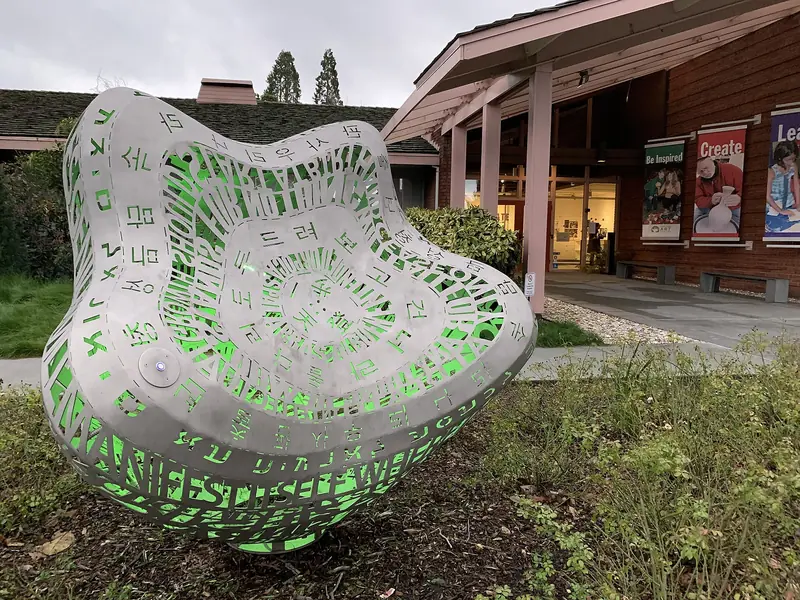
| Albuquerque | Gale Wagner | Palo Alto Art Center, 1313 Newell Rd. |
| Aperture | Gordon Huether | 3203 to 3223 Hanover St., Stanford Research Park |
| Passage (2022) | Susan Zoccola | Charleston Road at Sutherland, one of five sculptures there |
The Public Safety Building pieces are a short walk from the California Avenue shops and its Sunday farmers market. After the Fire pairs well with a visit to Mitchell Park and its Magical Bridge Playground.
Land art at the Baylands
Palo Alto's most unusual art covers a whole hillside. When the city capped its old landfill and built Byxbee Park, it hired the landscape firm Hargreaves Associates with environmental artists Peter Richards and Michael Oppenheimer. They designed 11 art elements into the park. The best known is the Pole Field, a grid of 72 wooden poles whose tops are trimmed to a single level plane against the sloping ground. Nearby, the Wind Wave sways and hums in the afternoon breeze and rows of concrete barriers form giant chevrons that pilots can read from the air. Mary Lucking's Baylands Vignette (2021) is a more recent addition to the city's Baylands art.
Temporary art and lost works
Not every piece stays. Digital DNA, a seven-foot egg covered in recycled circuit boards by Adriana Varella and Nilton Maltz, stood in Lytton Plaza from 2005. The city removed it in June 2018, citing maintenance costs. A private collector bought and restored it. Lytton Plaza at University Avenue and Emerson Street is now better known for the city's holiday tree lighting.
Temporary art arrives in bursts. Every other October the city stages Code:ART, a free festival of light and digital art downtown. Past editions projected artwork onto the City Hall tower and filled plazas and alleys with interactive pieces. The next is set for October 13 to 16, 2027. See our events calendar for more.
A self-guided downtown art walk
This loop takes about an hour at an easy pace and stays within a few blocks of University Avenue.
- Start at Lytton Plaza, University Avenue at Emerson Street.
- Walk to 534 Emerson Street to see Mona Caron's leatherwood mural.
- Head to Hamilton Avenue and High Street for Garbage Man with Venusian in Can.
- Continue along Hamilton Avenue to the post office and Boy Fishing.
- Turn onto Ramona Street for Nigel Sussman's mural at the Pacific Art League, then admire the Spanish Revival buildings on the 500 block.
- Walk to Waverley Street for Woman Watering and Harumo Sato's mural at All Saints Church.
- Finish at 300 Homer Avenue with the Arnautoff frescoes.
For context on the buildings you pass, read our guides to downtown Palo Alto and Palo Alto architecture. To cover the outlying sculptures in one go, a bike is ideal. Our biking guide explains the city's bike boulevards. You can also rent a bike for the day if you did not bring one.
Good to know
- Most murals are on private buildings. View them from the sidewalk and do not enter private lots.
- Report damage or graffiti on a city artwork to the Public Art office at (650) 329-2227.
- Stanford has its own large outdoor collection, from Rodin bronzes to Andy Goldsworthy's Stone River. See public art at Stanford.
Frequently asked questions
Where are the Greg Brown murals in Palo Alto?
Most are downtown within a few blocks of University Avenue. Boy Fishing is on the side of the post office on Hamilton Avenue. Garbage Man with Venusian in Can is at Hamilton Avenue and High Street. Woman Watering is on Waverley Street just off University Avenue.
Is there a map of public art in Palo Alto?
Yes. The city's Public Art Program publishes a collection map of permanently sited works and an interactive map on its website. Both make it easy to plan a walk or bike ride. The program office is at 1313 Newell Road.
Can you see the Arnautoff frescoes in Palo Alto?
Yes. Victor Arnautoff's 1932 frescoes are in the covered outdoor gallery at the entrance of the Roth Building, 300 Homer Avenue. Because they are outdoors you can see them from the walkway without a ticket. The four large color panels have been restored.
What happened to the Digital DNA sculpture?
Digital DNA, the circuit board covered egg by Adriana Varella and Nilton Maltz, stood in Lytton Plaza from 2005. The city removed it in June 2018, citing maintenance costs. A private collector bought and restored it.
When is Code:ART in Palo Alto?
Code:ART is a free festival of light and digital art held downtown every other October. The next edition is scheduled for October 13 to 16, 2027. Past festivals projected art onto the City Hall tower and filled plazas with interactive pieces.