On this page
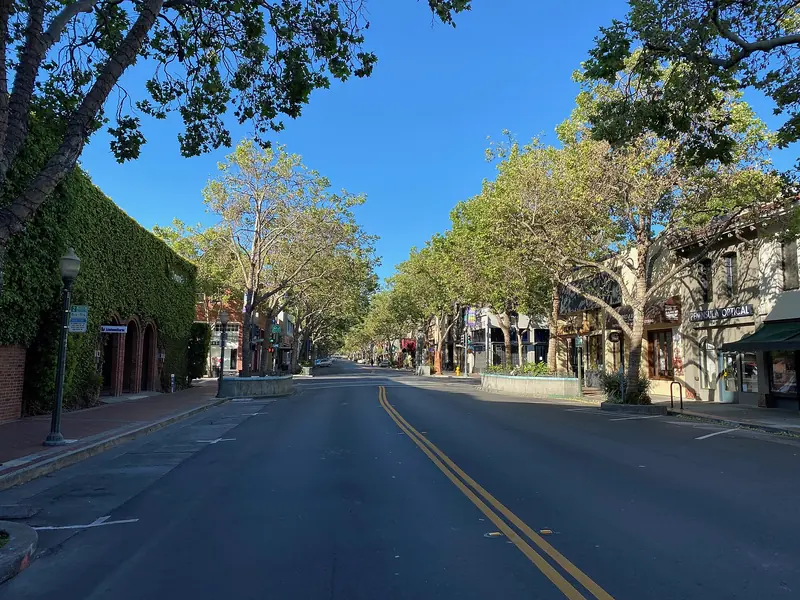
Lytton Plaza is easy to miss. It is a small open corner where University Avenue meets Emerson Street, with benches, tables and people waiting for a friend. Most days it is just a pleasant place to sit with a coffee. But for a few years around 1970 it was the most argued-over patch of ground in Palo Alto. Today it is best known as the spot where the city lights its holiday tree each December.
This guide covers how the plaza began, its turbulent late 1960s, the 2009 redo, the art it has held, the holiday tree lighting and what to expect if you stop by. For the wider story of the street, see our history of University Avenue.
A banker's gift to downtown
In 1964 banker Bart Lytton built an 8,500-square-foot plaza at University and Emerson. The site had held the old American Trust Company bank. Lytton's savings and loan had its offices across the street, so the plaza doubled as a front lawn for his business and a public amenity for downtown.
The design was simple: an open paved corner where shoppers could sit. One detail mattered more than anyone expected. Because the plaza was private land and had no fence, it fell outside the city's park rules. That legal gap would shape the next decade.
The protest years, 1968 to 1972
By 1968 Palo Alto was changing fast. Stanford students and young people from around the Peninsula were organizing against the Vietnam War. The Midpeninsula Free University offered alternative classes. Free rock concerts were part of the scene. Lytton Plaza, open to anyone and not bound by park curfews, became the place to gather.
Concerts, poetry readings and political rallies filled the square. Clashes with police followed. On July 11, 1970, officers arrested 263 people when music ran past an 11 p.m. limit. In August 1971 rioters broke more than $24,000 worth of windows along University Avenue. Things began to calm down in 1972. The city later bought the plaza, bringing it under public rules.
Those years are part of a bigger story that includes the Grateful Dead's early days, Perry Lane and Kepler's Books in Menlo Park. Our page on Palo Alto in the 1960s puts the plaza in that context.
The 2009 redo
For about four decades the plaza looked much as it had in the 1960s. The city redid it in 2009, its first real makeover since it opened. It is still a small corner space rather than a big civic square.
Since then the plaza has had mixed fortunes. Residents and council members have raised concerns about drug dealing there in recent years. In December 2025 the Friends of Palo Alto Parks said they wanted to make the space more inviting. Their early ideas included upgrading benches and tables, making the next-door parking lot less visible and hosting more lunchtime use and concerts. No formal plan had been announced in that report, so check local news for progress.
Art on the plaza
Lytton Plaza has held some memorable art. Digital DNA, a seven-foot egg covered in recycled circuit boards by Adriana Varella and Nilton Maltz, stood here from 2005. The city removed it in June 2018, citing maintenance costs. A private collector bought and restored it.
The plaza has also been a site for temporary installations during Code:ART, the city's free festival of light and digital art held every other October. The next edition is set for October 13 to 16, 2027. Our public art guide covers permanent works within a short walk, including Greg Brown's trompe l'oeil murals.

The holiday tree lighting
The city opens the holiday season downtown with a free Holiday Tree Lighting at Lytton Plaza. In 2026 it is on Friday, December 4, from 5:30 to 7 p.m. The city lists live music, performances and winter treats. Performers named for 2026 include School of Rock, the Boost Class Merry Holiday Dancers and the Palo Alto Chamber Orchestra.
A few tips make the evening easier:
- Arrive by 5:15 p.m. The plaza is small, so the best views go early.
- Take the train. The Palo Alto Caltrain station is a short walk away and downtown parking fills on a December Friday.
- Dress warmly. December evenings turn chilly once the sun goes down.
- Make a night of it. Hanukkah begins at sundown the same evening and Chabad of Palo Alto usually holds a public menorah lighting in front of City Hall around the first night. Check Chabad's listing for the time.
Our holiday guide covers Christmas Tree Lane on Fulton Street, Winter Lodge skating and the season's concerts.
Visiting the plaza
There is no admission, no ticket and no closing gate. The plaza works best as a short stop on a walk through downtown. Grab a drink from one of the cafes nearby and sit for a few minutes to watch University Avenue go by. Our coffee guide lists good options within a few blocks.
Weekday lunchtime brings office workers with takeout. Evenings are quieter, apart from event nights. The plaza is at its best on a mild afternoon, when the sun reaches the corner and the avenue is busy with shoppers and diners. If you are here for history, take a moment to compare the calm corner with photos of the crowds of 1970.
Good to know
- The plaza is a five minute walk from the Palo Alto Caltrain station.
- Cafes and restaurants on the surrounding blocks are the easiest places to find a restroom.
- Large events need a city permit. Contact the city before planning a gathering.
A one-hour history loop from the plaza
Lytton Plaza makes a good starting point for a short walk through downtown's past. All of these stops are free and outdoors:
- Lytton Plaza. Picture the crowds of 1970 on this small corner, then look across University Avenue to where Lytton's savings and loan stood.
- The Stanford Theatre, 221 University Avenue. The 1925 movie palace still shows classic Hollywood films under its original marquee.
- Ramona Street. The 500 block, between University and Hamilton, has been permanently car-free since a council vote in March 2025. Its Spanish Revival buildings are some of the best in town.
- City Hall and King Plaza, 250 Hamilton Avenue. The 1970 tower and its rotating residency art.
- The Roth Building, 300 Homer Avenue. Birge Clark's 1932 medical clinic, with Victor Arnautoff's frescoes in the covered entrance gallery. It is the future home of the Palo Alto History Museum.
The loop is under two miles. If you want more, our downtown architecture walk adds Birge Clark's post office and other stops.
Nearby
The Stanford Theatre, with its classic films and Wurlitzer organ, is a short walk away on University Avenue. A short walk south brings you to City Hall and King Plaza, where the city shows rotating public art. For shopping and dining along the avenue, see our guides to shopping University Avenue and downtown Palo Alto.
Frequently asked questions
Where is Lytton Plaza?
Lytton Plaza is on the corner of University Avenue and Emerson Street in downtown Palo Alto. It is about a five minute walk from the Palo Alto Caltrain station.
When is the Palo Alto tree lighting in 2026?
The city's free Holiday Tree Lighting is on Friday, December 4, 2026, from 5:30 to 7 p.m. at Lytton Plaza. The city lists live music, performances and winter treats, with performers including School of Rock and the Palo Alto Chamber Orchestra.
Who built Lytton Plaza?
Banker Bart Lytton built the plaza in 1964 on the site of the old American Trust Company bank, across from his savings and loan. It was later acquired by the city, which redid it in 2009.
What happened at Lytton Plaza in 1970?
From 1968 the plaza became a gathering place for concerts, rallies and radical groups. On July 11, 1970, police arrested 263 people there when music ran past an 11 p.m. limit. The plaza calmed down after 1972.
Is there art at Lytton Plaza?
The circuit board covered egg sculpture Digital DNA stood there from 2005 until the city removed it in June 2018, citing maintenance costs. The plaza has also been a site for installations during the city's Code:ART festival.