On this page
Palo Alto is a good city for looking at buildings because its history sits in clear layers. The first is wooden: the shingled houses that Stanford's early professors built in the 1890s. The second is stucco and red tile, the Spanish Colonial Revival look that one local architect, Birge Clark, spread across downtown between the wars. The third is glass and post-and-beam, the modern tract houses Joseph Eichler built on former orchards after World War II. Stanford adds its own story, from an 1880s sandstone quadrangle to a Frank Lloyd Wright house and a concert hall finished in 2013.
This tour gives each layer a day. It runs Friday to Sunday, which lines up the post office lobby, the Stanford museums and quiet Sunday streets in the Eichler tracts. Our Palo Alto architecture guide is the background reading. Nearly every house below is a private home, so stay on the sidewalk and keep your voice down.
Day 1 morning: downtown and Birge Clark
Start at the Palo Alto depot at 95 University Avenue, a 1941 Southern Pacific station in Streamline Moderne, the style that replaced Spanish Revival. Walk up University Avenue past the 1925 Stanford Theatre by Weeks and Day, with Persian and Moorish ornament inside. Next comes the 1927 Varsity Theatre by James and Merritt Reid, whose colonnaded courtyard looks like Clark's work but is not. At Cowper Street stands Clark's six-story Hotel President of 1929, now the Graduate by Hilton.
Double back to Ramona Street. The 500 block between University and Hamilton is the Ramona Street Architectural District, listed on the National Register on March 27, 1986. A council vote on March 10, 2025 made it permanently car-free. Pedro de Lemos built the Gotham Shop at 520 Ramona in 1925 around an oak he wanted to save. Clark designed much of the rest. At Hamilton Avenue, his Medico-Dental Building faces the 1924 Cardinal Hotel by William H. Weeks.
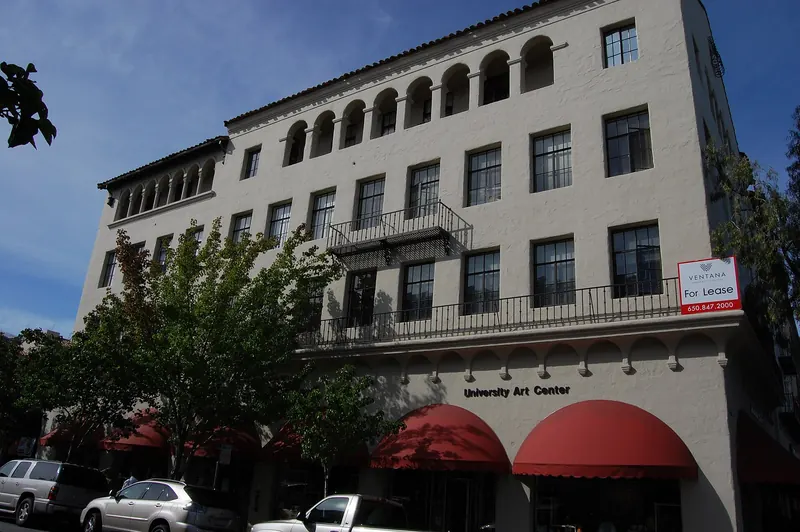

Walk along Hamilton past City Hall, a 10-story tower of 1970 by Edward Durell Stone's firm, to the 1932 post office at 380 Hamilton. Clark's arcade of round arches made it an unusual federal building for its day. It joined the National Register in 1981 and still operates as the Hamilton Station branch, so you can step into the lobby. Next is Clark's 1927 police and fire station at 450 Bryant Street, now the Avenidas senior center. Finish at the Roth Building at 300 Homer Avenue, his 1932 medical clinic. Victor Arnautoff's frescoes fill its covered entrance gallery and are free to see from outside. The planned Palo Alto History Museum there postponed its opening in January 2026 after water leaks and has no new date. Our downtown walking tour gives all 14 stops in order and our Birge Clark biography lists his buildings street by street.
Day 1 afternoon: Professorville and Crescent Park
Walk south into Professorville, listed on the National Register in 1980 with 105 contributing houses. The brown shingle houses with gambrel roofs follow the First Bay Tradition. Look for the Frank Angell House at 1005 Bryant Street, the Varian House at 1044 Bryant and Bernard Maybeck's Sunbonnet House at 1061 Bryant. Ernest Coxhead's 1907 Williams House at 351 Homer Avenue is now the Museum of American Heritage, one of the few historic houses you can enter, so check its days. Our Professorville walking tour maps the route.
For Spanish Revival houses, drive or bike to Crescent Park. Clark's 1926 Dunker House at 420 Maple Street is described as one of the first two houses in Palo Alto in the style. His Norris House at 1247 Cowper Street, built for the novelists Kathleen and Charles Norris, was his largest commission at the time. He also designed every house on Coleridge Avenue between Cowper and Webster streets. Our Spanish Colonial Revival guide explains what to look for.
Evening
Catch a show at the Lucie Stern Community Center at 1305 Middlefield Road. Clark designed it in the 1930s for the philanthropist Lucie Stern, with theaters and a ballroom around a patio and fountain. Show nights are the easiest way inside.
Day 2: Stanford
Stanford's campus is the most coherent piece of architecture in the region. Frederick Law Olmsted's firm drew the plan in 1886 and 1887, laying Palm Drive on a mile-long axis to the Oval and the Main Quad. The Boston firm Shepley, Rutan and Coolidge blended Richardsonian Romanesque stonework with the arcades and red tile of the California missions. The cornerstone was laid on May 14, 1887. Our Stanford architecture guide tells the full story.
- The Main Quad. Walk the inner arcades and look up at the carved capitals. Memorial Church, dedicated in 1903, closes the far side. Its maintenance closure ran from June 15 to October 31, 2026, so check the Memorial Church visitor page for hours.
- The Cantor Arts Center. Ernest Ransome built the original museum of reinforced concrete in the early 1890s, among the first large buildings in the country to use the method. It is free and open Thursday to Monday.
- The arts district. Bing Concert Hall by Ennead (2013), the Anderson Collection and the McMurtry Building by Diller Scofidio + Renfro (2015) make a modern trio along Lomita Drive.
- Hoover Tower. Arthur Brown Jr. finished it in 1941. Its observation deck is closed until January 25, 2027.
- Mid-century campus. The Stanford Bookstore of 1959 to 1960 and Tresidder Union of 1962 put modern frames under red tile roofs. Stone's 1959 Medical Center wraps its buildings in patterned concrete screens.
The Hanna House in late 2026
Frank Lloyd Wright designed the Hanna House in 1936 for Paul and Jean Hanna. It was his first Bay Area building and is laid out on a grid of hexagons with no right angles in the floor plan. It became a National Historic Landmark on June 29, 1989. As of November 1, 2026, Stanford's Hanna House tours site says the house is temporarily closed for repairs and conservation with no reopening date for public tours. You can email [email protected] to hear when booking opens. The house stands at 737 Frenchman's Road among faculty homes. Stay on the public road and expect only glimpses through the trees. The Lou Henry Hoover House nearby, finished in 1920 and also a National Historic Landmark, is not open to the public either.
If you want a guide for the San Francisco side of your trip, browse San Francisco architecture tours that cover the Victorians and the downtown towers.
Day 3 morning: the Eichler tracts
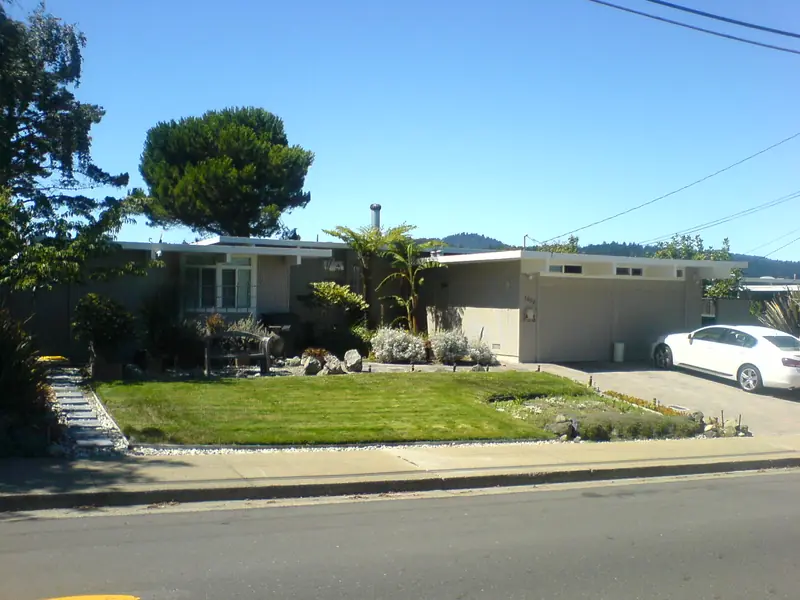
Palo Alto has about 2,700 Eichler homes by the city's count, roughly 17 percent of its single-family houses. They are single-story houses with post-and-beam frames, flat or low roofs, mostly closed faces to the street and walls of glass facing private gardens. Our Eichler history covers the developer and his architects.
Greenmeadow
Start at the Mitchell Park Library at 3700 Middlefield Road, which opened in December 2014 around a courtyard and earned LEED Platinum. Our Greenmeadow walking tour is a loop of about 2.3 miles from there. Greenmeadow's 243 Eichlers were built in 1954 and 1955 to plans by A. Quincy Jones and Frederick Emmons, around a park, community center and pool that the neighborhood still owns. It joined the National Register on July 28, 2005. Sunday mornings are quiet, but remember people live here.

Fairmeadow, Edgewood and Green Gables
Next door, Fairmeadow was built from 1951 to 1954 with concentric circular streets known as the Circles, a plan credited to Anshen and Allen. Then drive north to Edgewood Plaza at Embarcadero Road and St. Francis Drive, the only shopping center Eichler built, designed by Jones and Emmons and redeveloped in the 2010s. Green Gables, an early Anshen and Allen tract nearby, is the city's other National Register Eichler district. Our mid-century modern guide adds more stops.
Day 3 afternoon: civic modernism
Finish on Newell Road. The Palo Alto Art Center occupies Leslie Nichols's 1953 city hall and opens at 1 p.m. on Sundays. Stone's 1958 library across the street is now Rinconada Library. If you have time on a Friday or Saturday, drive to the Baylands to see Clark's ship-shaped Sea Scout Building, now the Environmental Volunteers EcoCenter, which opens for Science Days from 10 a.m. to 1 p.m.
Practical tips
- Getting around. Day 1 is all walking. Day 2 works on foot or by bike from downtown. Day 3 needs a car or bike, since the Eichler tracts lie two to four miles south.
- Photography. Photograph from public sidewalks only. Stanford bans visitor drones and the city bans them in parks.
- Light. Late afternoon light warms the sandstone and stucco. In November and December the sun sets around 5 p.m.
- Reading. Birge Clark's memoir, An Architect Grows Up in Palo Alto, is the best first-hand account of how the town was built.
Stay downtown so Day 1 starts at your door. Compare downtown hotels for a Friday to Sunday stay, when rates at business hotels are often lower.
Good to know
- Hanna House tours are paused with no reopening date as of November 1, 2026.
- The Cantor and Anderson Collection are closed Tuesday and Wednesday.
- Private homes outnumber public buildings on this tour. Never walk up driveways or onto porches.
Frequently asked questions
Can you tour the Hanna House at Stanford?
Not right now. Stanford's Hanna House tours site says the Frank Lloyd Wright house is temporarily closed for repairs and conservation and a reopening date for public tours has not been set. You can email [email protected] to hear when booking opens. Much of the house is screened by trees, so expect only glimpses from the road.
Where can I see Eichler homes in Palo Alto?
Greenmeadow in south Palo Alto has 243 Eichlers built in 1954 and 1955 and is on the National Register. Fairmeadow, with its circular streets, sits next to Mitchell Park. Green Gables in north Palo Alto is the other National Register tract. All are private homes, so view them from the street.
What did Birge Clark design in Palo Alto?
Birge Clark designed 98 houses in Palo Alto and nearly 400 commercial and civic buildings in and around it. Highlights include the 1932 post office at 380 Hamilton Avenue, the Lucie Stern Community Center, the 1929 Hotel President and the 1927 police and fire station at 450 Bryant Street.
Which architecture sites in Palo Alto can I go inside?
The post office lobby at 380 Hamilton Avenue, the Lucie Stern Community Center on show nights, the Children's Library, the Palo Alto Art Center and the Stanford museums are all open to visitors. Memorial Church's maintenance closure was scheduled to end October 31, 2026, so check the church's site for visiting hours. Most other buildings on this tour are private.
How long does a Palo Alto architecture walk take?
The downtown loop takes about 90 minutes to two hours with stops. A Stanford campus walk takes two to four hours. The Greenmeadow Eichler loop is about 2.3 miles and takes one to one and a half hours.