On this page
Palo Alto is built for bikes. The eastern two thirds of the city is almost dead flat. Distances are short: downtown to south Palo Alto is about three miles. Students ride to school in big numbers and plenty of tech workers ride to the office. The city was a pioneer in bike planning and it still has some of the calmest cycling streets in the region.
This guide covers the best routes, how to bring a bike on Caltrain, where to ride off road, how to stay safe and how to get a bike if you do not have one. One thing to know up front: Palo Alto has no public bike share program. You will need to bring or rent a bike.
The Bryant Street bike boulevard
Bryant Street is the backbone of cycling in central Palo Alto. It runs parallel to busier Middlefield Road and Alma Street, through downtown, Professorville, Old Palo Alto and Midtown. The city calls it the first bicycle boulevard implemented in the United States, dating to the 1970s. The idea is simple. Barriers and street design keep through traffic off the street, so cars that do use it are local and slow. Bikes get a quiet, direct route.
The street is officially the Ellen Fletcher Bicycle Boulevard. Fletcher escaped Nazi Germany as a child on the Kindertransport and became one of the country's early bicycle activists. She chaired the city committee that pushed the project in the 1970s and served on the City Council from 1977 to 1989. She died in 2012.
The boulevard runs from Palo Alto Avenue at the north end of town south toward East Meadow Drive. The city has plans to extend it south to San Antonio Road using Nelson and MacKay drives, but those projects were on hold as of 2021.
Other good routes
Beyond Bryant, the city has a network of quieter streets and paths. These are the rides most visitors enjoy:
- The Baylands and the Bay Trail. Ride east on Embarcadero Road past Highway 101 to the Baylands Nature Preserve. From there the Bay Trail runs north to East Palo Alto and Menlo Park or south to Shoreline at Mountain View. It is flat and car-free, with gravel on the levees.
- The Highway 101 bridge. Since November 2021 a bicycle and pedestrian bridge has crossed the freeway between West and East Bayshore Roads near Adobe Creek. It links south Palo Alto with the shore all year. The Adobe Reach Trail connects it to East Meadow Drive.
- The Bol Park path. A paved 1.25-mile path on an old railroad line through Barron Park, from Hanover Street to Arastradero Road near Gunn High School. Our Bol Park guide has the details, including the donkeys.
- Out to Arastradero. From the south end of the Bol Park path, ride west on Arastradero Road to Pearson-Arastradero Preserve, where bikes may use the dirt trails.
- Stanford campus. The campus is flat, full of bike lanes and racks and easy to explore by bike. Campus Drive loops around the academic core. Watch for students crossing at speed between classes.

Caltrain with a bike
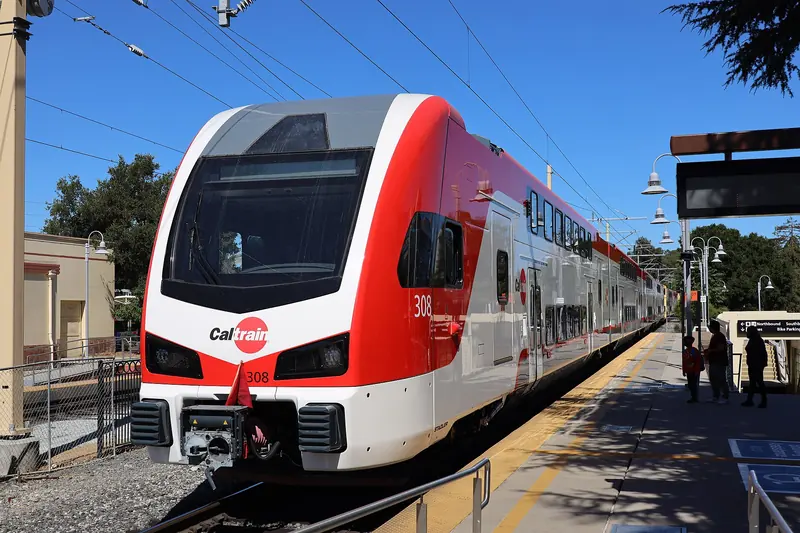
Caltrain is the easiest way to combine a ride with a trip up or down the Peninsula. Palo Alto has two main stations: Palo Alto station at University Avenue downtown and California Avenue station in the California Avenue district. Here are the key rules from Caltrain's bikes page:
- Bikes ride free. There is no extra charge.
- Electric trains have two bike cars that hold 36 bikes each, for 72 bikes per train.
- Riders with bikes board the bike cars first. Move as far in as you can and stack bikes by destination.
- Folding bikes can go in any car if folded before boarding and no wider than 32 inches.
- Gas-powered, tandem and three-wheel bikes are not allowed.
- Conductors can refuse bikes when trains are crowded. If the bike car is full you may need to wait for the next train.
Caltrain has been reviewing rules for oversized bikes. In early 2026 it proposed barring cargo bikes, longtails, bikes with tires wider than 3 inches or longer than 6 feet and bulky attachments such as baskets, panniers and child seats. Final rules may differ, so check the bikes page before you bring anything unusual. Many stations also have on-demand eLockers for secure parking if you would rather leave your bike at the station.
Road rides in the foothills
West of Interstate 280 the riding changes completely. The foothills and the Santa Cruz Mountains are some of the most popular road cycling terrain in Northern California. Page Mill Road climbs steeply and steadily from the Stanford Research Park toward Skyline Boulevard. Arastradero Road and Alpine Road offer gentler rolling routes. Portola Valley and Woodside, a short ride away, are full of cyclists on weekend mornings.
These are shared roads with narrow shoulders, blind curves and fast descents. Ride single file, use lights even by day and expect cars. If you are not used to mountain roads, start with the flatter Portola Valley loops before trying a big climb.
A few places to know about:
- Foothills Nature Preserve allows bikes only on its paved roads.
- The Dish bans bikes entirely.
- Midpeninsula Regional Open Space District preserves allow bikes on designated trails only, with helmets and a 15 mph limit. E-bikes are banned on most of their trails. See our hiking guide for the preserves.
Safety and rules
Palo Alto is safer than most cities for cycling, but it is not risk-free. A few basics:
- Helmets. California law requires them for riders under 18. Palo Alto requires them for everyone on its open space preserve trails.
- Lights. Use a white front light and a red rear light or reflector after dark, as state law requires. Winter evenings get dark by 5 p.m.
- Big streets. El Camino Real, Embarcadero Road, Oregon Expressway and Page Mill Road carry heavy traffic. Use the bike boulevards and signalized crossings instead.
- School hours. Bike lanes and paths near schools fill with students in the morning and mid-afternoon. Slow down.
- Locks. Bike theft is common in any Bay Area city, especially near Caltrain and downtown. Use a sturdy U-lock and lock the frame, not just a wheel.
- Shared paths. On the Bay Trail and preserve trails, yield to walkers and horses and ring a bell before passing.
Getting a bike
Because there is no bike share, visitors have three options. Bring your own, perhaps on Caltrain. Ask local bike shops whether they rent by the day. Or book online. You can compare bike rentals in the Bay Area and filter by type, from hybrids for the Bay Trail to road bikes for the hills. Ask for a lock and a helmet with any rental.
If your hotel is near a Caltrain station, a bike makes a car almost unnecessary for exploring the flat part of town. Our getting around guide covers buses, trains and ride-hailing for the rest.
Good to know
- Afternoon wind on the bay shore can be strong. Ride out against it and come back with it behind you.
- Summer days in the foothills get hot. Carry two bottles on any climb.
- For maps and current projects, check the City of Palo Alto transportation pages, such as the Bryant Street project page.
Frequently asked questions
Does Palo Alto have bike share?
No. Palo Alto has no public bike share program. Visitors who want a bike can rent one from a shop or rental service, or bring their own on Caltrain.
Can you take a bike on Caltrain?
Yes, at no extra charge. Electric trains have two bike cars with room for 36 bikes each, or 72 per train. Riders with bikes board the bike cars first. Folding bikes that are folded can ride in any car. Caltrain reviewed its rules on oversized bikes and attachments in 2026, so check its bikes page before you travel.
What is the Bryant Street bike boulevard?
It is a quiet north to south street through central Palo Alto that the city calls the first bicycle boulevard in the United States. It is designed to keep car traffic light and slow so bikes can travel easily. It is named for Ellen Fletcher, a former council member and bike advocate.
Can you bike at the Stanford Dish?
No. Bikes, skates and skateboards are banned on the Dish trail. You can ride on Stanford's campus roads and paths and on nearby foothill roads instead.
Where can you mountain bike near Palo Alto?
Pearson-Arastradero Preserve allows bikes on its dirt trails with a helmet. Many Midpeninsula Regional Open Space District preserves allow bikes on designated trails with a 15 mph limit. Foothills Nature Preserve allows bikes only on its paved roads.