On this page
Palo Alto gave Silicon Valley its garage. Mountain View gave it its silicon. The two stories are tangled together. They meet at a single address on San Antonio Road, a few blocks past the Palo Alto city line. This page untangles them.
It covers William Shockley's 1956 lab in Mountain View, the eight scientists who walked out of it, the company they built in Palo Alto, the invention of the integrated circuit and the founding of Intel. Our broader Silicon Valley history places this chapter between the HP Garage and Xerox PARC.
Good to know
- Shockley Semiconductor Laboratory was in Mountain View, at 391 San Antonio Road. It was never in Palo Alto.
- Fairchild Semiconductor's first building was in Palo Alto, at 844 East Charleston Road near the Mountain View border.
- Both sites are commercial property. You can see the markers from the sidewalk.
William Shockley comes home
William Shockley was one of the most celebrated physicists in America. At Bell Labs in New Jersey he had worked with John Bardeen and Walter Brattain on the transistor and then developed the junction transistor. In December 1956 the three shared the Nobel Prize in Physics.
Shockley had grown up in Palo Alto. His mother still lived there. In September 1955 he reached an agreement with Arnold Beckman, founder of Beckman Instruments, to start a semiconductor lab as a division of Beckman's company. Its mission, in the words recorded by the Computer History Museum, was to "engage promptly and vigorously in activities related to semiconductors." Wikipedia's account says Shockley chose the location to be near his mother. The area also offered Stanford's engineering school and a cluster of young electronics firms.
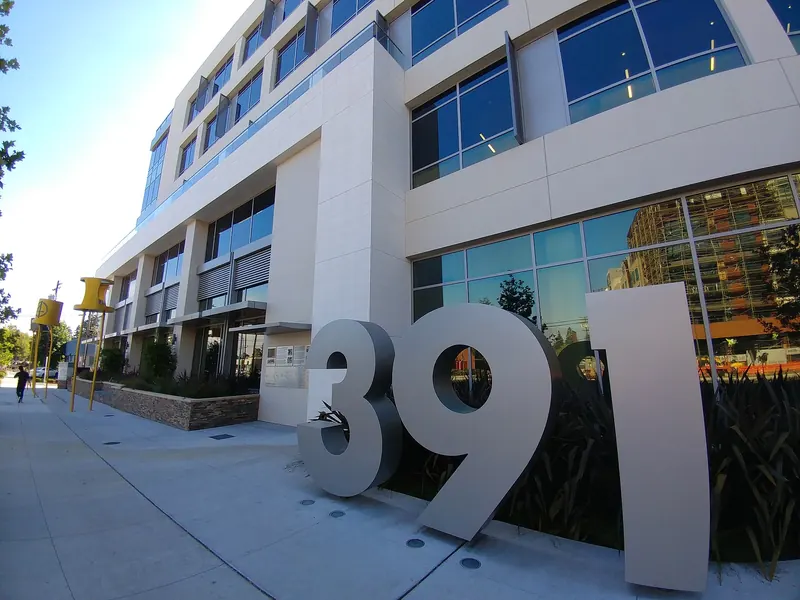
He rented a small commercial building at 391 South San Antonio Road in Mountain View. In early 1956 he began hiring what he called "the most creative team in the world for developing and producing transistors."
Inside the lab
The lab was the first to work on silicon devices in the region, which is why the Institute of Electrical and Electronics Engineers calls the site the "Birthplace of Silicon Valley, 1956." Gordon Moore and Robert Noyce developed silicon and diffusion techniques there that later shaped the industry.
The company was not a happy place. Shockley was brilliant but a difficult manager. He kept pushing a device he had conceived at Bell Labs, a four-layer diode for telephone switching. Many of his scientists wanted to focus on silicon transistors, which had a clearer market. The lab never made a profit.
When Shockley won the Nobel Prize in December 1956, his team celebrated at Rickey's Hotel in Palo Alto. A Computer History Museum photo shows Moore, Sheldon Roberts, Noyce and Jay Last among those raising a toast. Within a year many of them would be gone.

The traitorous eight
By early 1957 a group of senior staff had lost confidence in Shockley's management. Eugene Kleiner wrote to investors in New York in March about backing a new company. On May 29, 1957, Moore's group gave Arnold Beckman an ultimatum to put a new manager in charge. Beckman declined.
On September 18, 1957, eight men resigned together:
- Julius Blank
- Victor Grinich
- Jean Hoerni
- Eugene Kleiner
- Jay Last
- Gordon Moore
- Robert Noyce
- Sheldon Roberts
The nickname "traitorous eight" stuck, though no one knows who first used it. Shockley considered the departure a betrayal and, by Wikipedia's account, never spoke to Noyce again.
Their backing came through Arthur Rock and Alfred Coyle of the investment bank Hayden, Stone and Co. They eventually reached Sherman Fairchild, founder of Fairchild Camera and Instrument. His company lent the group $1.38 million. In return it got voting rights and the option to buy all the founders' shares for $3 million, which it exercised in 1959. Rock went on to become one of the first West Coast venture capitalists. Our history of venture capital picks up that thread.
Fairchild in Palo Alto
The new Fairchild Semiconductor began in Victor Grinich's garage. In November 1957 it moved into a building on the Palo Alto and Mountain View border at 844 East Charleston Road, on the Palo Alto side. That made Fairchild a Palo Alto company during its most inventive years.
The key breakthroughs came quickly:
- 1959: Jean Hoerni develops the planar process, which protects transistor junctions under a layer of oxide on a flat silicon surface.
- 1959: Encouraged by patent attorney John Ralls to find more uses for the planar process, Robert Noyce conceives a monolithic integrated circuit. He files a patent on July 30, 1959. It is issued on April 25, 1961.
- May 1960: A team of Fairchild engineers produces the first working planar integrated circuits.
Jack Kilby at Texas Instruments had demonstrated an all-semiconductor solid circuit in 1958. The two companies fought over patents for years. Courts eventually sided with Noyce, but by then the firms had already agreed to cross-license, with a net payment to Fairchild. Most histories now credit both men.
The Fairchild site is California Historical Landmark No. 1000, the "Site of the Invention of the First Commercially Practicable Integrated Circuit." Our famous tech addresses tour includes it.
Fairchildren and Intel
Fairchild's founders did not stay long. On January 31, 1961, Jay Last and Jean Hoerni left to start Amelco, a semiconductor unit of Teledyne. Kleiner and Roberts followed a few weeks later. Hoerni later founded Intersil in 1967. Dozens of other engineers left to start companies of their own, earning the nickname "Fairchildren."
The most famous departure came in the summer of 1968. Moore and Noyce founded NM Electronics in Mountain View. A year later it bought the rights to the name Intel. The company built memory chips at first, then in 1971 introduced the first commercial microprocessor, the 4004. Intel later moved to Santa Clara.
Eugene Kleiner took a different path. In 1972 he and Tom Perkins founded the venture firm now known as Kleiner Perkins on Sand Hill Road. Read more on our Kleiner Perkins page. That move tied the chip makers to the investors who would fund the next half century of startups.
What happened to Shockley
Shockley's lab never recovered from the walkout. Beckman sold the operation to Clevite in 1960. On July 23, 1961, Shockley was badly injured in a car crash. He later left the company and became a professor of electrical engineering at Stanford. ITT, a later owner, moved the lab to Florida by the end of the 1960s and it closed when staff would not relocate. Sources give 1968 or 1969.
In his Stanford years Shockley became notorious for promoting racist theories about intelligence and eugenics. Scientists and the public widely condemned those views and they overshadowed his reputation. He died in 1989.
The San Antonio Road building had a long second life as a retail store, including a produce market. The site was redeveloped in the 2010s as part of the larger San Antonio Center project in Mountain View.
Why Palo Alto matters to this story
If the lab was in Mountain View, why tell this story on a Palo Alto site? Several reasons:
- Family ties. Shockley set up nearby largely because his mother lived in Palo Alto.
- Stanford. Frederick Terman's engineering school and the 1951 Stanford Industrial Park made the area attractive to electronics firms.
- Fairchild. The integrated circuit was invented at Fairchild's building on East Charleston Road in Palo Alto.
- Money. Fairchild's founders seeded the Sand Hill Road venture industry next door to Palo Alto.
The name "Silicon Valley" itself caught on after journalist Don Hoefler used it in a 1971 series in Electronic News about the region's chip companies, most of which traced their roots to Fairchild.
Visiting the sites
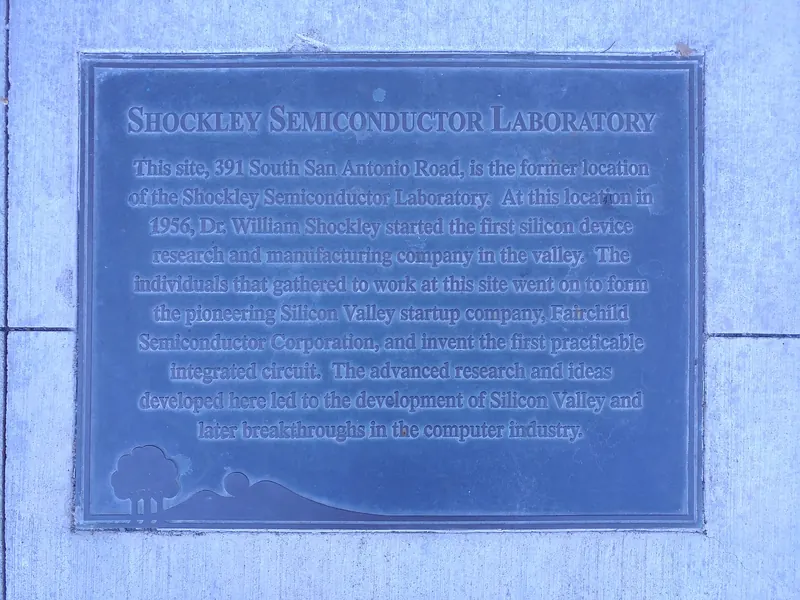
You can see both sites in one short bike ride or drive. Start at the Shockley monument area at 391 San Antonio Road in Mountain View, just south of California Street. The IEEE Milestone plaque, dedicated on August 15, 2018, is set into a larger information panel on a wall facing the street. Sculptures of early semiconductor devices and a large "391" address sculpture stand beside it. The site owners and the City of Mountain View maintain the area and it is open at all hours.

From there it is a short ride to 844 East Charleston Road in Palo Alto, the Fairchild site. Look for the state landmark marker outside the commercial building. Then continue north to the HP Garage on Addison Avenue to close the loop on Palo Alto's tech history. Visitors who would rather ride along with a guide can book a Silicon Valley tech tour. For a year-by-year view, see our Palo Alto timeline.
Frequently asked questions
Was Shockley Semiconductor in Palo Alto?
No. Shockley Semiconductor Laboratory was at 391 San Antonio Road in Mountain View, a short drive south of the Palo Alto city line. Fairchild Semiconductor, founded by eight of its scientists, was in Palo Alto at 844 East Charleston Road.
Why did Shockley set up near Palo Alto?
William Shockley grew up in Palo Alto and his mother still lived there. The area also offered Stanford's engineering school and a growing electronics industry. He rented a building in Mountain View in 1956.
Who invented the integrated circuit?
Jack Kilby at Texas Instruments demonstrated a solid circuit in 1958. Robert Noyce at Fairchild in Palo Alto conceived a practical monolithic integrated circuit in 1959, building on Jean Hoerni's planar process. Fairchild produced its first working planar ICs in May 1960.
Can you visit the Shockley lab site?
Yes, from the sidewalk. The original building is gone. A monument area at 391 San Antonio Road in Mountain View has an IEEE Milestone plaque, an information panel and sculptures of early semiconductor devices. It is outdoors and accessible at any hour.
Is Intel from Palo Alto?
No. Gordon Moore and Robert Noyce left Fairchild and founded Intel in the summer of 1968 in Mountain View. Intel later moved to Santa Clara. Both founders had worked in Palo Alto at Fairchild.